

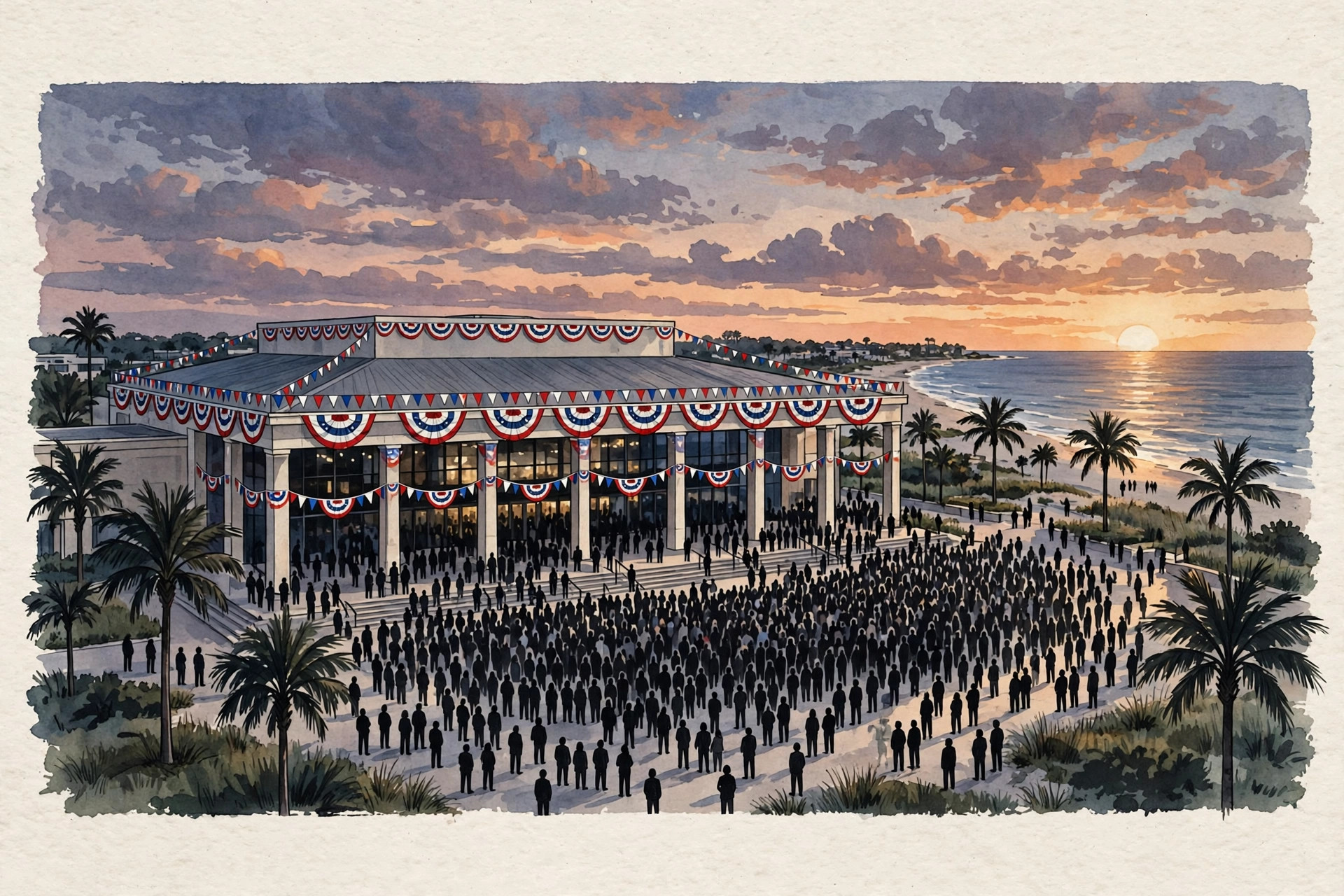
DAYTONA BEACH, Florida — President Donald Trump is scheduled to return to Daytona Beach on Friday evening, 30 October 2026, for one of the final rallies of the midterm campaign, bringing his closing argument for Republican candidates to a Florida beach city he has visited only a handful of times in his political career. The rally at the Ocean Center, on the Atlantic waterfront, is set to begin in the late afternoon, with doors opening at 3:30 p.m. and the president expected to take the stage at 7 p.m. It comes four days before Election Day on Tuesday, 3 November, and at a moment when Florida’s own marquee races — for governor and for the United States Senate — are drawing national attention, even though polling still favours Republicans in the state.
The event was announced by the Republican National Committee shortly after Trump’s previous Florida rally, in Fort Myers on 23 October, and it is the fourth political visit of his career to Daytona Beach. His first came on 3 August 2016, when he spoke at the same Ocean Center as a presidential candidate. He later attended the Daytona 500 motor race at Daytona International Speedway, in February 2020 and again in February 2025. The return to the Ocean Center therefore carries a deliberate sense of familiarity for a campaign that has leaned heavily on places where Trump has a personal history. Organisers have said admission is free, with registration through the party’s event page, but that registration does not guarantee entry because seating is first come, first served.
Who Trump Is Campaigning For
According to organisers, Trump is expected to campaign on behalf of two Republicans at the top of Florida’s ticket. The first is Representative Byron Donalds, who is running for governor against Democrat David Jolly. The second is Senator Ashley Moody, who is seeking election to the Senate seat she was appointed to in 2025, against Democrat Angie Nixon. Both races have been described in local reporting as hotly contested, and both candidates appeared alongside Trump at the Fort Myers rally a week earlier, when he brought them to the stage together. The Daytona event gives Trump a second Florida platform in eight days to present them jointly to voters in a different part of the state.
Florida’s political geography matters to that choice. Volusia County, home to Daytona Beach, has voted for Trump in each of his three presidential elections, by larger margins each time, including 60.2 percent in 2024, according to local reporting on the rally. A rally there is therefore less about persuading a hostile audience than about energising supporters and driving turnout in a county Republicans already carry, while the television and online coverage reaches voters across the state. That distinction is important in the final days of a campaign, when both parties are focused less on changing minds than on ensuring their own supporters actually cast ballots. Early voting in Florida is under way and ends on 31 October, with Election Day polls open from 7 a.m. to 7 p.m. local time.
A Closing Tour Across the Country
The Daytona stop sits inside a rapid final tour. In the past week alone, Trump has campaigned in Georgia, Michigan, Mississippi, Texas and South Carolina, according to local reporting on the Daytona event, before returning to Washington for the White House Halloween celebration on 29 October and then heading back to Florida. Reuters, previewing the final stretch, listed the Daytona rally on 30 October among the closing stops, with further rallies planned in the days that follow before Election Day. The pace reflects a strategy that has defined the closing phase: near-daily rallies in which the president himself is the central draw, even though he is not on the ballot.
That strategy has a clear political logic, and a clear risk. Trump has told Republicans to campaign as though he were on the ballot, and Democrats have been happy to oblige, framing the midterms as a referendum on his presidency. Reuters reported that the president’s approval rating has fallen to near the lowest point of his second term, with voters increasingly unhappy about the cost of living and about the war with Iran, even as he remains an animating force for his own party’s turnout. A rally in a friendly county tests the energising half of that equation. Whether it changes the broader national mood is a different question, and one that will only be answered when votes are counted.
Protests Planned Outside the Venue
Trump’s arrival is also expected to draw organised protest outside the Ocean Center, which holds about 9,000 people. Local reporting on the planned demonstrations names several Volusia and Flagler County groups, including the Port Orange Democratic Club, Just Us Volusia, the Volusia Democratic Socialists of America and Flagler 5051. Their plans, as described in that reporting, include demonstrating outside the venue as the rally takes place, and some participants have linked their protest to early voting, with “No Kings: Vote Early” demonstrators described as urging people to cast ballots before Election Day.
The protest plans are a reminder that a presidential rally in 2026 is two events at once: a gathering inside the hall, and a counter-gathering outside it. Organisers of the protests have argued, in the local reporting, that even Republican-held areas of Volusia County should not be taken for granted, pointing to local congressional representation as an example of seats where they believe Republicans should worry. Supporters inside, by contrast, will hear a message built around the president’s record and his endorsed candidates. Neither side’s turnout on the night will, by itself, decide the election, but both sides plainly believe that visible enthusiasm in the final days can influence voters who have not yet cast a ballot.
Road Closures and Travel Disruption
For residents and visitors who are not attending, the practical effects of the visit will be felt well beyond the Ocean Center doors. Local television reporting on the rally has warned of increased security measures, road detours, restrictions and closures near the venue and near Daytona Beach International Airport, with additional temporary closures as the president arrives and departs. Travellers flying in or out of Daytona Beach on Friday have been advised to allow extra time because of expected traffic, congestion and possible road closures.
The Ocean Center is located at 101 North Atlantic Avenue, on the beachfront, which means the security perimeter sits in one of the city’s busiest tourist corridors. That is a familiar trade-off for a presidential visit to a resort city: the same waterfront location that makes the rally visually striking also makes its logistics disruptive. City and law enforcement agencies typically manage those closures in the hours around the event, and the local reporting has emphasised that the disruption, while significant for a Friday evening, is temporary.
What the Rally Is Really About
Strip away the staging, and the Daytona rally is about turnout in the final 96 hours. Florida Republicans want their voters to hear, directly from the president, that the governor’s race and the Senate race require their participation, even in a state where Republicans have won recent statewide contests. Democrats, meanwhile, want their voters to hear that the races are closer than the state’s recent history suggests, and that early voting through 31 October is the moment to act. Both messages can be true at the same time: a race can favour one party in polling and still depend on which side’s supporters show up.
The Donalds and Moody campaigns also illustrate two different kinds of Republican candidacy in 2026. Donalds, a sitting member of Congress from Naples, is seeking to move from Washington to the governor’s mansion, a transition that requires him to present himself as a statewide executive rather than a legislator. Moody, appointed to the Senate in 2025, is seeking election in her own right for the first time, which requires her to convert an appointment into a voter mandate. Trump has endorsed both, and his presence is intended to transfer some of his own standing with Republican voters to candidates who still need to build it statewide.
The Weekend After Daytona
After the rally, Trump is expected to remain in Florida for the weekend. Reporting from the Palm Beach area has said he is expected to return to his Mar-a-Lago Club as early as Friday, 30 October, while the property prepares to host its annual Halloween gathering the following day, marking the start of the Palm Beach social season. Flight restrictions of the kind issued for presidential travel were expected between 30 October and 1 November, according to a Federal Aviation Administration notice cited in that reporting. That weekend stay means the Daytona rally is not a brief in-and-out visit, but the start of several days in his home state at the very end of the campaign.
Whether the rally shifts any votes is unknowable in advance, and any claim that it will would be speculation. What is knowable is the scale of the effort: a president in the final days before a midterm election, choosing a familiar Florida venue, sharing the stage in effect with his party’s governor and Senate candidates, facing planned protests outside, and asking supporters to vote early or on Tuesday. That is the closing argument in miniature, delivered in a city that has voted for him three times, to an audience his campaign hopes will carry that enthusiasm into the final days of voting.
For voters in Volusia County and across Florida, the practical details remain the simplest part of the story. Doors at the Ocean Center open at 3:30 p.m., the president is expected on stage at 7 p.m., early voting ends on Saturday, and Election Day is Tuesday. Everything else — the speeches, the protests, the coverage — is the campaign trying, one final time, to make sure those voters do not stay home.
The Florida Stakes Beyond the Rally
It is also worth stepping back from the rally itself to the two races it is meant to influence. The governor’s contest pits a sitting congressman against a former congressman, which means both candidates arrive with Washington records that their opponents can examine, and with fundraising networks built over years in federal office. That profile is common in modern Florida politics, where statewide races are often fought by figures who first built their names in Congress, and it means the campaign is less about introducing unknown candidates than about framing familiar ones. Donalds has campaigned as a Trump-aligned conservative, while Jolly has presented himself as a Democrat capable of appealing to voters dissatisfied with the direction of the state, and the rally is an opportunity for Trump to sharpen that contrast in his own language.
The Senate race carries a different dynamic. Moody was appointed to her seat in 2025, so this election is her first opportunity to win it directly from voters, and appointed senators historically face the challenge of proving that they deserve a full term rather than merely holding a seat until the next election. Nixon, her Democratic challenger, has campaigned as an alternative for voters who want a different voice in Washington, and the presence of the president on Moody’s behalf is intended to close any gap in name recognition and enthusiasm. In both races, the rally’s value is therefore not measured only by the size of the crowd inside the Ocean Center, but by whether the coverage that follows reaches voters who were not in the room and persuades them to vote early or on Tuesday.
Sources
USN reviewed reporting from multiple outlets for this story. Read more from Daytona Beach News-Journal, FOX 35 Orlando and Reuters.
[…] just days before voters decide control of Congress, and it arrives as the White House is making its final midterm push on the campaign trail and as Trump and Obama trade blows over the administration’s record. Whether voters treat the […]