

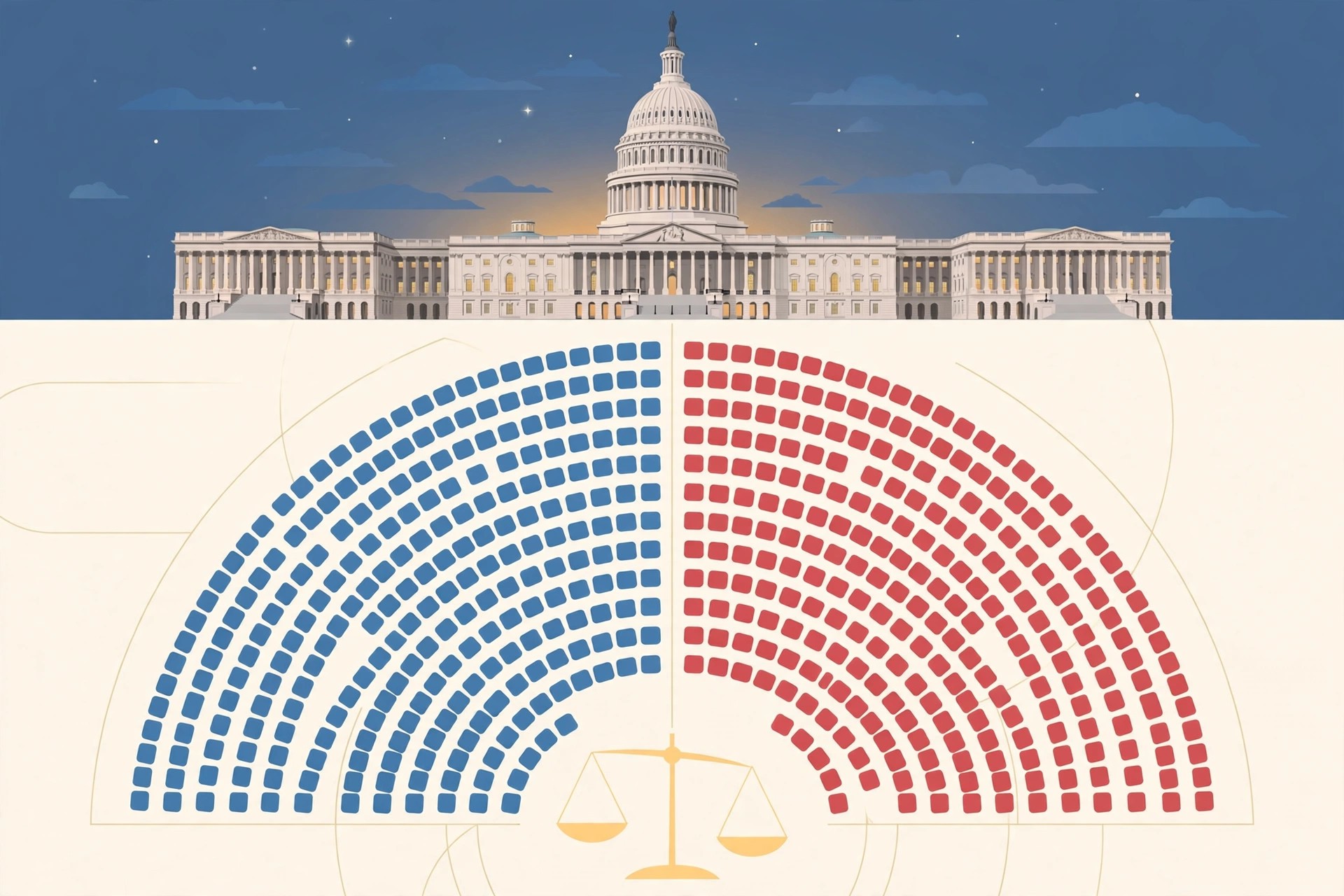
WASHINGTON — With two days left before Election Day, the fight for the United States House of Representatives has narrowed to a question of arithmetic. There are 435 voting seats, and 218 make a majority. Every other question in the campaign — which party’s message is working, which districts are truly close, what the next Congress will actually be able to do — flows from how many of those 435 seats each party wins on November 3, and from how close the final margin turns out to be.
This is a fresh scenario update based on forecasts dated November 1, not a repeat of earlier October coverage of ratings shifts. Earlier in October, forecasters moved a series of races toward Democrats, and that movement set the frame for the final week. What changed by November 1 is the consolidation of that picture across different kinds of forecasters: expert ratings, simulation models and final pre-election rankings now point in the same broad direction, while still leaving a realistic path for Republicans to hold the chamber. The story of the last 48 hours is therefore not a sudden swing, but a narrowing of uncertainty around a Democratic edge that is real, measurable and still reversible in a handful of districts.
The 218-seat math and where the race stands
The starting point is the current House. Republicans hold 218 seats to 214 for Democrats, with two vacancies and one independent, Representative Kevin Kiley of California, who left the Republican Party but still caucuses with Republicans for committee assignments. That four-seat edge is the smallest kind of majority that can still pass bills, and it has shaped everything about the current Congress: leaders have often had no votes to spare, and a small group of dissenters has been able to block or reshape legislation. Because all 435 seats are on the ballot, the vacancies do not carry over as empty chairs; every seat will be filled by the new Congress. But the current balance explains why Democrats need only a small net gain to take control, and why Republicans, despite defending the chamber, are playing defense in more districts than they are attacking.
What Democrats need to win the House
What Democrats need, in plain terms, is to win enough Republican-held seats to cross 218 while holding their own vulnerable seats. Forecasters’ most likely outcomes suggest they are positioned to do that, and possibly by more than the minimum. The Cook Political Report, in ratings updated on October 23, placed 220 seats at least leaning Democratic, 198 at least leaning Republican and 17 as toss-ups, and described a Democratic gain of twelve to twenty-two seats as the likeliest outcome. Sabato’s Crystal Ball, on October 30, was similar but slightly more favorable to Democrats, with 225 seats at least leaning Democratic, 193 at least leaning Republican and 17 toss-ups. If either set of leaning seats held and the toss-ups split evenly, Democrats would clear 218 comfortably. The catch is that leaning seats and toss-ups do not all behave the same way on election night, and a systematic polling error of a few points could move several of them at once.
What Republicans need to hold the House
What Republicans need is the mirror image, and it is not as far-fetched as the national polling lead for Democrats might suggest. The party needs to hold nearly all of its vulnerable seats and pick up a few Democratic-held seats to offset any losses. Final pre-election rankings from Fox News point to Democrats retaking the chamber, but the same rankings sketch a good night for Republicans in which the party ends with 212 seats, only six short of a majority, and a good night for Democrats in which they reach 240 seats. That range, from 212 to 240, is the honest measure of uncertainty: it captures a close Democratic win, a comfortable Democratic win and a narrow Republican hold, depending on how the closest districts break. Republicans also benefit from district lines drawn in several states during the mid-decade redistricting fight, which were designed to protect Republican incumbents and add Republican-leaning seats, even if those maps have not delivered as much as their authors hoped.
What the November 1 simulation models add
The November 1 simulation models add a second layer to the expert ratings, and they are worth understanding on their own terms. One ground-up House model dated November 1 expected 234 Democratic seats to 201 Republican or other seats, with Democrats favored in 225 seats, Republicans favored in 194 and 16 seats rated as toss-ups, and it put the chance of a Democratic majority at 87 percent, down slightly from 88 percent the day before. A separate simulation-based forecast dated November 1 put Democrats at a median of 233 seats, with a 90 percent range of 215 to 256 seats. The two models agree on the central estimate, around 233 or 234 Democratic seats, but the wide range in the second model is the point: a result as low as 215 Democratic seats, which would leave Republicans in control, sits inside the range of plausible outcomes, as does a Democratic total above 250. Models are not votes, and a probability is not a promise. An 87 percent chance still leaves roughly a one-in-eight chance of the other outcome, and that other outcome has happened before in elections where late-deciding voters broke one way.
House majority scenarios: California, New York and Pennsylvania battlegrounds
The battleground clusters that will decide the majority are now familiar to anyone who has followed the campaign, and they start with California, New York and Pennsylvania. California matters because Proposition 50 redrew the state’s map to make five Republican-held seats more favorable to Democrats, and a late October university poll found Democrats leading in four surveyed districts under the new lines. New York matters because the Hudson Valley’s 17th District, where Republican Representative Mike Lawler faces Democrat Cait Conley, is rated a toss-up by both Cook and Sabato, and because several other New York seats sit in the lean categories where a small swing changes the winner. Pennsylvania matters because it holds a cluster of the closest races in the country: the 8th District, where Republican Representative Rob Bresnahan faces Democrat Paige Cognetti, is a Cook toss-up, while the 1st District, where Republican Representative Brian Fitzpatrick faces Democrat Bob Harvie, is a toss-up in Sabato’s ratings and lean Republican in Cook’s, and the 7th District in the Lehigh Valley, where Republican Representative Ryan Mackenzie faces Democrat Bob Brooks, is rated leaning Democratic after earlier being a toss-up. Win most of these clusters and a party’s path to 218 becomes much easier; lose most of them and it becomes much harder.
Other battleground clusters that could swing it
Beyond those three states, the map spreads across the Midwest, the Mountain West, the South and the Northeast in a pattern that rewards breadth. In the Midwest, Michigan holds three Republican-held toss-ups or lean seats, Iowa’s 2nd District and Wisconsin’s 3rd District are toss-ups, and Ohio holds several competitive seats on both sides. In the Mountain West and Southwest, Arizona’s 6th District, Colorado’s 8th District and Montana’s 1st District are all toss-ups, and each has been contested on local issues as much as national ones. In the South and mid-Atlantic, Virginia’s 1st and 2nd Districts, North Carolina’s 1st and 11th Districts, Florida’s 14th and 22nd Districts and Texas’s 15th and 34th Districts all sit in the toss-up column in one or both major ratings sets. No single state decides the House, which is why both parties have spread their final campaigning across more than twenty states and dozens of districts, and why a national swing of even two or three points could flip the outcome in states that otherwise have little in common.
Johnson, Jeffries and the final campaign messages
The leaders’ final messages reflect those two different arithmetics. House Speaker Mike Johnson, campaigning in more than twenty states and forty districts, has said Republicans will retain what he calls a working majority, not a landslide, pointing to fundraising, candidate quality and crowds at campaign events, and arguing that the political mood resembles 2024 more than a typical midterm backlash against the president’s party. House Democratic Leader Hakeem Jeffries, who would be positioned to become speaker if Democrats win, has traveled to more than fifty cities and is preparing a first-hundred-days agenda centered on investigations, economic legislation and challenges to President Donald Trump’s policies. Neither leader’s confidence proves anything about the result, but the contrast in tone is instructive: Johnson is arguing for survival against history, since the president’s party usually loses seats in midterms, while Jeffries is arguing for a mandate to change direction. Voters in the toss-up districts will decide which argument they find more persuasive, and many of them have told pollsters that prices, health care costs and the president’s standing matter more than either leader’s travel schedule.
What a narrow majority would mean either way
That brings the analysis to the question both parties are already gaming out in private: what happens if the majority is narrow, whichever party wins it. A narrow Democratic majority, in the range of 218 to 225 seats, would give Jeffries the speaker’s gavel and control of committees, subpoena power and the floor agenda, but it would also give a small group of moderate or dissenting Democrats effective veto power over any bill that lacks Republican support. Passing legislation would require near-unanimity within the Democratic caucus, and the first vote of the new Congress, the election of the speaker itself, could become chaotic if any members refuse to support their party’s nominee, since the winner needs a majority of those present and voting. A narrow Republican hold, in the range of 218 to 222 seats, would look much like the current Congress: Johnson would keep the gavel, the party could continue advancing the president’s legislative agenda, but it would still have almost no room for defections, and the discharge petition, the procedure by which 218 members can force a bill to the floor over leadership objections, would remain a live threat whenever a bipartisan majority exists for a measure the leadership opposes.
In either narrow scenario, divided government becomes the defining fact of the next two years, because the Senate is rated a toss-up in final rankings and the presidency remains in Republican hands. A Democratic House could block Republican legislation, open investigations and use the power of the purse, but it could not enact its own program without Senate agreement and a presidential signature, or veto-proof majorities it is unlikely to hold. A Republican House could keep the president’s agenda moving through one chamber, but it would still face a Senate where the majority is uncertain and where sixty votes are usually needed for most major bills. That is why both parties, even while campaigning for a majority, are also preparing for negotiation, brinkmanship over funding deadlines and the possibility that the most consequential decisions of the next Congress will be about what does not pass, rather than what does. Readers following the wider fight for Congress can also read our earlier report on Democrats opening leads in four Senate battlegrounds.
Election night and the count that follows
Election night itself will not settle every question at once, and voters should be prepared for that. Polls close at different times across the country, California’s mail ballots take days to count fully, and several of the closest districts are in states where results have historically tightened or widened as later ballots are added. Forecasters and news organizations will project a House majority only when the math becomes unavoidable, and in a close outcome that projection could come days after Election Day. That delay is not a sign that something has gone wrong; it is a feature of a system in which millions of lawful ballots arrive by mail and are counted under state procedures. The same caution that applies to polls applies to early returns: a lead on election night in a district with many outstanding mail ballots is a snapshot, not a result.
The final judgment, then, is narrower than the headlines suggest. Democrats enter the last two days favored to win the House, with expert ratings, simulation models and the generic ballot all pointing the same way, and with California’s redrawn map offering a plausible route to most of the seats they need. Republicans enter with a real, if narrower, path to hold on, built on district lines, candidate strength in specific seats and the possibility that polls are overstating Democratic support, as they have in some past cycles. The difference between a Democratic majority of 230 seats and a Republican hold of 219 seats may come down to a dozen districts decided by a few thousand votes each, in states as different as California, New York, Pennsylvania, Michigan and Virginia. That is why the scenario to watch is not a single number, but the cluster of toss-ups, and why the most honest forecast on November 1 is also the simplest: Democrats are favored, Republicans are not finished, and the House will be decided district by district.
Sources
USN reviewed reporting from multiple outlets for this story. Read more from Fox News, Dave Manuel and NorthJersey.com.
[…] readers tracking the national picture, USN’s earlier reporting on what Democrats and Republicans need to win the House on November 3 sets out the seat-by-seat arithmetic that makes districts like Iowa’s 2nd so […]