

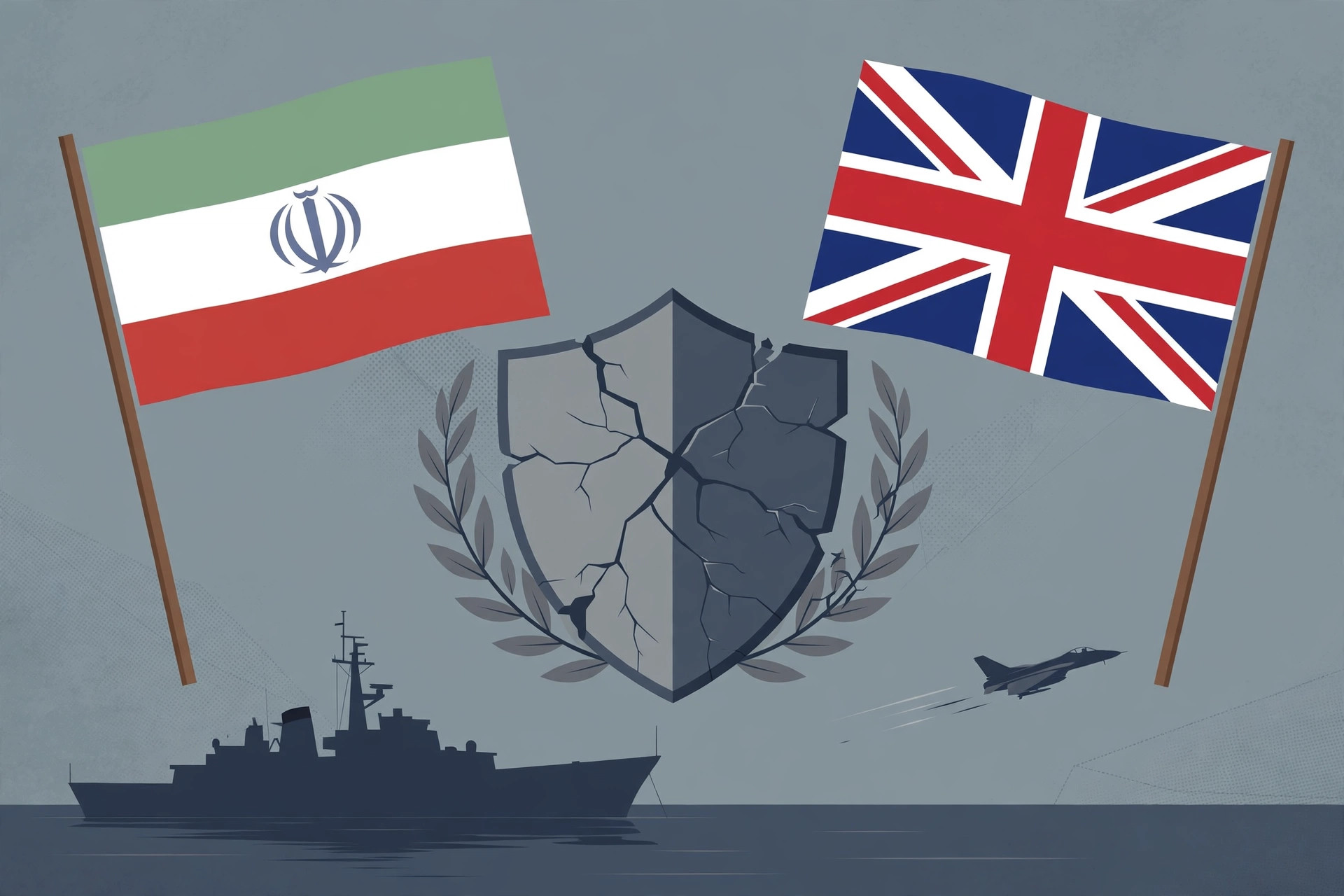
Iran announced on Sunday, November 1, 2026, that it has designated the United Kingdom’s Royal Navy and Royal Air Force as terrorist organisations and classified the Secret Intelligence Service, MI6, as a hostile group, in a striking escalation of Tehran’s confrontation with London. The announcement, made by Iran’s Foreign Ministry, took effect on issuance and was made under a resolution of Iran’s Supreme National Security Council, the country’s top security decision-making body. It places two branches of Britain’s armed forces and its foreign intelligence service on formal Iranian blacklists at a moment when the wider confrontation between Iran and the West is already running at a high pitch.
The designations rest on two different Iranian legal instruments, and the distinction matters for understanding what Tehran claims to be doing. The Royal Navy and the RAF were designated as terrorist organisations under Iran’s law on countermeasures against the United States’ designation of Iran’s Islamic Revolutionary Guard Corps, the IRGC. That law, in Tehran’s framing, authorises reciprocal action against the armed forces of states that have taken hostile measures against the IRGC. MI6, by contrast, was classified as a hostile group under Note 2 of Article 1 of a separate Iranian law, the law on tougher penalties for espionage and cooperation with Israel and with what Tehran calls hostile countries. In other words, the armed services were placed in one legal category and the intelligence service in another, each tied to a specific statute that Iran says justifies the step.
Tehran gave two stated reasons for the move. The first was Britain’s alleged support for what Iran describes as the United States-Israeli war against Iran, including the provision of military bases and facilities on British territory and logistical support for that campaign. The second was Britain’s decision on July 13, 2026, to place the IRGC under the State Threats Act 2026, a step that Tehran treats as a hostile act against a central institution of the Iranian state. Taken together, the two reasons present the designations as both a response to Britain’s conduct in the current war and a retaliation for a legal and political decision taken in London months earlier. They are, in Tehran’s account, cumulative grievances rather than a reaction to a single incident.
The timing of the announcement has drawn attention to a separate episode: a security incident at RAF Fairford, the Royal Air Force station in Gloucestershire that hosts United States aircraft. British Prime Minister Andy Burnham has alleged that the incident involved Iran, and two men appeared in a London court five days before the designations, charged under the National Security Act in connection with it. That sequence is reported context for the timing of Tehran’s announcement, and it helps explain why the story landed with particular force in Britain. It is not, however, one of the reasons Tehran itself gave for the designations, and the two should not be conflated. Tehran’s stated case rests on wartime support and the July IRGC decision; the Fairford episode is the backdrop against which observers are reading the announcement, not the justification Iran offered for it.
Iran’s Royal Navy and RAF terrorist designation and what Tehran says it means
The practical meaning of the designations is, for now, unclear. No enforcement mechanism was published alongside the announcement in the reporting available, and Iran has not set out, in the sources found, how it intends to give effect to the labels beyond the designations themselves. That silence matters, because a designation without a published enforcement framework is a political and legal signal whose operational consequences cannot yet be assessed. It would be speculation to suggest that the move automatically leads to arrests, prosecutions or other specific actions, and no such claim should be read into the announcement. What can be said is that Tehran has now placed the Royal Navy and the RAF in a category it reserves for organisations it regards as terrorist, and MI6 in a category it reserves for hostile groups, and that those labels will shape how Iranian institutions are instructed to treat them, even if the details remain unpublished.
The British response was swift and unequivocal. A spokesperson for the United Kingdom’s Ministry of Defence said: “We utterly reject this designation.” The spokesperson added that British forces would continue to defend the people of the United Kingdom, British personnel and British interests, together with allies. The wording was short, but its intent was clear: London does not accept the premise of Tehran’s action, does not regard its armed forces as falling within any legitimate definition of a terrorist organisation, and does not intend to change its military posture because of the Iranian announcement. No separate statement from the Foreign Office or from Downing Street was found in the reporting, and none should be assumed. The Ministry of Defence response stands, on the available record, as the British government’s public reply.
The significance of the move lies partly in its novelty and partly in its place within a larger story. Designating the armed forces of another sovereign state as terrorist organisations is an extreme diplomatic step, rarely taken even between adversaries, because it collapses the normal distinction between a state’s military and a non-state armed group. When Iran applies that label to the Royal Navy and the RAF, it is signalling that it no longer regards Britain’s military as a conventional counterpart, but as an actor engaged in terrorism as Tehran defines it. That is a rhetorical and legal escalation with diplomatic consequences, even before any practical enforcement is considered, because it narrows the space for the routine military-to-military communication and de-escalation channels that states normally preserve even during conflict.
It is also important to place the announcement correctly within the wider Iran story. The region is already gripped by a war involving the United States and Israel on one side and Iran on the other, and by diplomatic efforts, including talks mediated through Doha, aimed at finding a path out of that war. This designation is not a restatement of that existing story, and it should not be folded into it as if it were merely another warning or threat in an ongoing exchange. It is a new, United Kingdom-specific escalation: a set of formal legal designations aimed at British institutions, grounded in grievances that are specifically about Britain’s role and Britain’s legislation. The Doha process and the wider war provide the context in which the move happened, but the move itself opens a distinct bilateral front between Tehran and London.
How the UK responded and why the Fairford context matters
The Fairford background illustrates why that bilateral front matters now. RAF Fairford is not an obscure base; it is a forward operating location for United States heavy bombers and a symbol of the Anglo-American military relationship. An alleged Iranian connection to a security incident there, as claimed by the British prime minister, would, if established, represent an attempt to reach into the heart of that relationship on British soil. The court appearance of two men charged under the National Security Act five days before the designations adds a legal dimension to the same episode, suggesting that British authorities are treating the incident as a serious national-security matter rather than a minor intrusion. Against that background, Tehran’s decision to designate British forces can be read in London as defiance as much as retaliation: a refusal to be chastened by the Fairford allegations, answered with a counter-accusation of terrorism.
That reading, however, should not replace Tehran’s own stated reasons, and the distinction between reported context and stated justification remains essential. What the public record supports is limited: Tehran cited wartime support and the July decision, and the Fairford allegations and court case preceded the designations by days. Drawing a causal line beyond that, without evidence, would go further than the sources allow.
The July 13 decision is the older of Tehran’s two stated grievances and the one most rooted in British domestic law. Placing the IRGC under the State Threats Act 2026 signalled that London regarded the IRGC’s activities as a threat to United Kingdom security. Tehran has consistently rejected foreign designations of the IRGC, which it regards as a legitimate branch of Iran’s armed forces. From Tehran’s perspective, Britain’s July move was therefore an attack on the standing of the Iranian state itself, meriting a reciprocal response in kind: armed force for armed force, blacklist for blacklist.
The wartime-support claim, the second stated reason, is broader and harder to verify in detail, because it concerns the use of bases, facilities and logistics across British territory during an ongoing war. Tehran’s claim is that this cooperation, in the context of what it calls the United States-Israeli war against Iran, amounts to direct support for a war against Iran itself. London has not, in the response found, addressed that claim point by point; its reply was a blanket rejection of the designations and a reaffirmation of its forces’ mission.
What comes next will depend on whether either side adds practical steps to the legal labels. If Iran publishes enforcement measures, or if British forces or personnel encounter concrete consequences as a result of the designations, the story will move from diplomatic signalling to operational reality. If, as is also possible, the designations remain largely symbolic, their main effect will be diplomatic: a further hardening of positions, a further narrowing of communication, and a further complication for any mediation effort that needs both Tehran and London, directly or indirectly, at the table. Related USN coverage: US Iran Doha talks gain momentum as mediators push reciprocal steps Related USN coverage: Trump defends Iran war and claims Venezuela recovered its costs
For now, the facts are stark enough without embellishment. On November 1, 2026, Iran designated the Royal Navy and the RAF as terrorist organisations and MI6 as a hostile group, effective immediately, under a Supreme National Security Council resolution and two Iranian statutes. Britain, through its Ministry of Defence, utterly rejected the designations and pledged that its forces would continue to defend British people, personnel and interests with allies. The enforcement consequences remain unclear, no separate Foreign Office or Downing Street statement has been reported, and the Fairford episode remains reported context rather than Tehran’s stated reason. Within a war and a mediation effort that already stretch across the region, a new and specifically British front has now been opened, and its next moves will be watched in London, Tehran and every capital with a stake in preventing the wider conflict from widening further.
Sources
USN reviewed reporting from multiple outlets for this story. Read more from Times Now News, News18 and The Tribune.