

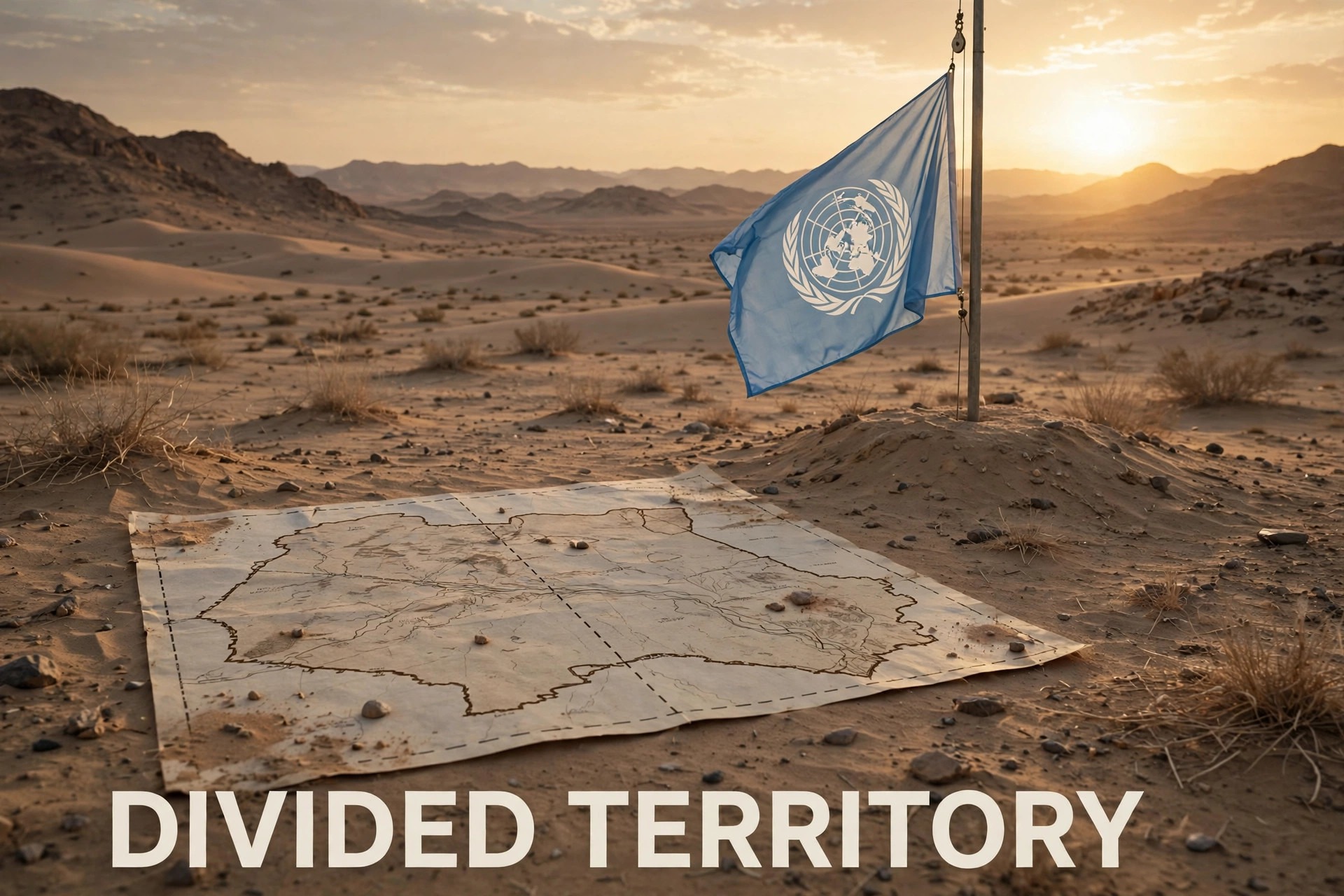
Western Sahara UN Mission Ends After 35 Years
The United Nations peacekeeping mission in Western Sahara ended its operations on November 1, 2026, after 35 years, when the Security Council failed to renew its mandate. The mission, known as MINURSO — the United Nations Mission for the Referendum in Western Sahara — had been in place since the 1991 ceasefire that ended open warfare over the disputed territory. On November 1, it entered what the UN calls a liquidation phase, the formal process of closing down a mission: withdrawing personnel, disposing of or transferring equipment, closing bases, and settling accounts. The end of MINURSO does not resolve the underlying dispute over Western Sahara’s status, which remains contested and unresolved. It removes, however, the international presence that had monitored the ceasefire for more than three decades, and that removal is why the UN Secretary-General warned of potential escalation, even though no new outbreak of hostilities has been confirmed as a result of the closure itself.
Western Sahara is a territory on the northwest coast of Africa, bordered by Morocco to the north, Algeria to the east, Mauritania to the south and east, and the Atlantic Ocean to the west. Its status has been disputed since Spain withdrew as the colonial power in the 1970s. Morocco claims sovereignty over the territory and administers most of it, including its main towns. The Polisario Front, a Sahrawi independence movement backed by Algeria, claims the territory as the Sahrawi Arab Democratic Republic and seeks a referendum on self-determination. The United Nations continues to list Western Sahara as a Non-Self-Governing Territory, a designation that reflects the unresolved question of its final status. That legal and political ambiguity is the backdrop to everything that follows: the mission, the ceasefire, the failed referendum, and the Security Council deadlock that ended MINURSO.
MINURSO was established under Security Council Resolution 690, adopted on April 29, 1991. Its original mandate had two central tasks: to monitor the ceasefire between Morocco and the Polisario Front, and to organise and conduct a referendum in which the people of Western Sahara would choose between independence and integration with Morocco. The ceasefire monitoring role endured, in various forms, for 35 years. The referendum, by contrast, never took place. Disagreements over who would be eligible to vote — in particular, over the identification of voters and the treatment of Moroccan settlers and Sahrawi refugees — prevented the referendum from being held, and the mission’s role gradually became, in practice, a ceasefire monitoring and confidence-building presence rather than a referendum-organising one. That history explains why the mission’s end is significant even though its original purpose was never fulfilled: it was the last formal UN mechanism linking the parties to a negotiated settlement process.
The immediate cause of the mission’s end was a Security Council deadlock on October 30, 2026. The United States put forward a draft resolution that would have extended and restructured the mission. That draft was supported by 11 of the Council’s 15 members, including France and the United Kingdom, but it was vetoed by Russia, one of the five permanent members with veto power. A competing Russian resolution was then put to a vote. It received three votes in favour, one against and 11 abstentions, falling short of the nine votes needed for adoption. With neither resolution adopted, MINURSO’s mandate expired, and the mission’s peacekeeping operations ended on November 1. The sequence — a vetoed majority-backed draft followed by a failed alternative — is a familiar pattern in Security Council deadlocks, but its consequence here was unusually concrete: the closure of a long-standing peacekeeping mission, rather than merely the blocking of a statement or a sanction.
Secretary-General António Guterres responded by warning of potential escalation of hostilities and by saying that the United Nations stands ready to continue supporting dialogue toward a peaceful resolution. That warning should be read carefully. It is an assessment of risk, not a report that hostilities have resumed. The Secretary-General’s concern is that, without MINURSO’s monitoring presence, incidents along the ceasefire line — known as the berm, a long sand wall built by Morocco that divides the territory — could be harder to verify, harder to de-escalate, and more likely to be misinterpreted by either side. The UN’s readiness to support dialogue is also significant: it signals that, even without a peacekeeping mission on the ground, the UN does not regard its political role as ended, and that it remains available to facilitate talks if the parties are willing.
How the Western Sahara UN Mission Mandate Failed in the Security Council
To understand why the Council failed to renew MINURSO, it is necessary to understand the positions of the key players, and to distinguish between what each side says about the territory and what the Council was actually voting on. The United States draft, according to reporting on the vote, would have extended and restructured the mission. Restructuring, in UN language, can mean changing the size, tasks or reporting arrangements of a mission, and it often reflects an attempt to adapt a long-standing mission to new political circumstances. The fact that 11 members supported the US draft suggests broad agreement on the Council that some form of continued UN presence was desirable. Russia’s veto, however, blocked that draft regardless of its majority support, because a single veto by a permanent member is sufficient to prevent adoption.
Russia’s position, as reflected in its competing draft and in the Council debate, was distinct from the US position, although the full details of the competing text were not the subject of broad public reporting at the time of the vote. The Russian draft’s failure — three in favour, one against, 11 abstentions — shows that it did not command majority support either. Abstentions in the Security Council are often a signal of discomfort with a text, or of a desire not to take sides between competing drafts, rather than outright opposition. In this case, the large number of abstentions on the Russian draft, combined with the veto of the US draft, left the Council with no adopted resolution and no mandate for MINURSO. That outcome is sometimes described as a “failure to renew,” but it is more precisely a failure to agree on any renewal text, with two different proposals both failing for different procedural reasons.
The Council’s deadlock also reflects a broader shift in the politics of Western Sahara over the past several years. In 2025, the Council adopted a US-drafted resolution that described Morocco’s autonomy plan — autonomy for Western Sahara under Moroccan sovereignty — as the “most feasible” basis for a settlement. That language was welcomed by Morocco, which has long presented autonomy as a realistic compromise that preserves Moroccan sovereignty while giving the territory a degree of self-government. It was viewed with concern by the Polisario Front and by Algeria, which argue that any settlement must be based on self-determination, including the option of independence, and that describing autonomy as the most feasible outcome prejudges the result of a referendum that has never been held. The 2026 vote took place against that background, and the disagreement over the future direction of the political process contributed to the inability to agree on a mission renewal.
Morocco welcomed the end of MINURSO in the context of its autonomy plan, according to reporting on the reactions to the closure. From Rabat’s perspective, the mission’s original referendum mandate had long since become obsolete, and its continuation served mainly to keep an outdated framework alive. Morocco’s position is that autonomy under Moroccan sovereignty is the only realistic solution, that the territory is already integrated into Morocco’s political and economic life, and that international attention should shift toward development and investment rather than toward a referendum. Algeria-backed Polisario Front representatives, by contrast, expressed concern about the mission’s end, arguing that the removal of the UN monitoring presence increases the risk of escalation and weakens the international commitment to self-determination. Those reactions are not merely rhetorical: they reflect fundamentally different views of what a just and durable settlement would look like.
What MINURSO Did, and What Its Closure Means
MINURSO’s work over 35 years was less visible than that of larger peacekeeping missions, but it had a specific and important function. Military observers monitored the ceasefire along the berm, investigated alleged violations, and reported to the Security Council. The mission also maintained liaison with both parties, facilitated communication when incidents occurred, and, in its earlier years, worked on voter identification for the planned referendum. In a territory where the ceasefire line is long, remote and sparsely populated, and where both sides maintain military forces, that monitoring role provided a degree of transparency and a channel for de-escalation. Without it, alleged violations may be harder to verify independently, and each side may be more likely to rely on its own account of events.
The liquidation phase that began on November 1 is the UN’s standard process for closing a mission, but it is not instantaneous. It involves the phased withdrawal of military observers and civilian staff, the handover or disposal of facilities and equipment, the repatriation of contingents, and the archiving of records. During liquidation, the mission’s operational capacity diminishes, and its ability to monitor the ceasefire effectively ends. The UN has, in past mission closures, retained a small political presence or a liaison office where the Security Council has agreed to one, but no such successor arrangement was adopted in this case at the time of MINURSO’s closure. The Secretary-General’s statement that the UN stands ready to support dialogue therefore refers to a political willingness, not to a continued on-the-ground presence of the same kind.
The risk of escalation that the Secretary-General warned about should not be overstated, but it should not be dismissed either. The ceasefire that MINURSO monitored has already been under strain in recent years, with the Polisario Front declaring in 2020 that it no longer considered itself bound by the ceasefire after an incident at Guerguerat, a crossing point in the south of the territory. Since then, there have been periodic reports of exchanges of fire along the berm, although the scale and frequency of those incidents have been contested and difficult to verify independently. The end of MINURSO does not create that tension, but it removes an independent monitor that could help establish what happened when incidents were reported. In a dispute where narratives about incidents matter politically, the loss of an independent verifier is itself a significant change.
For the Sahrawi people, the mission’s end has a human dimension that goes beyond Council procedure. Tens of thousands of Sahrawi refugees have lived for decades in camps near Tindouf in Algeria, dependent on humanitarian aid and waiting for a political settlement that has not arrived. Inside Western Sahara, Sahrawi communities live alongside Moroccan settlers, in a territory where political expression, economic opportunity and identity are all shaped by the unresolved status question. For both groups, the end of MINURSO may feel like the international community stepping back from a promise — the promise of a referendum — that was made in 1991 and never fulfilled. Whether that feeling translates into renewed political mobilisation, or into resignation, will depend on developments in the coming months, including whether any new diplomatic initiative emerges to replace the mission’s political role.
The Contested Future of Western Sahara After MINURSO
The future of Western Sahara after MINURSO will be shaped by three sets of actors: Morocco and the Polisario Front, who are the direct parties to the dispute; Algeria and Mauritania, as neighbouring states with interests in the region; and the Security Council, which retains responsibility for international peace and security even without a peacekeeping mission on the ground. Morocco is likely to continue promoting its autonomy plan as the basis for a settlement, and to seek international recognition of its sovereignty, building on recognitions it has already received from the United States and others. The Polisario Front is likely to continue insisting on self-determination and a referendum, and to seek support from states and international bodies that share that position. Algeria, which hosts the Sahrawi refugee camps and backs the Polisario Front, is likely to continue opposing any settlement that does not include a referendum option.
The United States and Russia, whose Council drafts both failed, will also remain central to any future negotiation. The United States, as the penholder on Western Sahara in the Council and as a supporter of Morocco’s autonomy plan, has significant influence over the direction of any future resolution. Russia, as a veto-wielding permanent member, has the ability to block resolutions it opposes, as it demonstrated on October 30. France and the United Kingdom, both of which supported the US draft, are also important, given their historical ties to the region and their permanent Council seats. Any future agreement on a UN presence, a political process, or a settlement framework will need to navigate those Council dynamics, which proved insurmountable in the MINURSO renewal vote.
It is also worth noting what the end of MINURSO does not do. It does not change Western Sahara’s legal status under international law. It does not remove the territory from the UN list of Non-Self-Governing Territories. It does not recognise Moroccan sovereignty, nor does it recognise Sahrawi independence. It does not end the UN’s political responsibility for the issue, even if it ends the peacekeeping mission. And it does not, by itself, mean that war will resume. Those distinctions matter, because reporting on mission closures can sometimes imply a finality that the legal and political reality does not support. The dispute remains unresolved, the sovereignty question remains contested, and the risk identified by the Secretary-General is a warning about what could happen without a monitoring presence, not a confirmed event.
What happens next will depend on whether the parties and the Council can agree on a new framework. That could take the form of a new political mission, a renewed peacekeeping mission with a different mandate, a special envoy process, or bilateral talks facilitated by the UN. It could also take the form of a prolonged period without any formal UN presence, during which the ceasefire is monitored, if at all, by the parties themselves. The history of Western Sahara suggests that the dispute does not resolve itself in the absence of international engagement; it persists, with periodic flare-ups, humanitarian costs for refugees, and political costs for the region. The end of MINURSO after 35 years is therefore not just the closure of a mission. It is a test of whether the international system can find a new way to manage a dispute that its old mechanism, for all its longevity, never resolved.
Sources
USN reviewed reporting from multiple outlets for this story. Read more from Al Jazeera, CNBC Africa and The Week.