

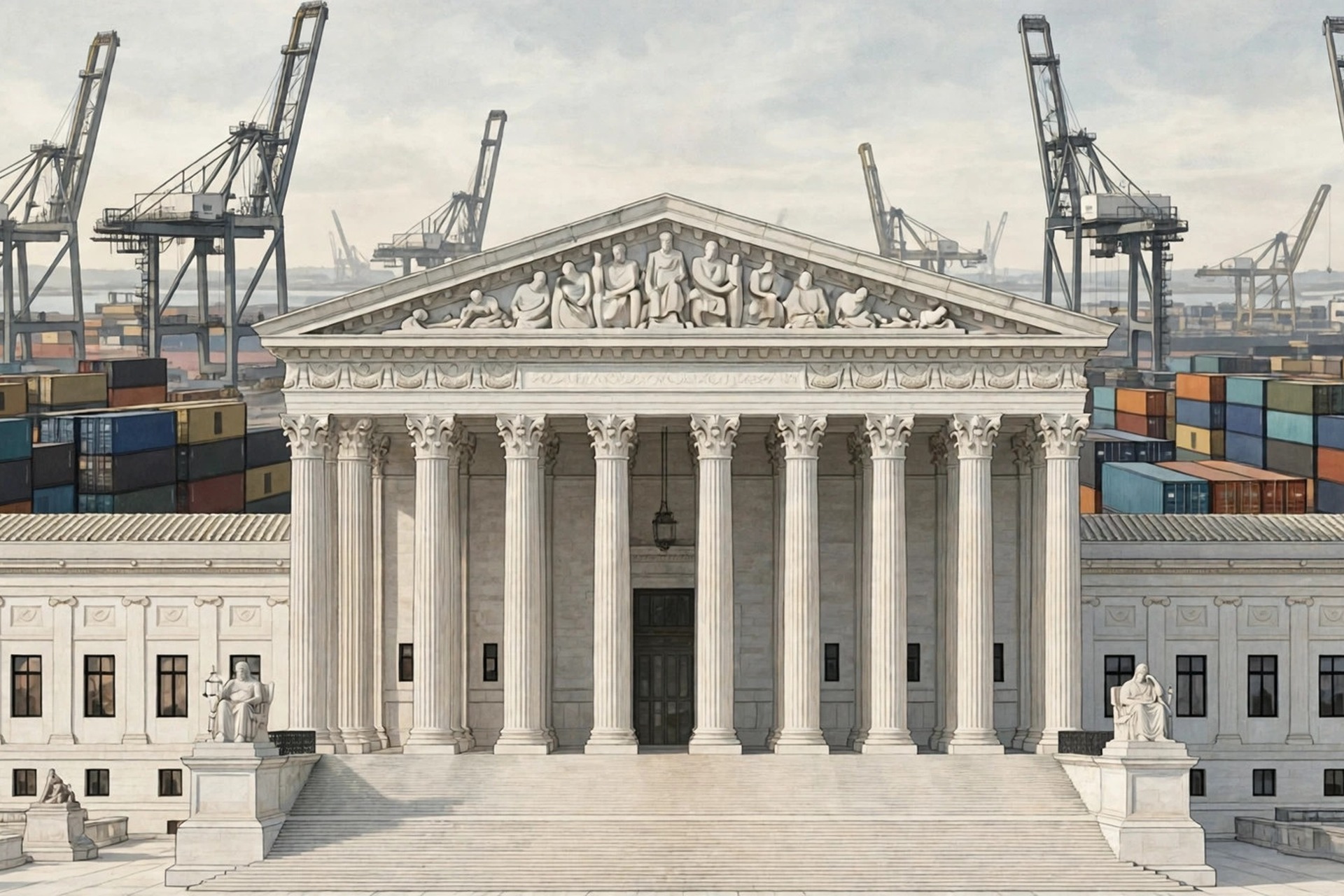
Washington — The Supreme Court took up one of the most consequential economic questions of the Trump presidency on Thursday, November 5, 2026, hearing nearly three hours of argument in Learning Resources v. Trump and its companion case, Trump v. V.O.S. Selections, over whether a president may impose sweeping tariffs around the world by invoking emergency powers. The case does not ask the justices to decide trade policy in the abstract. It asks a narrower, but far more fundamental, question: when Congress gave the president authority to regulate imports during a national emergency, did it also give him the power to tax those imports through tariffs?
The hearing arrived after a long and contested path through the lower courts. The Court of International Trade and the U.S. Court of Appeals for the Federal Circuit had already ruled against the administration’s use of the International Emergency Economic Powers Act, known as IEEPA, to support the tariffs at issue. That record gave the challengers momentum as they entered the Supreme Court, but it did not settle the matter. The Supreme Court is the final arbiter, and its decision, whenever it comes, will determine whether the tariff programme stands, falls, or survives in a narrowed form. No decision was announced at the hearing, and nothing heard on November 5 should be read as a ruling. The Court took the cases on an expedited schedule, and a decision is expected in the coming months.
At stake is not only the future of a particular set of import duties. The case tests the boundary between presidential action and congressional authority over taxation and trade. The Constitution assigns the power to lay taxes and regulate commerce with foreign nations to Congress. Presidents have long exercised delegated trade authority, but the challengers argue that IEEPA, as written, does not contain the clear grant of tariff power that the administration claims. The government, by contrast, defends a broader reading of the statute, arguing that the power to regulate importation in an emergency necessarily includes the tools needed to make that regulation effective.
What Learning Resources v. Trump Is Really About
Learning Resources, Inc., the lead challenger in the case name, is an educational products company, and its dispute is representative of a much larger group of importers who say they have borne the cost of tariffs imposed without a lawful basis. The legal dispute, however, turns on statutory interpretation rather than on the commercial merits of any single product. The justices must decide what Congress meant when it enacted IEEPA in 1977, in the aftermath of an earlier emergency-powers statute that had given presidents very broad economic authority.
IEEPA allows the president, after declaring a national emergency, to investigate, regulate, or prohibit transactions involving foreign interests, including importation. The administration has argued that tariffs are a form of regulation of importation. The challengers respond that a tariff is, in substance, a tax, and that Congress does not hand over taxing power through vague or indirect language. That distinction — between regulation and taxation — was central to the questioning on November 5, with justices pressing both sides on where the line should be drawn and what limits, if any, would remain if the government’s reading were accepted.
The history of the statute matters because Congress has, in other laws, granted tariff authority explicitly, with detailed procedures, findings, and limits. The challengers argue that this pattern shows Congress knows how to authorise tariffs when it intends to do so, and that its failure to use such language in IEEPA is telling. The government argues that emergencies require flexibility, and that a president confronting a declared emergency should not be confined to a narrow menu of tools while foreign economic threats evolve. The tariffs at issue were imposed under five executive orders issued from February 2026 onward, including the April 2 reciprocal tariffs of 10 to 50 percent on most imports and duties on Canada, Mexico and China imposed in the name of addressing fentanyl trafficking and the trade deficit.
How the Supreme Court Tariffs Hearing Unfolded
Solicitor General D. John Sauer, arguing for the government, faced sustained questioning from justices across the ideological spectrum, and several conservative justices expressed open doubt about the administration’s position. Chief Justice John Roberts pressed Sauer on the text of the statute itself, noting that the law never uses the word tariff. “Well, but the exercise of the power is to impose tariffs, right? And the statute doesn’t use the word tariffs,” Roberts said. Roberts also returned repeatedly to the major questions doctrine, the principle the Court has used in recent years to require Congress to speak clearly before the executive may claim powers of major economic significance. He told Sauer that the doctrine seemed directly applicable to a claim of tariff authority that no president had asserted under IEEPA in nearly fifty years.
Justice Neil Gorsuch pressed the separation-of-powers consequences of the government’s reading, asking what would stop Congress from handing the president its core responsibilities if the Court accepted that a vague delegation could carry tariff power. Justice Sonia Sotomayor put the point in the starkest terms, telling Sauer that the power to tax belongs to Congress. “It’s a congressional power, not a presidential power, to tax. And you want to say tariffs are not taxes, but that’s exactly what they are,” she said. Justice Ketanji Brown Jackson told Sauer that Congress had used IEEPA to constrain presidents rather than to grant them unlimited authority.
Justice Clarence Thomas asked the first question of the day, and Justice Samuel Alito sounded the most sympathetic to the administration, acknowledging the president’s broad authority during emergencies. But Alito also asked a question that may prove the most revealing of the hearing: if the Court were to hold that IEEPA does not authorise tariffs, what would stop the president from simply reissuing the same tariffs under other statutes, such as Sections 301, 232 or 338 of the trade laws? Counsel acknowledged that nothing would prevent that, and that the authority of those other statutes would then be litigated anew. The exchange suggested that even a ruling against the government might not end the tariff programme, only force it onto a different legal footing.
Neal Katyal, arguing for the businesses challenging the tariffs, told the justices that tariffs should be treated as taxes, a power reserved to Congress, and that the word “regulate” had never before been read to include them. Oregon Solicitor General Benjamin Gutman, arguing for a group of states that joined the challenge, faced sharp questions of his own, particularly from Justice Brett Kavanaugh. Such questioning is not a reliable predictor of the outcome. Justices often press the side they may ultimately support hardest, and they use argument to clarify the weakest points in each brief. What the hearing did reveal, however, is that the Court is focused on the structural question — who decides — as much as on the immediate trade consequences.
The Licences Question and the Regulatory Tariff Argument
One of the most closely watched exchanges of the day concerned a single phrase in IEEPA. Justices Amy Coney Barrett and Neil Gorsuch zeroed in on language allowing the president to regulate importation “by means of licenses or otherwise.” Gorsuch observed that the statute’s focus had been on regulating importation, “but actually the statute says the President may, by means of licenses or otherwise, regulate importation,” and suggested that licences are economically similar to tariffs. Barrett asked Sauer to point to any other part of the federal code, or any historical instance, in which the words “regulate importation” had been used to grant tariff-imposing authority.
Sauer’s central response was to draw a line between regulatory tariffs and revenue-raising tariffs. “It’s very important that they are regulatory tariffs, not revenue-raising tariffs,” he told the justices, arguing that the duties are designed to change the behaviour of trading partners rather than to fill the Treasury. He added that the policy was, in his words, “by far the most effective if nobody ever pays the tariffs.” The argument drew scepticism from justices who noted that the tariffs have in fact raised large sums, and that the president has repeatedly described the revenue they generate. Sotomayor’s exchange on that point — that tariffs are taxes whatever label the government prefers — captured the tension at the heart of the case.
Justice Kavanaugh, meanwhile, pressed the challengers on what he called a gap in their reading of the statute. He observed that the challengers’ position would allow the president to shut down all trade with another country, or to impose a significant quota on imports from every country in the world, but would not allow a tariff of even one percent. The point suggested that at least some justices are uneasy with a reading under which the greater power is permitted and the lesser power forbidden. Barrett, too, pressed both sides, asking challenging questions of the government about the statutory text and of the challengers about the practical consequences of a ruling in their favour. Observers who followed the argument closely described the overall tone as sceptical of the government, while cautioning that the questioning gave no reliable count of votes.
The IEEPA Tariff Authority and Congress Question
The congressional-power dimension of the case extends beyond the parties in the courtroom. If the Court holds that IEEPA does not authorise tariffs, Congress would retain the central role in deciding whether, when, and how tariffs are imposed. Lawmakers could still enact tariff legislation, but they would have to do so openly, with votes and debate, rather than leaving the decision to emergency declarations. Supporters of that outcome argue that this is how the constitutional system is supposed to work, especially for measures that raise prices for consumers and businesses.
If the Court holds the other way, the precedent would be substantial. Future presidents, of either party, could point to the ruling as authority for using emergency declarations to reshape trade policy without new legislation. Critics of that outcome warn that it would shift a core legislative power to the executive branch and make tariff policy more volatile, changing with each administration’s emergency findings. Supporters respond that Congress deliberately created a flexible emergency tool and that courts should not second-guess its use merely because the economic stakes are large.
The case also raises questions about the relationship between emergency powers and ordinary trade law. The United States has a detailed system of trade remedies, including anti-dumping duties, countervailing duties, and national-security investigations, each with its own procedures and standards. The challengers argue that reading IEEPA as a general tariff power would allow the executive to bypass those carefully constructed regimes. The government argues that emergencies, by definition, are situations in which ordinary procedures may be insufficient. President Trump, who has called the case one of the most important in the history of the Supreme Court, did not attend the argument. He spent the day speaking to business leaders in Florida, where he described the large sums the tariffs have brought in.
The Tariff Refunds Question Hanging Over the Case
One of the most closely watched issues at the hearing was not the legal theory alone, but the money already collected. IEEPA has been used to justify nearly 70 percent of the Trump administration’s tariffs, including the reciprocal tariffs and the duties on China, Canada and Mexico, and reporting on the hearing put the amount collected at more than 89 billion dollars. Importers, retailers, and consumers have asked, in effect, what happens to that money if the tariffs are held unlawful. Estimates of what refunds could cost run into the tens of billions of dollars, with some estimates above 100 billion dollars. President Trump has claimed the figure could be far higher, telling reporters that refunds could exceed 3 trillion dollars — a claim of his own, not a figure any court or independent estimate has endorsed.
Justice Barrett raised the refunds question directly with Katyal during the argument. “If you win, tell me how the reimbursement process would work. Would it be a complete mess?” she asked. Katyal acknowledged that refunds would be complicated, but said an administrative process exists for importers to seek repayment through protests to customs authorities, while cautioning that the process could take a long time for a large number of claims. Barrett observed that unwinding the duties “could be a mess,” a remark that captured the practical difficulty the Court faces whatever it decides.
Businesses that paid the duties have argued that they should not be left without a remedy if the tariffs were imposed without lawful authority. The government, for its part, has an interest in an orderly process that avoids chaos in customs administration. The Court may address refunds directly, leave the question to lower courts, or decide the underlying validity question while saying little about the mechanics of repayment. Until a decision is issued, any discussion of refunds remains hypothetical, and no importer should treat a refund as guaranteed.
The refund question also illustrates why the case matters beyond trade lawyers. Tariffs are paid at the border, but their costs ripple through supply chains. Companies that imported components, finished goods, or educational materials faced higher costs, and many passed at least part of those costs onward. A ruling that the tariffs were unlawful would therefore raise not only a legal question, but a distributional one: who should be made whole, and how?
Why the Decision Will Matter Beyond November 5
Whatever the Court decides, the ruling will shape the next chapter of American trade policy. A decision against the tariffs would not end debate over trade, manufacturing, or economic security. It would, however, return that debate to Congress, where tariff proposals would need to win legislative majorities. A decision for the government would preserve the current programme and embolden future emergency-based trade action, while also inviting further litigation over the scope of each emergency declaration.
The timing of the decision is also uncertain. The Court heard argument on November 5, but it has not announced when it will rule. The cases were taken on an expedited schedule, and some reporting suggests a ruling could come by the end of the year, but Supreme Court decisions in major cases often arrive months after argument, sometimes near the end of the term. Until then, the tariffs challenged in the case remain the subject of litigation, and businesses, trading partners, and policymakers must plan amid legal uncertainty.
For now, the only firm conclusion from November 5 is that the justices have heard both sides, pressed the government hard on the text of IEEPA and on the constitutional allocation of taxing power, and will decide the question in due course. The hearing clarified the competing readings of the statute, the constitutional stakes, and the practical questions surrounding refunds. It did not decide them. Readers should be cautious about commentary that treats pointed questions from the bench as a vote count, or that presents a predicted outcome as a settled result. The decision, when it comes, will speak for itself.
Sources
USN reviewed reporting from multiple outlets for this story. Read more from Tax Notes, KVNU News and The Jackson Press.