

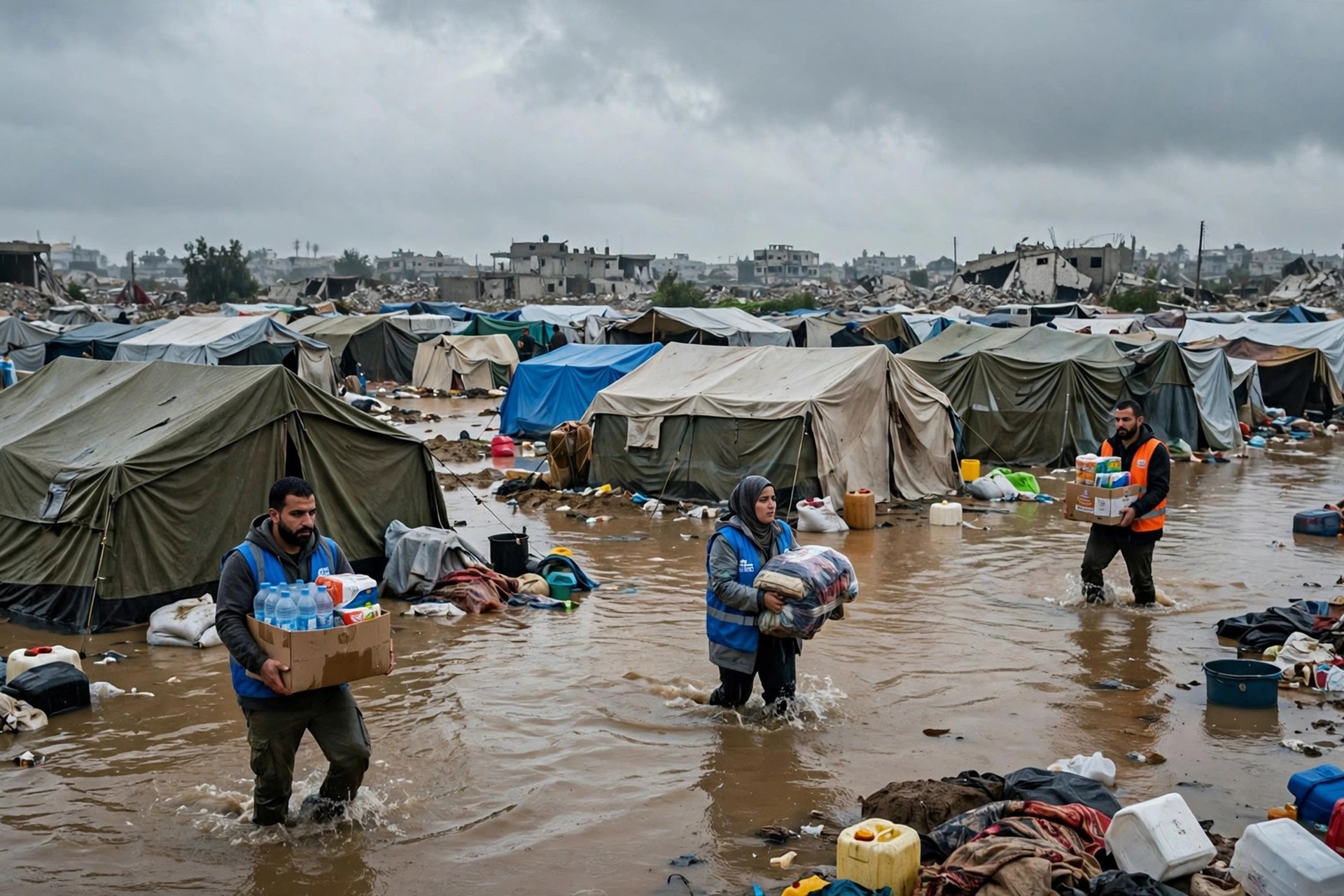
President Donald Trump’s Board of Peace, the new body set up to oversee Gaza’s post-war administration and reconstruction, is offering permanent seats to world leaders at a reported price of one billion dollars each, even as Gaza itself faces a deepening humanitarian emergency. Torrential rain that began on the evening of November 6 flooded tens of thousands of tents across the strip, killed at least six people, including children, and left thousands of families without shelter. The United Nations estimates that about 1.4 million Palestinians, roughly 65 per cent of Gaza’s population, are living in tents or makeshift shelters, and aid agencies warn that stocks of tents, tarpaulins and blankets inside Gaza are virtually exhausted.
The contrast between the board’s grand design and the conditions on the ground in Gaza is the story of the initiative so far. In meeting rooms and at signing ceremonies, the Board of Peace is presented as a sweeping new international organisation, chaired by Trump himself, with a mandate that stretches beyond Gaza to conflicts around the world. In Gaza, meanwhile, families are bailing water out of tents, civil defence teams are overwhelmed by distress calls, and more than 150,000 tents purchased by humanitarian partners are waiting outside the strip, unable to get in. The board’s promise is reconstruction. The reality, for now, is a population facing winter in shelters that cannot withstand a moderate storm.
What the Trump Gaza Board of Peace Is
The Board of Peace was announced by President Trump on a Friday as a supervisory authority over Gaza’s post-war administration, and it was later endorsed by the United Nations Security Council, which in November adopted a resolution backing the American framework for ending the Israel-Hamas conflict and recognising the board as a transitional authority with international legal personality to coordinate Gaza’s reconstruction. The board was first proposed in September, on the sidelines of the United Nations General Assembly, as a mechanism to support the administration, reconstruction and economic recovery of the Gaza Strip.
Its structure gives Trump sweeping authority. The charter, an 11-page document with eight chapters and 13 articles, makes no direct reference to Gaza at all, and instead proposes a broad mandate for a new international organisation that seeks to promote stability, restore dependable and lawful governance and secure enduring peace in areas affected or threatened by conflict. Trump serves as chairman, with final authority over the interpretation of the charter and veto power over key decisions, including membership removal and executive board actions. Under the proposals, he would be entitled to remain chair for life.
The board’s founding executive board includes Secretary of State Marco Rubio, Special Envoy Steve Witkoff, former British Prime Minister Tony Blair, World Bank President Ajay Banga and Trump’s son-in-law Jared Kushner. Below the founding council sits a Gaza executive board, tasked with regional coordination and supported by representatives from Arab countries. Board members are to oversee portfolios described by the White House as critical to Gaza’s stabilisation and long-term success, including governance, capacity-building, regional relations, reconstruction, investment attraction, large-scale funding and capital mobilisation.
The One Billion Dollar Question
The most contentious feature of the board is its price of entry. According to a draft charter first reported by Bloomberg News, member nations may serve three-year terms unless they contribute more than one billion dollars in cash within the first year, which would grant them permanent membership. The figure has been reported widely, and it has become the shorthand for the whole initiative: a billion dollars for a permanent seat at Trump’s table.
The White House has not confirmed the amount. The administration has described some of the reporting as misinterpretation, and has said it has not officially confirmed whether the one billion dollar figure is the price of permanent membership or how the money would be used. The draft charter circulating in international media is the document on which the reporting rests, and the terms it describes, three-year terms renewable only with the chairman’s approval, and permanent membership for those who pay, are the terms governments have been reacting to.
The uncertainty has not stopped the figure from shaping the debate. Critics have called the arrangement a pay-to-play body, and have questioned whether a board that charges for permanence can claim to be a neutral international organisation. Supporters have described the contribution as a marker of seriousness and prestige, and as a way of ensuring that reconstruction is funded by those who join. The Reuters news agency, in its explainer on the board, confirmed the charter’s terms as reported: member states limited to three-year terms unless they pay one billion dollars each to fund the board’s activities and earn permanent membership.
Who Has Joined, and Who Has Not
Invitations to join the board were sent to dozens of countries, and the responses have split along lines that reveal much about how the world sees the initiative. Hungary and Belarus confirmed their acceptance over the weekend after the announcement, with Hungarian Prime Minister Viktor Orban publicly releasing Trump’s invitation letter, and Belarusian President Alexander Lukashenko welcoming the offer, according to Minsk. Kazakhstan confirmed that President Kassym-Jomart Tokayev had accepted an invitation to join, calling the country a founding participant.
Other countries moved more slowly, or not at all. The Kremlin confirmed on Monday that Russian President Vladimir Putin had received an invitation to participate, though the White House has not confirmed whether Russia was formally offered a seat. Putin responded by floating a one billion dollar contribution drawn from Russian assets frozen by Washington, a gesture that turned the fee into a pointed diplomatic rebuke. Israeli Prime Minister Benjamin Netanyahu received an invitation, according to Reuters, and his office later confirmed that he had accepted it, despite earlier criticism from his office over the composition of a subordinate committee linked to Gaza oversight.
Trump formally launched the board at a signing ceremony at the World Economic Forum in Davos in January 2026, and the board held its inaugural meeting the following month at the United States Institute of Peace in Washington, where more than 40 countries and the European Union sent representatives. In the end, 27 countries agreed to join the board, while several European governments, including Britain, France, Norway, Sweden and Slovenia, declined full membership over concerns about the board’s relationship with the United Nations. Egypt confirmed its participation, with the foreign ministry announcing that President Abdel-Fattah el-Sissi had accepted, and eight Muslim-majority countries, Saudi Arabia, Qatar, Turkiye, Indonesia, Jordan, the United Arab Emirates, Egypt and Pakistan, confirmed in a joint statement that they would join. Canada agreed in principle to participate but made clear it would not pay the one billion dollar fee, while France and Britain have declined to pay the entry fee, leaving the board’s membership weighted toward countries willing to accept Trump’s terms.
Gaza Flooding: The Emergency on the Ground
While the board’s membership was being negotiated, Gaza was flooding. Heavy rain and strong winds hit the strip from the evening of November 6 through the weekend, causing widespread flooding, the collapse of damaged buildings, damage to shelters, humanitarian facilities and learning spaces, and disruption to essential services across all five governorates. An infant reportedly drowned, and at least six people were killed in the storm, according to UNICEF, including three children and two women who died when a sand dune collapsed on their tents at the Al Berka Reservoir, west of Deir al-Balah, according to the United Nations aid coordination office, OCHA. Local authorities said about 70,000 tents were flooded and more than 200,000 people were affected.
The scale of the damage was stark. By November 8, humanitarian partners had received appeals from more than 26,000 households whose shelters or belongings were damaged, with the overall impact believed to be greater. More than 6,000 family shelters were reportedly destroyed and 17,400 otherwise damaged, and more than 3,900 households were reported to have no shelter at all. Water levels rose to 1.5 metres in some locations, and civil defence units received 2,166 distress calls but could respond to only 218 of them. More than 106,000 people were directly affected by the storm, according to UNICEF, and about 950,000 displaced Palestinians were living in areas exposed to flooding.
The storm exposed a shelter crisis that had been building for months. Some 65 per cent of Gaza’s population, about 1.4 million people, live in tents or makeshift shelters, according to the United Nations, and most of those tents are worn out and cannot withstand what would be considered a moderate storm elsewhere. Humanitarian stocks of tents, tarpaulins, blankets and clothes inside Gaza are virtually exhausted, while more than 150,000 tents purchased by humanitarian partners and member states are outside Gaza ready to be dispatched, including about 117,000 from the Egyptian Relief Committee alone in Al-Arish. A recent flood risk assessment estimates that 761,000 people in displacement sites across Gaza are likely to be affected by flooding this winter.
Why the Board Matters Now
The flooding is the immediate test of whether the Board of Peace can do what it was created to do. The board’s purpose, as presented, is to coordinate reconstruction and to mobilise the funding Gaza needs. But reconstruction cannot begin in earnest while the strip’s population is living in tents that flood, while shelter materials are stuck outside the territory, and while the funding meant for rebuilding has not reached the people who need it. One report found that the World Bank-administered fund established for the board officially contained zero dollars, despite approximately 17 billion dollars in pledges from various nations, with disbursement stalled and no reconstruction contracts awarded because the board cannot operate inside Gaza without security.
At the board’s inaugural meeting in February, Trump promised 10 billion dollars from the United States, and nine member states pledged more than 7 billion dollars between them, taking total pledges to about 17 billion dollars. Qatar, Saudi Arabia and the United Arab Emirates each promised at least one billion dollars. Those pledges, if they materialise, would be a start on a reconstruction bill estimated at 71 billion dollars over the next decade. But pledges are not deliveries, and the gap between what has been promised and what has arrived is the measure by which Gazans will judge the board.
The board’s defenders say the structure is necessary: that Gaza needs a single coordinating authority with the power to make decisions, and that Trump’s chairmanship gives it the political weight to act. Its critics say the structure is the problem: that a body chaired for life by one man, with membership priced at a billion dollars, cannot be the neutral administrator Gaza needs, and that the charter’s silence on Gaza itself shows the board’s ambitions lie elsewhere. Both arguments will be tested not in Davos or in New York, but in Gaza, where the next storm is already a matter of when, not whether. Readers following Gaza diplomacy may recall the meeting of more than 60 nations on Gaza and West Bank peace hosted by the European Union.
What Comes Next for Gaza and the Board
The immediate priority in Gaza is shelter, and the immediate demand from aid agencies is for approvals and access: for the 150,000 tents waiting outside the strip to be allowed in, for the vacuum trucks, mobile dewatering pumps, engine oil, hoses and heavy machinery needed to clear floodwater to be brought in, and for the funding gap in the winter response, estimated at 186.5 million dollars out of 267.9 million dollars needed, to be closed. OCHA has warned that continued shortages of fuel, lubricants, spare parts and heavy machinery could undermine the response to future storms, and that thousands of buildings across Gaza remain at risk of collapse.
For the Board of Peace, the next steps are practical rather than ceremonial: turning pledges into deliveries, getting the stalled reconstruction money moving, and deciding how the board will operate and who will pay for it. Whether the billion-dollar fee is confirmed, waived or quietly dropped will shape who joins and who stays away. Whether the board can move from ceremony to delivery, from pledges to tents on the ground, will shape whether it is remembered as a reconstruction authority or as a diplomatic pageant. The pressure to deliver grew this week: an Israeli airstrike on Gaza’s Nasser Hospital on Wednesday night killed six people and injured 27, according to United Nations reporting, and a nine-month-old baby died of the cold after days of heavy rain and flooding. More than 50 countries and organisations, led by Britain, Qatar and Jordan, have demanded that Israel allow more winter supplies into Gaza immediately.
For the 1.4 million Palestinians living in tents, the distinction is not abstract. The rain that fell on November 6 was the first winter storm, not the last, and the shelters that failed then will fail again when the next storm comes. The Board of Peace was created to rebuild Gaza. Its first real test is whether it can keep its people dry.
Sources
USN reviewed reporting from multiple outlets for this story. Read more from Worthy News, Dhaka Tribune and Manila Times.