

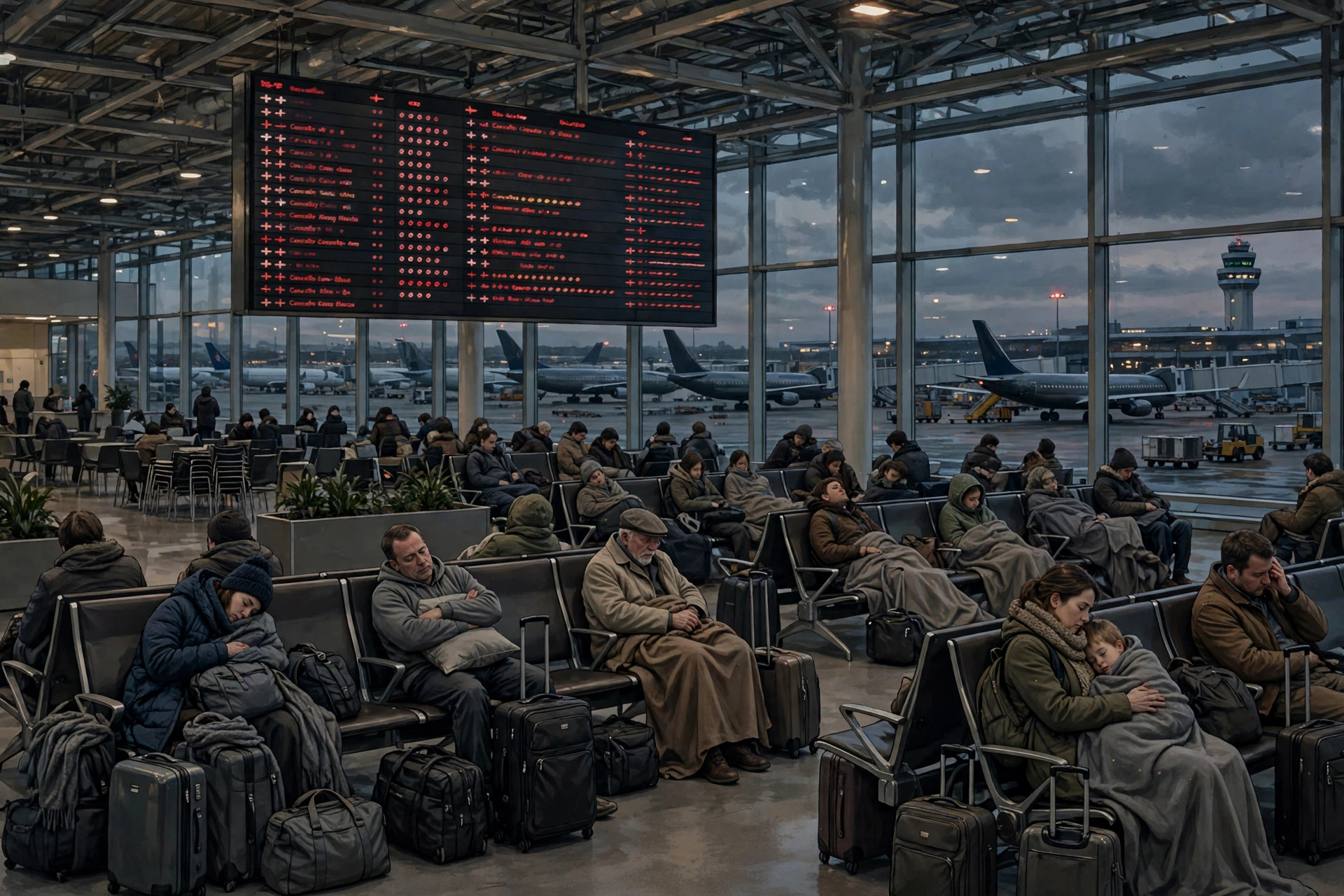
American air travel came to a near standstill on Friday, November 13, 2026, when the Federal Aviation Administration ordered a nationwide ground stop that kept every departing flight on the ground for more than four hours. The halt, the second nationwide ground stop since the September 11, 2001 attacks and the longest since then, stranded an estimated 1.5 million passengers, led to about 12,462 flights being cancelled on Friday, according to the FAA, and exposed how much of the country’s air traffic control system still runs on ageing copper wire. By Saturday morning, the cause was coming into focus: routine maintenance work by the contractor L3Harris Technologies, replacing an old copper telecommunications line with fibre, had gone wrong, and a newly installed router began flooding the system with bad data.
The disruption began at 3.36 p.m. Eastern Time, when controllers at air traffic control centres across the country started seeing unstable radar and communications feeds. Within minutes, the FAA took the drastic step of stopping all departures nationwide, a decision it described as necessary because controllers could no longer rely on the systems they use to keep aircraft safely separated. More than 3,500 aircraft were already in the air when the order went out, and they were allowed to continue to their destinations, but nothing new took off. The ground stop was lifted at about 8.15 p.m. Eastern Time, yet the damage to the weekend’s travel plans was already done, with about 6,700 further flights cancelled on Saturday and more than 2,000 on Sunday, taking the three-day cancellation total past 17,000, according to FlightAware, and officials warning that it could take days for airlines to return to normal.
Transportation Secretary Sean Duffy, who held a 45-minute news conference on Saturday morning to explain what had happened, apologised to travellers and was blunt about the state of the system behind the failure. He blamed outdated technology, said the trouble had started at a single remote location, and pointed directly at the contractor’s work. At the same time, he stressed that investigators had found no evidence of a cyberattack, no sign of foreign interference and nothing to suggest the failure was deliberate. For passengers heading into one of the busiest travel periods of the year, with Thanksgiving less than two weeks away, the episode was a reminder that the infrastructure guiding their flights is older and more fragile than most of them had assumed.
What Happened on Friday Afternoon
The first signs of trouble appeared shortly after 3.30 p.m. Eastern Time, when the FAA began receiving reports of instability in the radar and communications systems at air route traffic control centres. Duffy later put the precise moment at 3.36 p.m., when controllers noticed that the information reaching their screens was inconsistent and unreliable. In its initial statement, the FAA said the nationwide ground stop followed communication problems at multiple Air Route Traffic Control Centers, and that its technicians were investigating. The agency soon made the decision to halt departures across the entire country rather than risk controllers working with feeds they could not trust.
The scale of the stoppage was extraordinary. FAA Administrator Bryan Bedford told reporters on Saturday that as many as 17 of the country’s 22 air traffic control centres were affected, though none of them actually went dark. Instead, facilities reported frequencies going in and out, forcing controllers to switch repeatedly between primary systems and backups. Because the agency could not immediately explain why so many centres were affected at once, it chose the nationwide stop. The order went out shortly before 4 p.m. Eastern Time and stayed in force until about 8.15 p.m., a halt of roughly four and a half hours.
For the airlines, the arithmetic of the day was brutal. FlightAware counted 9,201 cancellations within, into or out of the United States on Friday, 13 November, while the FAA later put the day’s total at about 12,462, including 9,082 by major airlines, and cautioned that not all of those cancellations were directly caused by the ground stop. Delta Air Lines and American Airlines each reported more than 2,200 cancellations, and United Airlines recorded about 1,800, according to Flightradar24. The data firm Cirium estimated that around 1.5 million passengers were stranded by the disruption. Saturday brought about 6,696 more cancellations, according to FlightAware, and officials promised that everyone affected would either be re-accommodated on a flight or given a full refund.
Why the FAA Nationwide Ground Stop Happened
By Saturday morning, Duffy was able to describe the chain of events with growing confidence, even though he cautioned that the investigation was not complete. The trouble, he said, began while the contractor L3Harris was carrying out routine telecommunications maintenance at one of the FAA’s remote locations, switching a line from old copper wire to fibre-optic cable. The work itself, he said, was straightforward and had been happening across the country for decades. This time, however, something went wrong during the switch, and the router that was installed began flooding other routers on the air traffic control system with data, corrupting the information flowing to controllers.
Duffy described the mechanism in plain terms: switches and routers became overloaded with data, resulting in inconsistencies in the information supplied to air traffic control centres. In at least one remote location, the copper-to-fibre switch was under way when the fault appeared. The FAA’s update on 15 November pointed to two sites: a radio communications site at El Dorado, Arkansas, where L3Harris had deployed a new router, and a radar site at Amarillo, Texas. The agency said a flood of data, about 1,000 connection attempts every four to five seconds, had overwhelmed its legacy equipment, and that it had disabled the function on the routers that started the flood, as a precaution disabling the same function on about 60 similar routers. Duffy himself was careful about assigning blame, saying it was not yet clear whether the failure came down to a contractor error or a faulty piece of equipment. “Not clear if it was incompetence or faulty router that led to shutdown,” he said, describing the uncertainty around the cause.
The contractor at the centre of the episode is one of the most important companies in American aviation infrastructure. L3Harris Technologies, headquartered in Melbourne, Florida, manages the FAA Telecommunications Infrastructure, the network that supports about 45,000 daily flights in the United States and connects more than 4,400 facilities. In a statement to CNN, the company said it had been modernising the communications infrastructure supporting the National Airspace System in close coordination with the FAA, and that it was supporting the FAA’s investigation to understand the conditions that led to the November 13 ground stop. Duffy, for his part, was sharply critical of the contractor during the Saturday news conference, saying there could have been “mistakes made” during the procedure.
10000 Flights Cancelled and 1.5 Million Passengers Stranded
The human cost of the stoppage was visible in terminals across the country on Friday evening and through the weekend. Passengers who had expected to be home for the weekend found themselves sleeping in airports, queuing for rebooking, or trying to find rental cars and hotel rooms at short notice. At Phoenix Sky Harbor International Airport, FlightAware listed 334 delays and 275 cancellations as of 4.25 p.m. on Saturday, a day after the ground stop was lifted, and the airport’s own flight board showed 123 cancellations and 161 delays for flights scheduled between 4 p.m. on November 13 and 4 p.m. on November 14. In New York, the three busy airports of JFK, LaGuardia and Newark faced longer recovery delays than most, because three crowded fields share tight airspace.
The disruption also reached beyond American borders. International flights bound for the United States were affected, and the chaos rippled through connecting itineraries worldwide. The ground stop was only the second nationwide halt since September 11, 2001, and the longest since then, a comparison that underlined how rarely the FAA takes a step of this magnitude. Officials and experts warned that the knock-on effects could linger for days, as aircraft and crews were left out of position and airlines worked through a backlog of stranded passengers. Duffy expressed confidence that the system would return to normal before Thanksgiving, one of the busiest travel periods of the year, but the days after the stoppage showed how slowly a network of this size recovers from a shock.
The episode also arrived at an awkward moment for the administration’s aviation agenda. Only days earlier, Duffy had been pressing Congress for around 50 billion dollars to overhaul the air traffic control system, arguing that the country’s ageing infrastructure was a growing risk. USN has covered the earlier strain on the system during the government shutdown, when the FAA cut flights at 40 American airports as Thanksgiving travel risk grew. The November 13 failure gave that argument a vivid, expensive illustration, and it is now likely to feature heavily in the debate over how quickly the modernisation money should be spent.
No Cyberattack: What Officials Ruled Out
In the first hours after the ground stop, one question dominated the speculation: had someone attacked the system? Duffy and Bedford moved quickly to answer it, and their answer was consistent across the weekend. The department does not believe the outages were caused by a cyberattack or any “nefarious” activity, Duffy said, adding that there was no evidence a foreign nation had attacked the network. Bedford was equally direct, telling reporters: “We see zero evidence of anything nefarious, and zero evidence of anything AI-related.”
Homeland Security Secretary Markwayne Mullin reinforced the message outside the White House, telling reporters that officials wanted to assure the American people that the episode was not a safety threat and not another September 11. “There’s no prior indication as of yet that this was nefarious attack against us,” he said, describing the event as “just a telecommunication outage as of right now”. The reassurances mattered, because a nationwide halt to air travel inevitably invites comparisons with 2001, and the administration was keen to draw a sharp line between a systems failure and a security incident.
Homeland Security Secretary Markwayne Mullin added on Sunday that the FAA failure and the separate Microsoft outage the day before were not connected, telling Fox News that the two incidents were unrelated.
That distinction, however, does not make the failure any less serious in the eyes of aviation experts. A system that can be brought down by a single router during routine maintenance is a system with a single point of failure, and the fact that 17 of 22 control centres felt the effects at once suggests that the network’s resilience has not kept pace with its age. The investigation will need to establish whether the fault lay in the equipment, in the way the work was carried out, or in the design of a network that allowed one site’s problem to spread so widely. Until those answers arrive, the official position is that this was an accident of ageing infrastructure, not an attack.
Duffy Blames Ageing Technology and Points at L3Harris
Duffy’s Saturday news conference was as much an argument about investment as it was an explanation of the failure. He returned repeatedly to the age of the equipment, describing a system that still relies on copper wire in places and on technology that has been in service for decades. While a majority of copper wires have now been switched to fibre, he said, around 30 percent have yet to be replaced. The maintenance that caused the failure was itself part of that slow modernisation, which made the episode a particularly uncomfortable illustration of the problem: even the work of fixing the system can break it.
The secretary’s criticism of L3Harris was unusually sharp for a cabinet official speaking about a contractor in the middle of an investigation. He said the company had been doing routine maintenance to switch telecommunication lines from old copper wire to fibre in at least one remote location, and that there could have been mistakes made during the procedure. At the same time, he kept open the possibility that the router itself was faulty, a distinction that matters for who bears responsibility and for what fix is needed. L3Harris has said it is cooperating fully, and the FAA’s technicians are working through the logs to establish exactly what happened in the minutes before the ground stop.
President Donald Trump, who was at the White House as the disruption unfolded on Friday and was briefed on it but made no public appearance, has declared updating the national air traffic control system “a national emergency”. The declaration gives Duffy’s funding request a presidential endorsement, but it also raises the stakes: if modernisation is a national emergency, then a failure like November 13 becomes a test of whether the emergency is being treated as one. The administration’s answer, so far, is to press ahead with the overhaul while the investigation runs its course.
On Sunday, Trump broke days of public silence on the disruption, blaming the Biden administration for the state of the system in posts on Truth Social and urging Congress to approve the modernisation money quickly. Duffy, speaking on Sunday, said the router from the El Dorado site was being examined at an L3Harris laboratory in Florida, and that the FBI had offered assistance. The root cause of the failure remains under investigation.
The Recovery: Days of Delays Before Thanksgiving
Lifting the ground stop did not end the disruption. Airlines warned that it would take days to get aircraft and crews back into position, and Saturday’s cancellations showed that warning was accurate. About 6,700 flights were cancelled on Saturday, according to FlightAware, and delays continued into the weekend at hubs across the country. Passengers were told they would be rebooked or refunded in full, but for many the practical question was whether they could reach their destinations at all, and when.
The timing added to the pressure. Thanksgiving, on November 26, is traditionally one of the busiest travel periods in the United States, and the airlines were already preparing for a surge of passengers. A system failure two weeks before the holiday, however brief, shakes confidence in the network’s ability to cope with peak demand. Duffy said flight operations were “slowly returning to normal” and that the administration was working with aviation stakeholders to clear the backlog, but the experience of the weekend showed that “slowly” was the operative word. By Monday morning, operations had largely returned to normal, with about 300 cancellations and 1,500 delays recorded by 9 a.m., according to Reuters, down from more than 2,300 cancellations on Sunday.
For travellers, the practical lessons of the episode are familiar ones: build in buffer time, keep an eye on airline apps for rebooking, and know the refund rules. For the system itself, the lesson is starker. A nationwide ground stop is the FAA’s last resort, used only when controllers cannot trust the information in front of them. That it was needed at all, and that it was needed because of a router swap at a single remote site, will be the central fact of the investigation, and of the debate over how fast the country replaces the copper wire that still carries so much of its air traffic.
What Comes Next for Air Traffic Control
The investigation into the November 13 failure is now the immediate priority, and its findings will shape both the contractor’s future and the modernisation programme. Investigators need to determine whether the router was faulty, whether the installation was mishandled, and why a problem at one location was able to affect 17 of the country’s 22 control centres. Those answers will decide whether the fix is a matter of replacing equipment, changing procedures, or redesigning parts of the network so that a single failure cannot cascade.
The political consequences are already taking shape. Duffy’s request for around 50 billion dollars to rebuild air traffic control now has a fresh and costly piece of evidence behind it, and the administration’s declaration of a national emergency gives the request added weight. But the episode also invites scrutiny of how the money would be spent, and of whether the modernisation work itself is being managed safely. If routine maintenance can ground the nation’s airlines, lawmakers will want to know what safeguards govern that work, and whether the pace of the copper-to-fibre switch is fast enough to remove the risk before it happens again.
For now, the system is back at full operations, according to Duffy, and the flights are moving again. The 1.5 million passengers who were stranded, the 10,000 flights that never left the ground, and the four and a half hours in which American aviation simply stopped will remain the measure of what went wrong on November 13. The next test will be Thanksgiving, when the network faces its heaviest load of the year, and when travellers, airlines and the administration will all be watching to see whether the lessons of the ground stop have been learned in time.
Sources
USN reviewed reporting from multiple outlets for this story. Read more from CNN, USA Today and Detroit Free Press.