

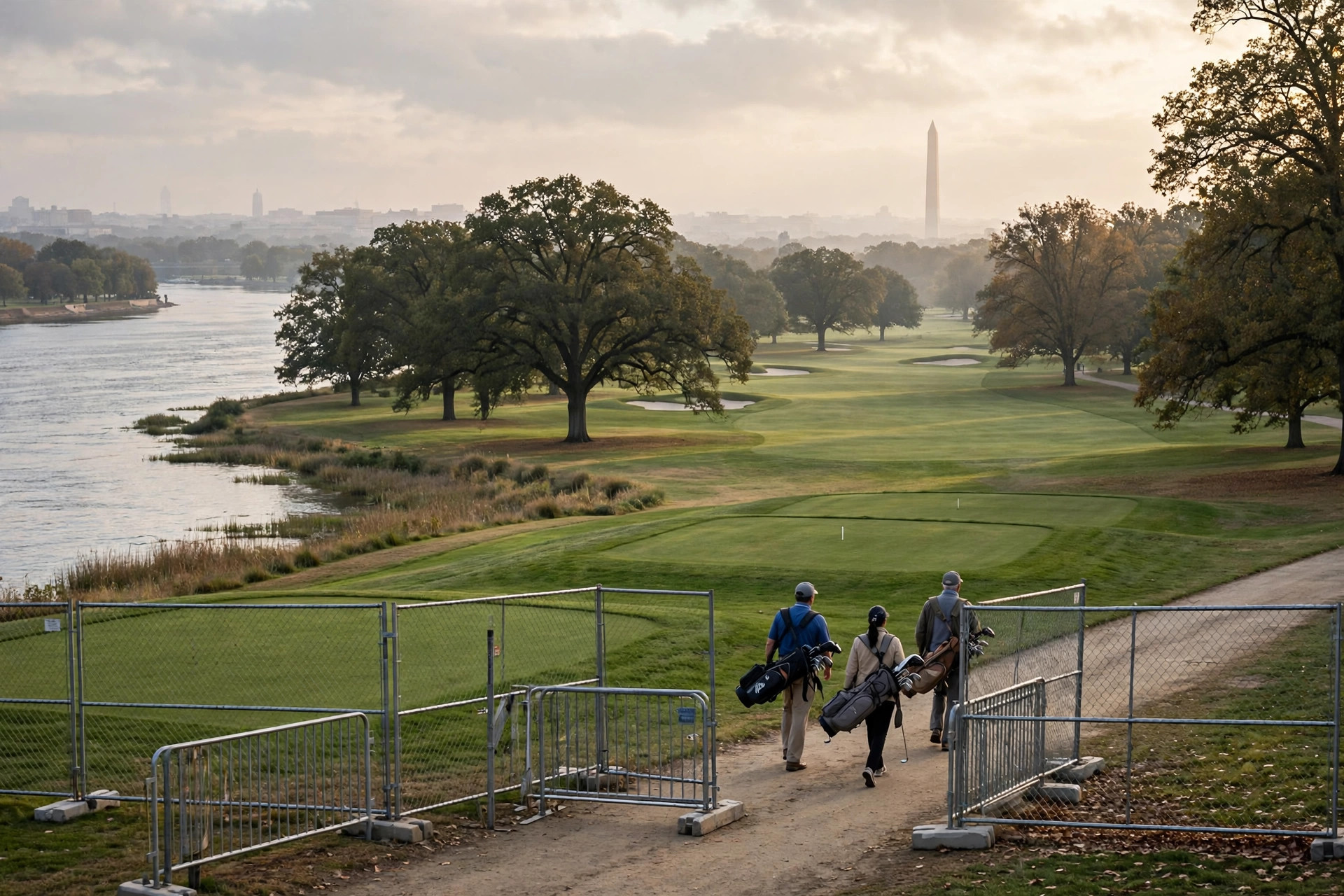
A federal judge on Saturday, November 14, 2026, ordered a temporary stop to any work at a historic Washington public golf course not far from the White House, blocking for now President Donald Trump’s push to redevelop the site along the Potomac River into a championship-level venue. United States District Judge Ana Reyes issued the temporary restraining order a day before the East Potomac Golf Links was due to close on Sunday, November 15, for 15 months, ruling that the administration’s stated reasons for the closure were “pretextual” and that the government had violated at least two federal laws “to meet an arbitrary deadline”. The order, which runs through November 28, 2026, or until the court issues a further order, is the latest setback for the president’s sweeping effort to remake the nation’s capital through major construction projects.
The ruling came at the end of a five-hour court hearing on Friday, November 13, during which Judge Reyes had signalled that she was likely to issue a stoppage order. In a 30-page decision issued on Saturday, she wrote that “President Trump directed this closure for one reason: so that work could begin on a new Fazio Design to replace the current East Potomac Golf Course.” The administration had announced that work would begin on November 15 despite a legal challenge initiated in February by the DC Preservation League and two local golfers, who argue that the redevelopment would fundamentally change the character of an accessible public course and make it unaffordable for ordinary residents. Trump denies that claim, and the Justice Department said the ruling did not prevent the administration from continuing to plan the redevelopment.
For the golfers, cyclists, runners and families who use East Potomac Park every day, the order means the park stays open, at least for now. Temporary fencing had already gone up at the park on Saturday, and the closure had been presented as a settled fact. Instead, the park’s future is now in the hands of a judge who has already shown she is willing to scrutinise the administration’s conduct in this case closely, including by naming a former United States attorney to examine whether government lawyers misled her. No hearing had been set before the order expires on 28 November, and the federal planning commission is due to take up the new course design on 3 December.
A Ruling Hours Before the Closure
The timing of the ruling was no accident. Trump had announced on October 26 that the site would close on November 15 to renovate and rebuild for “Competitive (with other such projects!), Safety, Modernisation, and Aesthetic reasons”, and had said in an October 18 social media post that the closure would last 15 months and transform the park’s golf offerings into “one of the Best and Most Spectacular Golf Courses anywhere in the World”. The plaintiffs went to court to stop the closure before it happened, and Judge Reyes heard their arguments in a five-hour session on Friday that stretched into the evening.
By Saturday, she had ruled. The order “ENJOINS the government from closing East Potomac Park and the East Potomac Golf Course during the daily hours in which they were open as of November 14, 2026”, she wrote, adding that it does not order the government to undertake any active management of either the park or the course. The government, she made clear, remains free to conduct repairs on any part of the park and course, with any notice required by the existing preliminary injunction. The order is in effect “through November 28, 2026, or further order from the Court, whichever comes first”.
The ruling was the latest in a series of court decisions in lawsuits challenging Trump’s capital projects that were issued just hours before construction was expected to begin. A different judge recently ordered a 14-day delay on work for the large memorial arch the president has championed, a decision that came shortly after a key planning commission stacked with Trump appointees approved plans for the project. The pattern is now familiar: the administration sets a date, the opponents go to court, and a judge intervenes at the last moment.
Why Judge Reyes Blocked the East Potomac Golf Course Closure
At the heart of Judge Reyes’s decision was her finding that the administration’s stated reasons for closing the park did not match its real ones. She ruled that the government violated at least two federal laws in its attempt to close the park by November 15, and that the closure appeared designed to start work on a new Fazio course, rejecting the safety explanation the administration had offered. “The government proposes to close a historic park, daily enjoyed by Washingtonians of all stripes, indefinitely,” she wrote, a sentence that captured both the legal and the human stakes of the case.
The president’s own public announcements weighed heavily in the decision. Reyes noted in her ruling that Trump’s social media posts presented a problem for the government, because they linked the closure directly to the renovation of the golf course rather than to any safety concern. Trump had said on October 26 that “we are closing the East Potomac Golf Course Site as scheduled on November 15th in order to renovate and rebuild for Competitive (with other such projects!), Safety, Modernization, and Aesthetic reasons”, and had added that the goal was to renovate and rebuild “a World Championship Public Facility”. For the judge, those words undercut the argument that the closure was a neutral safety measure.
Even before the order was issued, Trump lashed out in a social media post on Saturday, contending that Reyes was biased against him. The judge, who was nominated to the court by Democratic President Joe Biden and whom Trump has called a “lunatic”, had for months been reticent about approving the plaintiffs’ requests for work stoppages. That history made Saturday’s order more striking: a judge who had held back for months concluded that the administration had crossed a line in rushing to meet its own deadline.
The 30-Page Order: What It Does and Does Not Do
The temporary restraining order is a short-term measure, not a final decision on the legality of the administration’s larger plans for the property. It preserves the status quo while the legal dispute continues, keeping the park accessible during its normal operating hours through November 28 unless the court issues another order before then. It does not require federal officials to continue operating the golf course itself, a distinction that matters for golfers hoping to play a round: the park stays open, but the government is not obliged to run the course.
The order also leaves the administration room to manoeuvre. The Justice Department said in a statement on Saturday that the judge acknowledged that the National Park Service can limit access to its facilities where the public is at risk of harm, and that the ruling did not prevent the administration from continuing to plan the redevelopment. “The Department of Justice will always vociferously defend the Trump Administration’s agenda in court,” the statement said. The administration can also ask the court to lift or narrow the order, or appeal it, and the November 28 expiry date means the fight will return to court within two weeks either way.
The case itself, DC Preservation League v. Department of the Interior, No. 1:26-cv-00477, was brought by the DC Preservation League, a historic preservation group, and two local golfers who say the redevelopment violates various federal regulations and statutes. The plaintiffs argue that Trump’s plan would change the character of the accessible golf course and make it unaffordable, something the Republican president denies. The temporary restraining order does not resolve those claims; it simply prevents the government from closing the park while they are litigated.
The Fazio Redesign at the Heart of the Case
The redevelopment at the centre of the dispute would replace the park’s existing 36 holes across three golf courses with a single 18-hole championship-level course designed by Fazio Design, the firm behind some of the most famous courses in the country. The administration presents the project as a transformation of a tired public facility into a world-class venue, one that would put Washington on the map for professional golf. The plaintiffs see it differently: a beloved, affordable public course replaced by a championship layout aimed at professional golfers and the visitors who follow them.
The disagreement is not only about golf. It is about who public land in the capital is for, and who gets to decide. East Potomac Park is federal land, managed by the National Park Service, but it functions as a neighbourhood park for the people who live near it. The plaintiffs’ argument is that the administration is using a safety closure as a pretext to begin a redevelopment that has not been through the full legal process, and Judge Reyes’s finding that the stated reasons were “pretextual” gives that argument judicial backing, at least for now.
The administration’s broader programme of remaking the capital provides the context. The golf course is one of several projects Trump has championed, alongside the large memorial arch, a White House ballroom and the John F. Kennedy Center for the Performing Arts. Each has drawn legal challenges, and each has tested how far a president can go in reshaping federal property by executive will. The East Potomac ruling is the latest instance of the federal judiciary pushing back against those efforts, and it will not be the last.
A Century-Old Public Course: Why East Potomac Matters
East Potomac Golf Links opened in 1920 and was among Washington’s earliest public golf courses. The National Park Service recognises it as part of the historic East and West Potomac Parks district, and the park sits along the Potomac River about two miles from the White House, near the Jefferson Memorial. Today it has three golf courses totalling 36 holes, a miniature golf course and a paved loop popular with cyclists and runners, a mix that makes it one of the most heavily used public recreation spaces in the city.
That history and that daily use were central to the plaintiffs’ case and to the judge’s reasoning. A championship course is a different kind of place from a 36-hole public facility where beginners, families and casual players can find a game. The plaintiffs argued that the redevelopment would fundamentally change the character of the course and price out the ordinary residents who use it now. The administration disputes that, insisting that the rebuilt facility would remain public. But the question of what “public” means when a course is redesigned for championship play is exactly what the lawsuit asks the court to decide.
The park’s place in Washington life also explains why the case has attracted such attention. East Potomac is not a remote federal enclave; it is where Washingtonians go to play, to exercise and to spend time outdoors. The sight of temporary fencing going up on Saturday, hours before the planned closure, brought that home for the people who use the park every day. The judge’s order keeps the gates open, for two weeks at least, and the reaction from regular users has been relief mixed with uncertainty about what comes next.
The Administration’s Response and the Wider Capital Projects
The Justice Department’s response to the ruling was defiant in tone but limited in substance. It emphasised the points in the judge’s favour, the National Park Service’s ability to limit access where the public is at risk, and the fact that planning for the redevelopment can continue. It did not say whether the administration would appeal, or whether it would seek to lift the order before November 28. For now, the administration’s position is that the ruling is a temporary delay, not a defeat, and that the project will proceed once the legal process runs its course.
On Sunday, President Trump said in a social media post that his administration would “immediately appeal, on an expedited basis”, calling the ruling a “highly destructive and political decision”. It was not clear whether a temporary restraining order can be appealed immediately, since such orders are short-term measures meant to preserve the status quo, and no appeal filing had been reported by Sunday afternoon.
That position has to be read against the history of this case. Judge Reyes has already shown a willingness to hold the administration to account in this litigation. USN has previously covered the judge’s decision to order an ethics inquiry into government lawyers over the renovation plans, and her announcement that she would name Jessie Liu, a former United States attorney for the District of Columbia, to examine whether Interior Department, National Park Service and Justice Department officials had violated ethics rules or misled her. A judge who has already questioned the government’s candour is not a judge the administration can expect to defer to its timetable.
The wider programme of capital projects also faces its own legal headwinds. The memorial arch, the ballroom and the Kennedy Center have each drawn lawsuits and planning disputes, and the courts have repeatedly intervened at the last moment. The administration’s argument is that a president elected to remake the capital should be allowed to get on with it. The courts’ answer, so far, is that even a president must follow the law, and that the law requires more than an announcement on social media.
What Happens Before November 28
The immediate question is what happens when the temporary restraining order expires on November 28. The court could extend it, convert it into a longer preliminary injunction, or let it lapse, in which case the administration could move to close the park. The plaintiffs will argue that the same reasoning that justified the two-week pause justifies a longer one, while the government will argue that the delay is already costing time and money and that the safety case for closure is real.
Either way, the underlying lawsuit will continue, and the redevelopment cannot proceed while the legal challenge is pending without further court approval. The administration’s plan to have work under way by November 15 has already failed, and the schedule for a 15-month closure is now in doubt. If the courts continue to intervene, the project could be delayed by months, and the political cost of fighting for a golf course in the middle of other battles, over the budget, the war in Iran and the cost of living, will grow.
For the people who use East Potomac Park, the next two weeks are a reprieve, not a resolution. The park stays open during its normal hours, and the cyclists and runners keep their loop, but whether golf can still be played there is unclear: the order does not require the government to run the course, and the National Links Trust, which operated it, agreed to stop running the course on 15 November. What happens after November 28 will depend on a judge who has already found the administration’s reasons wanting, and on an administration that has shown it does not intend to give up on a project the president has made his own. The fight over a public golf course in Washington has become a test of how much a president can reshape the capital on his own say-so, and the answer, for now, is: not this fast, and not this way.
Sources
USN reviewed reporting from multiple outlets for this story. Read more from The Hindu, Associated Press and Northland News Radio.