

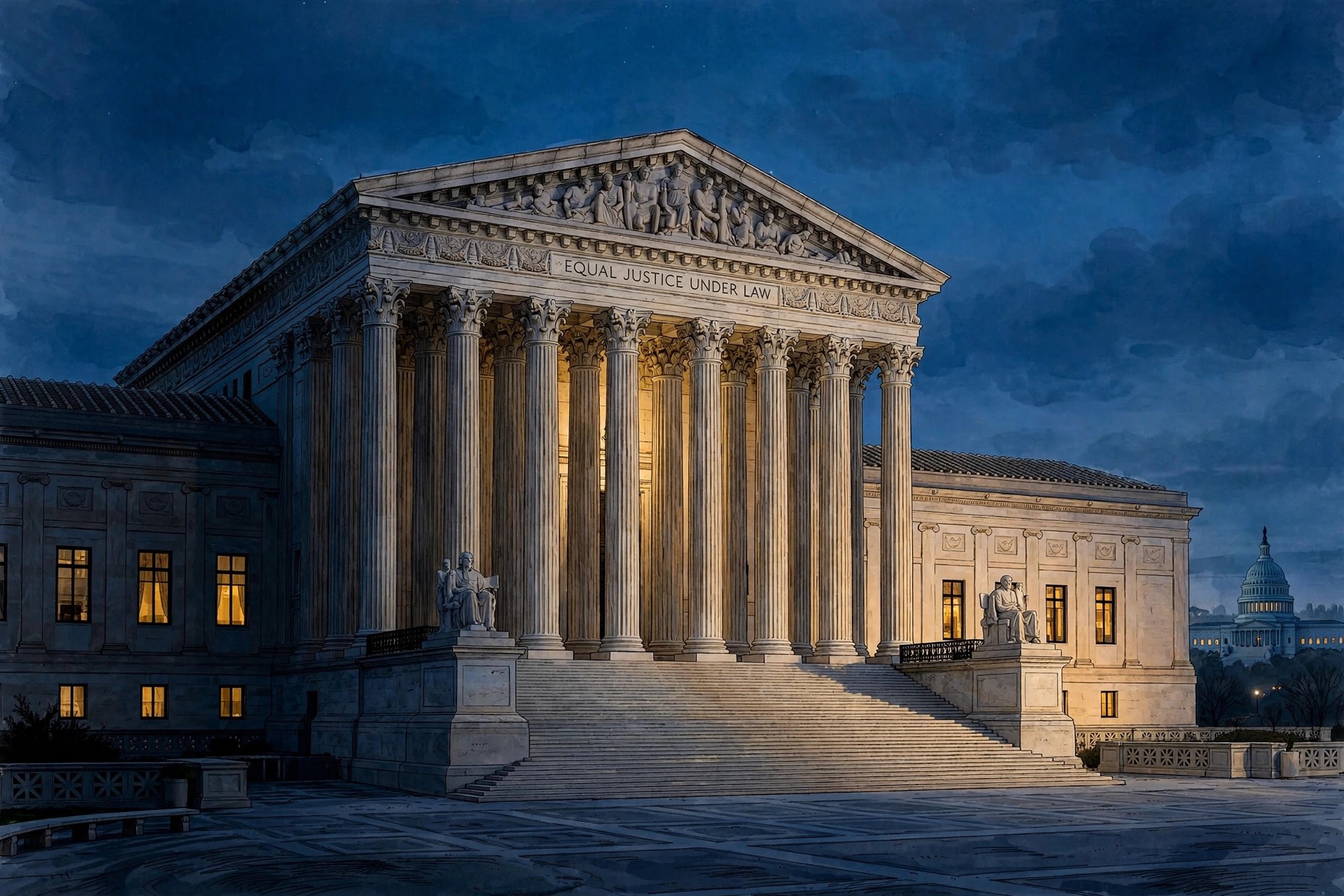
Justice Samuel Alito warned on Thursday, November 12, 2026, that Congress has the power to shut down the Supreme Court by cutting off its funding, telling a Federalist Society dinner in Washington that lawmakers could “turn off the lights” at the nation’s highest court. The remark, delivered as a defence of judicial independence, drew wide attention because it came nine days after Democrats won control of both chambers of Congress in the November 3 midterm elections. But two facts reported alongside the warning are essential to understanding it accurately: Alito did not mention the midterm elections or the incoming Democratic majorities during his remarks, and no member of the incoming Congress has proposed cutting the court’s funding.
Alito spoke at the Federalist Society’s annual Antonin Scalia Memorial Dinner, held during the group’s National Lawyers Convention in Washington, before an audience of more than 1,000 conservative lawyers. He was interviewed on stage by Mollie Hemingway, the Federalist’s editor-in-chief. The dinner is named for the late Justice Antonin Scalia and has become a fixture of the conservative legal movement’s calendar each November. In the same appearance, Alito named three principles he said Americans must hold fast to — freedom of speech, religious liberty and racial equality — and he criticised some lower court judges for what he called unjustified orders blocking presidential policies.
The warning itself was blunt. “Congress can turn off the lights at the Supreme Court and stop everything from happening if they want to defund their activities. And there are many, many, many other things that they can do, or at least try to do,” Alito said, according to The Hill, which first reported his remarks. He added: “So, it is important to preserve the independence of the judiciary. If that is eliminated, then the Constitution as adopted in 1789 will no longer be the same.” The words were a claim about what Congress could do, not a claim that Congress had done it, and the distinction has shaped much of the reaction since.
The Warning, in Alito’s Own Words
Alito framed his argument in constitutional terms. The judiciary, he told the crowd, is the least powerful of the three branches of government, and it is vulnerable to both Congress and the executive. He illustrated the point with an analogy that drew on the language of the Founders, who described the judiciary as the least dangerous branch because it controls neither the sword nor the purse. “If you think about a hand grenade, a 500-pound bomb and a nuclear weapon,” he said, “the hand grenade is the least dangerous. But that is not to say that it is not dangerous.” The point was that vulnerability is not the same as weakness, and that a branch without its own funding or enforcement power depends on the others to function.
The funding warning followed from that premise. Congress holds the power of the purse under the Constitution, and the Supreme Court’s operating budget, like that of the rest of the federal judiciary, is set by legislation. Alito’s argument was that this dependence creates a lever: if lawmakers chose to use it, they could starve the court of the money it needs to operate, even though they could not remove the justices themselves. The phrase “turn off the lights” was his shorthand for that possibility, a vivid image of a court that still exists on paper but can no longer do its work.
Alito has made this dinner a regular platform. He addressed the Scalia dinner virtually during the pandemic, in a speech in which he described the health crisis as having caused previously unimaginable restrictions on civil liberties. Last year, Justices Brett Kavanaugh and Amy Coney Barrett shared the stage at the dinner, and the year before that Justice Neil Gorsuch appeared alongside former Justice Stephen Breyer. Alito’s return to the dinner in person this year, at 76 years old and in his twentieth year on the court, put his remarks about the institution’s fragility in a personal as well as an institutional frame.
What Alito Did Not Say
The most important correction to early reactions to Alito’s remarks is also the simplest: he did not say what some headlines implied he said. The Hill’s account of the speech, which was the first and most widely cited report, stated plainly that Alito made no reference to the midterm elections or the pending change in power during his remarks. Multiple other outlets that reviewed the remarks reported the same thing. The warning was about Congress in general, not about a particular party or a particular majority, and Alito named no lawmaker, no bill and no proposal.
That matters because the timing invited a different reading. The dinner came a week after Democrats swept both houses of Congress, and several outlets framed the warning as a response to that result. Some reports described Alito as warning that a Democratic Congress could use the spending power to shut the court down, and at least one noted that the justice’s comments appeared to be a reference to the midterm victories, while acknowledging that he had not specifically mentioned them. The inference is understandable given the calendar, but it is an inference, not something Alito said, and it should be reported as one.
Equally important is what has not happened since the speech. A review of reporting from November 12 to November 16 found no record of any member of the incoming Congress proposing or scheduling a funding cut for the court. Alito did not claim that Democrats had already filed a defunding bill, and no such bill has been identified in the coverage of his remarks. The warning was about a power Congress holds, not about a step Congress has taken.
There is a historical footnote that helps explain why the idea was not entirely new to Alito’s audience. In the past, a group of Democratic senators proposed withholding 10 million dollars in Supreme Court funding until the justices adopted stricter ethics requirements, according to the New York Post. That proposal was tied to ethics rules, not to shutting the court down, and it came from an earlier Congress, not from the incoming one. It is part of the background to the debate over Congress and the court, but it is not evidence that the incoming Congress plans to defund the judiciary.
The Constitutional Mechanics: What Congress Can and Cannot Cut
Alito’s warning rests on a real feature of the constitutional design, and understanding it requires separating two different kinds of money. Article III of the Constitution protects the pay of sitting justices: Congress cannot reduce a justice’s compensation during that justice’s continuance in office. That protection is explicit, and it means lawmakers cannot punish an individual justice by cutting that justice’s salary.
Operating funds are different. The money that pays for the court’s staff, its clerks, its building, its security and its day-to-day operations comes through appropriations, and Congress sets those amounts through legislation. A funding restriction would not automatically stop every judicial function, and its practical effects would depend on the restriction, the resources available and the activities that could legally continue. But the court’s own experience shows that funding lapses have real consequences: during the federal shutdown, the judiciary issued a notice on October 17, 2025, saying that only limited operations necessary for constitutional functions would continue after funds for full, paid operations ran out, with other staff facing furlough.
That distinction is why the warning cannot be dismissed as empty, and also why it should not be overstated. A measure designed to prevent a constitutionally established court from performing its duties would raise different legal questions from an ordinary budget adjustment, and scholars disagree about how far Congress could go. What is not in dispute is that Congress controls the appropriations, that the justices’ own pay is protected, and that the court’s institutional needs depend on money Congress must vote to provide.
The immediate funding picture is also narrower than the warning might suggest. The judiciary is currently operating under temporary funding provided through a continuing resolution, with the Congressional Research Service describing temporary funding for the judiciary running through December 11, 2026. A continuing resolution, a proposed reduction and an enacted cutoff are three different legislative events, and none of the reporting on Alito’s remarks identified an enacted law defunding the Supreme Court.
Why the Timing Drew Attention Anyway
Even though Alito did not mention the midterms, the timing of his remarks is part of the story, and it is fair to report it as context. The November 3, 2026, midterm elections handed Democrats control of the House and the Senate, and the new Congress is scheduled to convene in January 2027, with Hakeem Jeffries and Chuck Schumer in line for leadership roles. The court Alito sits on has a 6-3 conservative majority, and the prospect of a Democratic Congress dealing with a conservative court has shaped political discussion for years.
Democrats have previously eyed Congress’s power of the purse as leverage against the conservative-majority court, and that history is part of why Alito’s audience heard his warning the way it did. The Federalist Society dinner draws more than a thousand conservative lawyers, many of whom have spent the years since the court’s recent major rulings watching Congress debate ethics rules, term limits and other proposals aimed at the judiciary. Alito did not need to name a party for his audience to understand which Congress he might have in mind, and some of the coverage made that connection explicitly.
But the same context also explains why precision matters. The convention at which Alito spoke was themed “250 Years of American Exceptionalism,” built around the nation’s 250th anniversary, and his speech ranged far beyond funding. He spoke about free speech, religious liberty and racial equality as principles that must be preserved regardless of the country’s political mood. Treating the funding passage as a partisan warning about a specific incoming majority would flatten a broader speech about the judiciary’s place in the constitutional system into a single political message, and the reporting that stayed closest to what Alito actually said avoided doing that.
The Other Half of the Speech: Lower Judges ‘Gone Far Astray’
Alito did not direct his criticism only at Congress. He also turned to the lower courts, and his remarks there were pointed. He told the audience that some lower court judges have issued unjustified orders blocking presidential policies in recent years, and he said that while lower judges are dedicated and skillful, they are not perfect. “They are dedicated and they are skillful, but they’re not perfect and they make mistakes,” he said. “And in some instances, I think they have gone far astray in abuse of their powers.”
The criticism did not name specific judges, cases or orders in the reporting of the speech, and the public excerpts do not identify which rulings Alito had in mind. That generality is worth noting, because district courts have frozen major executive actions across administrations of both parties, and a complaint about overreach can mean different things depending on which orders are meant. What is clear is that Alito presented the two halves of his speech as connected: the judiciary must be protected from outside pressure, and judges must also respect the limits of their own authority.
That second point reflects a long-running argument within the conservative legal movement about the use of nationwide injunctions and other broad orders by trial judges. Alito’s framing, that skill does not license overreach, and that the Supreme Court becomes the backstop when lower courts stretch their writ, is consistent with views he has expressed from the bench. It also complicates any simple reading of the speech as a plea for the court’s protection alone: Alito was arguing for judicial independence and for judicial restraint at the same time.
The setting reinforced the message. The Federalist Society does not officially take political or legal positions, but over decades the nonprofit has become an incubator for Republican judicial nominees and a tentpole of the conservative legal movement. Speaking there, Alito was addressing an audience that shares his view of the judiciary’s role, and his criticism of lower judges landed as an internal warning as much as an external one.
Three Principles Alito Said America Must Preserve
Beyond the funding warning, Alito used the dinner to set out three principles he said Americans must hold fast to in order to preserve the integrity of the republic: freedom of speech, religious liberty and racial equality. The framework gave the speech a broader purpose than the funding passage alone, and it is the part of the remarks that may be most remembered.
On free speech, Alito said preserving freedom of speech is paramount, warning that “you cannot have Democratic self-fulfillment if you cannot have robust free speech.” He extended that protection to even speech that is hurtful to some of the people who hear it. The argument was that free expression is not a favour granted to agreeable views, but a condition of democratic government itself.
On religion, Alito said that “I think that we have placed religious liberty on a sounder footing than it was on 20, 25 years ago.” He argued that the principle is tied to the country’s diversity, saying Americans will not be able to get along amicably and productively without respecting everyone’s right to follow the religion of their choosing, or none. The remark echoed themes from a 2020 Federalist Society address in which he said that in certain quarters religious liberty had fast become a disfavoured right.
On equality, Alito said America must maintain racial equality, calling it “essential for our pluralistic society.” He invoked the Rev. Martin Luther King Jr.’s speech at the Lincoln Memorial and its hope that children would be judged by the content of their character. The three principles, taken together, were presented as a test of the republic’s health that applies regardless of which party holds power, and Alito’s point was that they must be preserved even when, and especially when, the political mood turns against them.
What to Watch When the New Congress Convenes
The question now is what happens when the new Congress takes its seats in January 2027. What to watch is not a defunding bill, of which there is no sign, but the ordinary business of judiciary funding, security appropriations and oversight of the court, which will come before the new majorities in the regular course of legislating. How a Democratic-led Congress approaches those questions will show whether Alito’s warning was a prescient reading of institutional risk or a general statement about a vulnerability that no one intends to exploit.
There are already signs of how the court itself approaches Congress on funding. Over the summer, Justices Elena Kagan and Amy Coney Barrett made a rare joint visit to Capitol Hill to advocate for the judiciary’s budget and for increased security funding, in the wake of rising threat levels against judges. The court has had to ask Congress for basic protection and operating funds, and that record makes Alito’s funding warning concrete rather than theoretical: the institution he described as vulnerable is already dependent on Congress for its safety as well as its operations.
Security remains part of the same story. Threats against justices are no longer rare, and the Justice Department’s response after the attempted attack on Justice Brett Kavanaugh, including its vow to appeal an eight-year sentence for the would-be assassin, has kept the issue in view. An independent court needs its lights on, its doors secure and its docket moving, and all three depend on appropriations.
Alito’s own future is a separate question that the speech did not resolve, but that it touched. He has said he plans to remain on the Supreme Court even if Democrats capture the Senate, dismissing speculation that he might quickly retire so that Donald Trump could get a successor confirmed. With Democrats set to control the Senate in the next Congress, any future vacancy would face a confirmation process in a chamber run by the opposing party, which raises the stakes of retirement decisions among the court’s older members. His remarks at the dinner did not announce a departure, and nothing in the reporting suggests one is imminent.
In the end, Alito’s warning is best read as he delivered it: a statement about institutional vulnerability, not evidence that Congress has already exercised the power he described. Congress can, in his words, turn off the lights at the Supreme Court. Whether it will try, and what would happen if it did, are questions for the new Congress, and for the courts, to answer in the months ahead.
Sources
USN reviewed reporting from multiple outlets for this story. Read more from Louisiana First News, Political.org and PopTV Culture.