

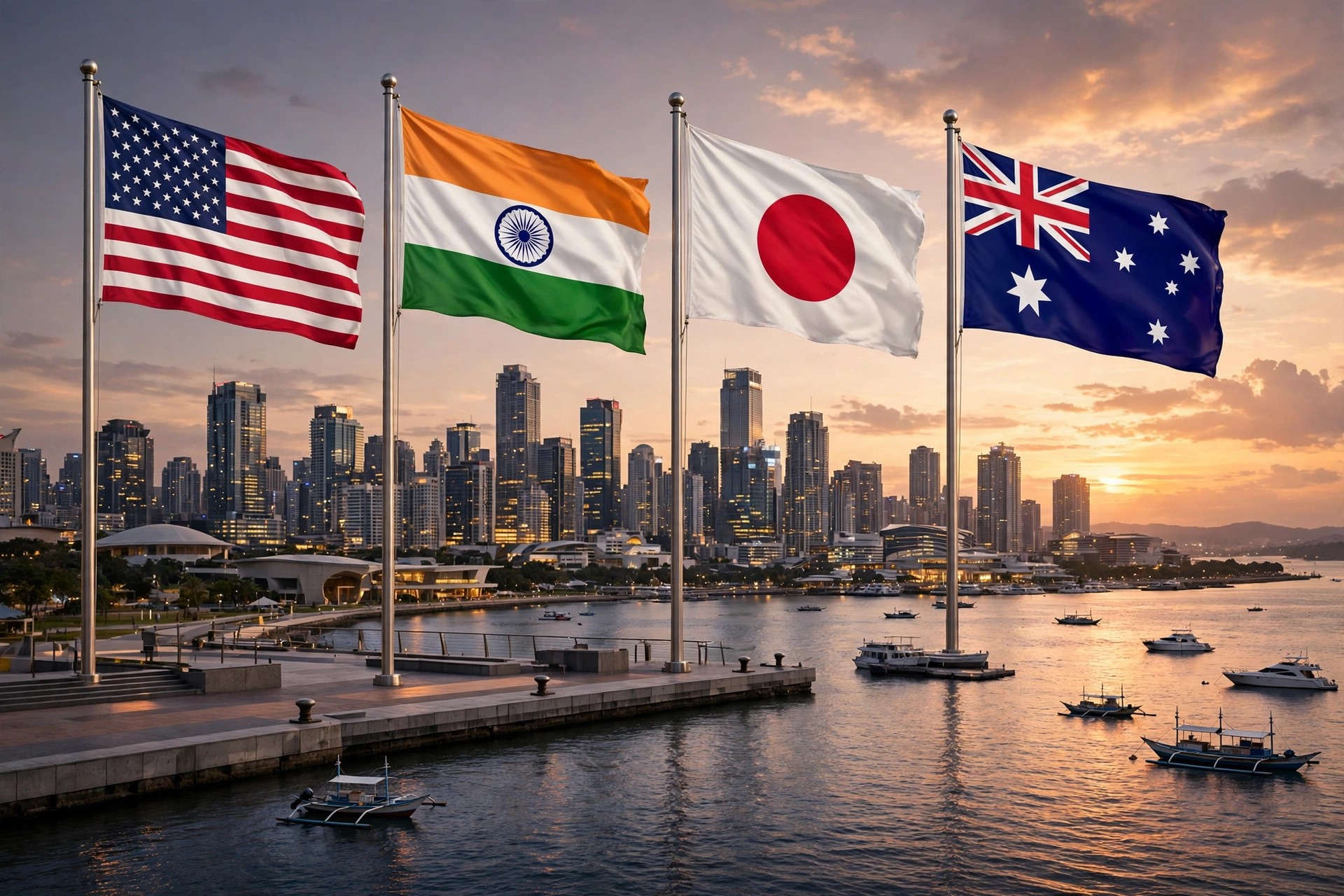
The leaders of the United States, India, Japan and Australia met in Manila on Tuesday, 17 November 2026, for the first leaders-level meeting of the Quadrilateral Security Dialogue, known as the Quad, since President Donald Trump returned to the White House. The meeting brought together Trump, Indian Prime Minister Narendra Modi, Japanese Prime Minister Sanae Takaichi and Australian Prime Minister Anthony Albanese on the sidelines of the Association of Southeast Asian Nations summit in the Philippine capital, ending a gap of more than two years since the four leaders last sat down together in person.
According to the White House schedule, the leaders were due to greet one another and take part in a photograph at 6:20 p.m. at the Solaire Resort in Manila, followed by a multilateral meeting at 6:30 p.m. The discussions were scheduled to begin at 4 p.m. Indian Standard Time. Trump arrived in Manila shortly after 5:30 p.m. local time and went directly to the venue, making the Quad meeting his first substantive engagement of a three-day Asian trip that would take him onward to China for meetings linked to the Asia-Pacific Economic Cooperation forum.
The Manila gathering was significant for its timing as much as for its setting. It was the first time the Quad leaders had met since September 2024, and the first time they had met in a country that is not itself a member of the grouping. It also came at a moment when each of the four governments has been trying to balance closer security and economic cooperation with the pressures of great-power competition, strained supply chains and rapid change in artificial intelligence and other critical technologies. The leaders used the meeting to reaffirm their shared approach to the Indo-Pacific and to announce a set of practical steps, including a new forum for business leaders and further work on maritime security, counterterrorism, undersea cables and cybersecurity.
The Meeting in Manila: Time, Place and Participants
The Quad meeting was held at the Solaire Resort in Manila, in the Parañaque area of Metro Manila, on the evening of Tuesday, 17 November. The White House schedule listed the engagement simply as a meeting of Quad leaders, with a greeting and photograph at 6:20 p.m. and the meeting itself at 6:30 p.m. local time. That timing placed the start of the discussions at 4 p.m. in India, a detail that underlined how closely the event was being followed in New Delhi as well as in Washington, Tokyo and Canberra.
Trump was the last of the four leaders to arrive in Manila. He was welcomed on arrival by Philippine officials and the United States ambassador before travelling to the Solaire Resort. Modi had arrived in the Philippines on Monday, 16 November, for a two-day visit, while Takaichi had also arrived on Monday. Albanese was already in Manila for the ASEAN-related meetings. The four leaders posed together for a group photograph before the talks began, a familiar image for a grouping that has made the leaders-level photograph one of its most visible symbols.
Albanese had confirmed the planned engagement in advance, referring to Trump’s participation in the ASEAN and APEC meetings. Modi, in his departure statement on Monday, confirmed that he would take part in the 23rd ASEAN-India Summit and the 21st East Asia Summit in Manila on 17 November, at the invitation of Philippine President Ferdinand Marcos Jr. He said India’s relationship with ASEAN countries was at the heart of its Act East Policy and occupied a central place in its MAHASAGAR vision, and that he looked forward to exchanging views with participating leaders on strengthening peace, stability and cooperation in the Indo-Pacific.
What the Quad Is and How It Works
The Quad, formally the Quadrilateral Security Dialogue, brings together the United States, India, Japan and Australia. It is not a military alliance and it does not have a secretariat or a treaty. Instead, it is a flexible grouping of four democracies that coordinate on shared interests in the Indo-Pacific, a vast region that stretches from the east coast of Africa through South and Southeast Asia to the Pacific islands and the west coast of the Americas.
The idea of the four countries working together dates back to cooperation after the 2004 Indian Ocean tsunami, and the dialogue was revived at officials’ level in 2017 after a gap of several years. It was elevated to leaders’ level in 2021, when the four heads of government began meeting regularly and issuing joint statements. Since then, the Quad has expanded well beyond its original security focus. Its work now covers maritime security and maritime domain awareness, health security, climate action, critical and emerging technologies, cybersecurity, infrastructure, disaster response and economic security.
The Quad Summit in Manila and Its Expected Agenda
The White House schedule did not specify an agenda for the Quad talks in Manila. That absence was itself notable, because it left analysts and reporters to infer the likely subjects from recent ministerial meetings, public statements and the wider context of the ASEAN week. Reporting before the meeting suggested that discussions were expected to cover regional security, technology, critical minerals, maritime cooperation and investment.
Those expectations were consistent with the direction set by the Quad foreign ministers at their most recent meeting. On 31 October, in Atlanta, Georgia, on the sidelines of the Group of 20 foreign ministers’ meeting, the ministers reviewed progress on existing initiatives and outlined new measures on economic security, critical technologies, maritime safety and regional connectivity. They emphasised that economic security was central to global stability and prosperity, and they reiterated their commitment to developing reliable and open supply chains and trusted, resilient infrastructure.
Critical minerals were a central theme of that ministerial discussion and were expected to feature again in Manila. The four countries have been working to reduce dependence on single suppliers for minerals that are essential to high-technology manufacturing, clean energy and defence. Artificial intelligence was also expected to be prominent, reflecting both its economic importance and the growing competition over the rules and infrastructure that will shape its development. Maritime security, including the sharing of information about shipping, fishing and other activity at sea, has been a Quad priority since the leaders’ level was established, and it remains one of the most concrete areas of cooperation.
A briefing by the Center for Strategic and International Studies on 9 November described the proposed Manila gathering as the first Quad leaders’ meeting of the current United States administration. That description captured the political significance of the event. The previous in-person Quad summit was held in Wilmington, Delaware, on 21 September 2024, under then-President Joe Biden. The declaration issued at that summit had envisaged India hosting the next leaders’ meeting in 2025 and reaffirmed that the Quad was here to stay. India had planned to host the summit last year, but it did not take place, in part because there was no clarity about a visit to India by Trump. The Manila meeting, held on the sidelines of ASEAN rather than as a full stand-alone summit hosted by one of the four members, offered a practical way to bring the leaders together after that delay.
From Ministers to Leaders: The $85 Million AI Pledge in Context
It is important not to confuse the Manila leaders’ meeting with an earlier Quad announcement made at ministerial level. On 1 November, following the foreign ministers’ meeting in Atlanta on 31 October, the four countries said they intended to provide more than $85 million in technical and financial assistance to promote access to trusted artificial intelligence technologies across the Indo-Pacific, including through the Quad AI Accelerator. The United States also committed $10 million for critical minerals recycling facilities in India and Southeast Asia.
That announcement was made by ministers, not by leaders. The ministers involved were Indian External Affairs Minister S. Jaishankar, United States Secretary of State Marco Rubio, Japanese Foreign Minister Toshimitsu Motegi and Australian Foreign Minister Penny Wong. Their joint statement highlighted the importance of artificial intelligence and initiatives such as Pax Silica for future economic growth, and it covered a wider set of issues, including work to identify semiconductor supply chain vulnerabilities, new maritime cooperation activities and disaster response.
The distinction matters because the two events played different roles. The ministerial meeting prepared the ground and put figures and programmes on the table. The leaders’ meeting in Manila was the moment when the four heads of government could endorse that direction, add their own priorities and give the work political momentum. Reporting on the Manila meeting noted that artificial intelligence, critical minerals and maritime security were again part of the discussion, suggesting continuity between the ministerial groundwork and the leaders’ conversation.
The $85 million figure should also be read with care. The joint ministerial statement described an intention to provide more than $85 million in technical and financial assistance, and it did not specify individual country contributions or how the money would be allocated. That is common in Quad announcements, where the headline figure often covers a bundle of existing and new programmes across four governments. The value of the pledge lies less in any single payment than in the signal that the four countries intend to work together on access to trusted artificial intelligence, rather than leaving the field to less open or less reliable suppliers.
What the Leaders Announced in Manila
After the Manila meeting, the leaders announced a set of outcomes spanning economic cooperation, counterterrorism, maritime surveillance, cable connectivity and cybersecurity. India will host the inaugural Quad Business Leaders’ Forum in Mumbai in 2027, a new initiative intended to bring private-sector leaders from the four countries into the Quad’s work. The forum, proposed by India and scheduled for early 2027, is expected to focus on the practical side of economic cooperation, including investment, supply chains and technology partnerships.
The creation of a business forum reflects a broader shift in the Quad’s approach. Early Quad work was driven mainly by governments, but the four countries have increasingly argued that secure supply chains, trusted technology and resilient infrastructure cannot be built by governments alone. A regular meeting of business leaders would give companies a structured way to identify bottlenecks, propose projects and coordinate investment across the four countries and the wider region.
The leaders also issued a joint statement after the meeting in Manila. According to reporting on that statement, the leaders said they strongly opposed any destabilising or unilateral actions that sought to change the status quo, including by force or coercion, which escalated tensions and undermined regional peace and stability. They also expressed grave concerns about economic coercion, including through arbitrary export restrictions. That language echoed the ministers’ statement in Atlanta, which had denounced arbitrary export restrictions, and it pointed to one of the most sensitive issues in the region: the use of trade and supply restrictions as a tool of political pressure.
Modi, speaking at the summit, described the Quad as a constructive and trusted partnership that strived to deliver trusted solutions across the Indo-Pacific, spanning maritime security, supply chains, new technologies and disaster response. He expressed confidence that the meeting would help leaders set concrete goals for the next phase of cooperation. Trump, for his part, told reporters as the leaders gathered that he wanted to ensure the future of artificial intelligence was shaped by countries that shared United States values, a remark that underlined how central technology had become to the Quad’s agenda.
Why the Manila Meeting Matters for the Indo-Pacific
The Manila meeting mattered first because it happened at all. After a gap of more than two years, and after the planned India-hosted summit in 2025 did not take place, there were questions about whether the leaders-level Quad would regain momentum under Trump’s second term. A meeting of all four leaders, even on the sidelines of ASEAN, answered that question in the affirmative. It showed that the grouping remained a priority for the current United States administration, and that the other three members were willing to work within the format even when a full stand-alone summit was not possible.
It mattered second because of where it was held. Manila is not a Quad capital. Holding the meeting in the Philippines, on the sidelines of ASEAN, placed the Quad in the middle of Southeast Asia rather than at a distance from it. That choice carried a message for ASEAN members, some of whom have been wary of great-power competition and anxious not to be forced to choose sides. By meeting in Manila, the Quad leaders signalled that they saw their work as complementary to ASEAN’s central role in the region, rather than as an alternative to it. Modi’s participation in the ASEAN-India Summit and the East Asia Summit on the same day reinforced that point.
Finally, the meeting mattered because of what it revealed about the limits of the Quad. The grouping remains a coordination mechanism, not an alliance, and its members have different interests, different relationships with China and different domestic priorities. India, for example, has its own complex relationship with China and with Russia, and it has been careful to present the Quad as a partnership for development and security rather than as a bloc directed against any one country. Japan and Australia, as treaty allies of the United States, bring a different set of commitments. The United States, under Trump, has pursued a distinctive approach to trade, tariffs and bilateral deals. A single evening meeting cannot resolve those differences, but it can keep the conversation going and keep the practical work moving.
What Comes Next: Shenzhen, APEC and the Road Ahead
After Manila, Trump was scheduled to travel to Shenzhen for the Asia-Pacific Economic Cooperation meetings. The APEC Economic Leaders’ Meeting was due to take place on Wednesday and Thursday, 18 and 19 November, in the southern Chinese tech hub. Trump was also due to meet Philippine President Ferdinand Marcos Jr. in Manila on Wednesday before departing for China.
The Shenzhen leg of the trip was expected to be closely watched for two meetings in particular. Trump was due to hold a bilateral meeting and working lunch with Chinese President Xi Jinping on Thursday, in what would be their third meeting this year as the world’s two largest economies continued to grapple with trade and technology disputes. The two sides extended a trade truce on 9 November, and it now runs until 10 January next year, but they have yet to finalise a plan announced in September to cut tariffs on $60 billion worth of reciprocal trade. The bilateral meeting was therefore seen as a test of whether the truce could be maintained and deepened.
Trump was also due to take part in a trilateral meeting with Xi and Putin on Thursday, 19 November, on the sidelines of the APEC summit. China’s foreign ministry confirmed that Xi would hold a meeting with Putin and Trump in Shenzhen on that date, and the White House and the Kremlin had previously confirmed the three-way meeting. It would be the first trilateral meeting of the leaders of the three nuclear powers. United States officials said Trump wanted to discuss reducing nuclear arsenals and the war in Iran, but was not expected to discuss Russia’s war in Ukraine at that meeting, and no separate bilateral meeting between Trump and Putin was scheduled. The Wall Street Journal has reported that Putin, for his part, has pitched using the meeting to discuss an end to Russia’s war in Ukraine, a reminder that the three leaders would enter the talks with different priorities.
For the Quad, the road ahead will be measured by follow-through rather than by statements. The Business Leaders’ Forum in Mumbai in early 2027 will be an early test of whether the private sector can be drawn into the grouping’s work in a sustained way. The export credit agencies of the four countries were already scheduled to meet in Tokyo on 18 November to coordinate practical steps, and the ministers’ work on semiconductors, critical minerals and maritime cooperation will need to be turned into funded projects. The next leaders’ meeting, whenever and wherever it is held, will be judged in part on whether those projects have moved from announcement to delivery.
Sources
USN reviewed reporting from multiple outlets for this story. Read more from Tribune India, Reuters and Firstpost.