

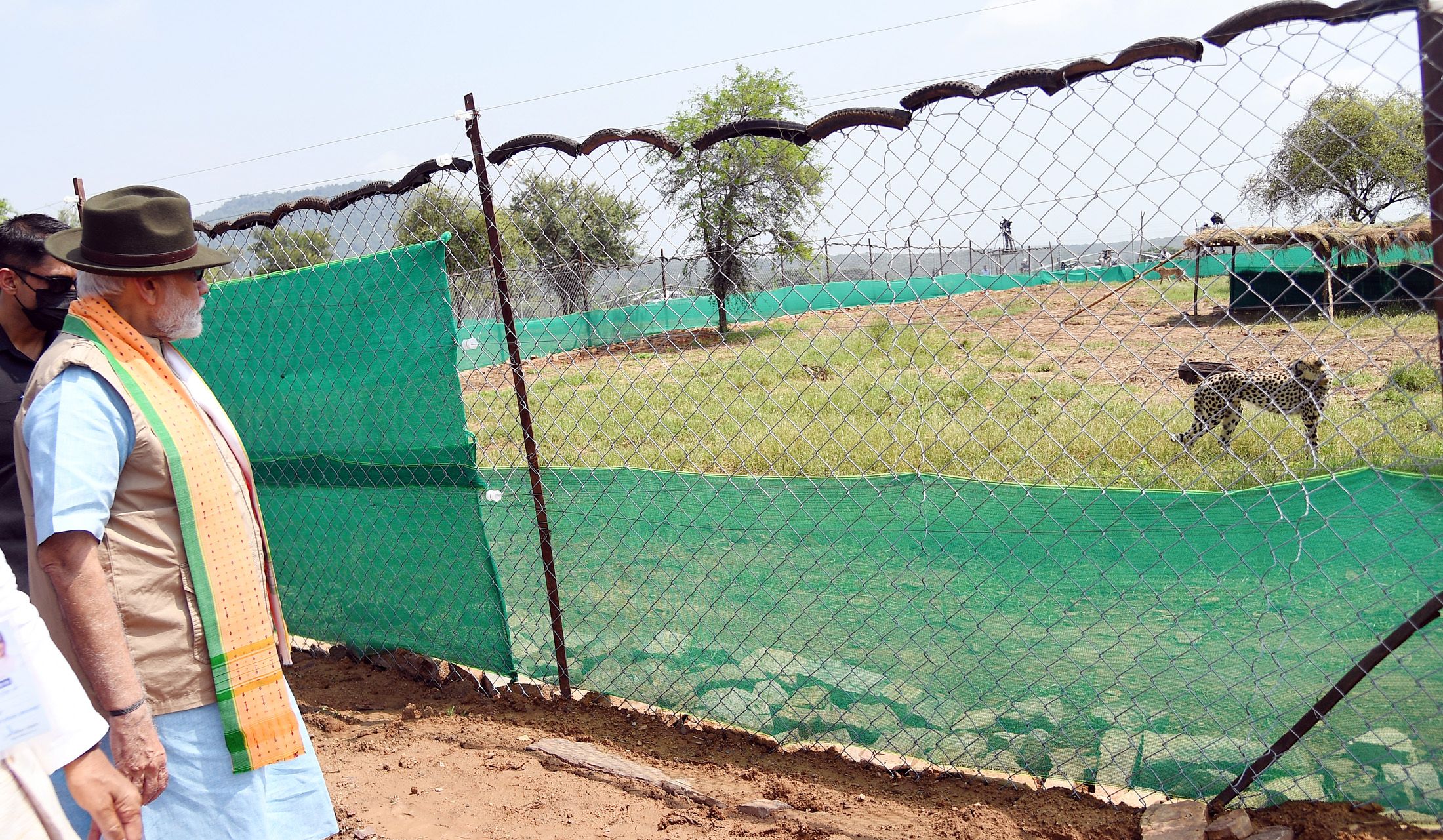
A cheetah brought to India from Botswana has given birth to four healthy cubs in the wild at Kuno National Park, taking India’s cheetah population to 62 and giving Project Cheetah one of its clearest signs yet that the reintroduced animals can breed on their own in Indian conditions. The birth, announced on 20 November 2026, is only the second time since the reintroduction began in 2022 that cheetah cubs have been born outside a monitored enclosure, and the first time a female from the Botswana group has produced a litter in India.
The mother, a two-and-a-half-year-old female identified as KOMG 3, delivered the cubs in the open forest of Kuno, in Madhya Pradesh’s Sheopur district, after spending more than four months roaming free in the wild. Union Minister for Environment, Forest and Climate Change Bhupender Yadav announced the birth on social media, describing it as a landmark moment for Project Cheetah and a proud milestone in India’s journey towards restoring a viable cheetah population. Kuno National Park Director Uttam Kumar Sharma confirmed that all four cubs are healthy.
With the four new arrivals, the ministry said India’s cheetah population has risen to 62, including 43 animals born in the country since the project began. That figure matters because it shows the population is no longer made up mainly of animals flown in from Africa. More than two-thirds of the cheetahs now in India were born here, a shift the project team has been working towards since the first eight animals arrived from Namibia in September 2022.
Four Cubs Born in the Wild at Kuno
The birth took place in the wild, not inside one of the large fenced enclosures where most of Kuno’s cheetahs still live. That distinction is central to the story. KOMG 3 had been living free in the park for more than four months before she gave birth, hunting, moving and choosing her own den site without the daily support that enclosure animals receive. Her cubs were born under natural conditions, which is exactly what the reintroduction programme is designed to achieve.
Minister Yadav said the birth strengthens hope and deepens the commitment to conservation, adding that conservation is a journey of patience, perseverance and collective effort. He also acknowledged the work of the project managers, veterinarians and frontline forest staff who monitor the animals around the clock. Madhya Pradesh Chief Minister Mohan Yadav congratulated the experts, veterinarians and field staff, saying their dedication had helped advance the programme.
The timing adds to the significance. The first recorded wild birth at Kuno came only in April 2026, more than three and a half years after the project began. That litter was lost within a month. The fact that a second wild birth has now followed within seven months suggests that free-ranging breeding, long treated as the programme’s hardest test, is beginning to repeat rather than happening once by chance.
For now, the park’s priority is quiet monitoring. Newborn cubs are at their most vulnerable in the first weeks, and the forest department has not released details of the den site or the cubs’ sexes. What officials have confirmed is that the mother and cubs are being watched through the project’s radio-collar and field-tracking network, and that the four cubs were healthy at the time of the announcement.
Who Is KOMG 3? The Botswana Cheetah Behind the Milestone
KOMG 3 is one of nine cheetahs brought to India from Botswana in February 2026, six females and three males, in the third and most recent translocation under Project Cheetah. She was about two years old when she arrived at Kuno on 28 February 2026, and she is the first female from that Botswana group to give birth in India.
The Botswana animals were added to the programme to widen the gene pool of India’s small cheetah population. The first two groups came from Namibia and South Africa, and wildlife managers have been clear that a population founded on only twenty animals would carry too little genetic diversity to survive in the long term. Adding a third source country, with unrelated bloodlines, was meant to reduce the risk of inbreeding as the Indian-born generations multiply.
The Botswana cheetahs arrived as a gift during the President of India’s visit to Botswana in November 2025, according to reporting on the transfer. Their release at Kuno in February 2026 brought the total number of cheetahs translocated from Africa to 29. KOMG 3’s litter is the first proof that the Botswana animals are not only settling into Indian conditions but reproducing in them.
Her age also matters. At two and a half, she is a young first-time mother, and she gave birth after only a few months in the wild. Project staff will be watching closely to see whether she can keep four cubs alive through their first weeks, when they are most exposed to predators and to the demands of hunting enough food while nursing.
How Project Cheetah Rebuilt India’s Cheetah Population
The cheetah was declared extinct in India in 1952, after the last Asiatic cheetahs vanished from the country’s grasslands and open forests. For seventy years the animal existed in India only in photographs and museum records. Project Cheetah, launched on 17 September 2022 when Prime Minister Narendra Modi released the first eight cheetahs from Namibia into enclosures at Kuno, was an attempt to reverse that loss — the first time anywhere in the world that a large carnivore had been moved between continents for reintroduction.
The programme is run by the Ministry of Environment, Forest and Climate Change through the National Tiger Conservation Authority. Twelve more cheetahs arrived from South Africa in February 2023, and the nine from Botswana followed in February 2026. In total, 29 founder animals were brought to India in three batches.
Breeding began quickly. The first cubs were born on Indian soil in 2023, and by April 2026 officials reported that 49 cubs had been born in 11 litters at Kuno since 2023, with 37 surviving. All seven adult females at the park had produced litters by then. The population count announced by the ministry after each birth or death climbed through the year — 48 in February 2026, 53 in March, 57 in April — before reaching 62 with KOMG 3’s litter.
The composition of that total has changed steadily. When the project began, every cheetah in India was an import. Today, 43 of the 62 were born in India, including second-generation animals whose parents were themselves born at Kuno. In November 2025, a female named Mukhi became the first Indian-born cheetah to give birth, delivering five cubs in an enclosure. The programme’s goal, in the ministry’s own words, is a viable, self-sustaining population — one that grows through births in India rather than through further imports.
The cheetah is listed as Vulnerable by the International Union for Conservation of Nature and is protected under Appendix I of the Convention on International Trade in Endangered Species of Wild Fauna and Flora, which bans commercial trade. India sourced Southeast African cheetahs, a different subspecies from the Asiatic cheetah that once lived here, because no Asiatic cheetahs survive in the wild in numbers that could supply a reintroduction.
The First Wild Birth — and the Hard Lessons of 2026
KOMG 3’s litter is the second recorded wild birth under Project Cheetah. The first came on 11 April 2026, when an Indian-born female known as KGP12, the 25-month-old daughter of the South African cheetah Gamini, gave birth to four cubs in the wild at Kuno. It was the first time a cheetah had given birth outside an enclosure since the reintroduction began, and the first involving an Indian-born female.
That milestone ended badly. About a month later, on 12 May 2026, the monitoring team found all four cubs dead near their mother’s den, in the Sheopur territorial forest outside the national park. The cubs had bite marks and deep wounds, and officials said preliminary evidence pointed to an attack by a leopard. The loss was a sharp reminder that wild births, however welcome, do not guarantee survival — cubs born in the open face the same predators that wild cheetahs have always faced.
KGP12 herself recovered and gave birth again on 18 September 2026, this time to four cubs inside a secured enclosure, becoming the first Indian-born cheetah to produce two litters in less than six months. Her story captures both sides of the project in a single year: a historic first, a painful loss, and a second chance.
2026 has brought other setbacks. By late September, officials reported that 24 cheetahs, adults and cubs combined, had died since the project began. Eight of those deaths came in 2023, the programme’s first year, from causes including kidney disease, a fatal injury during mating, septicaemia following maggot infestation in collar-related wounds, and heart failure. A cub born to the female Asha died on 12 October 2026, and on 27 October a 19-month-old cub known as KNG22, the offspring of the female Nirva, died after being found injured outside Kuno with five firearm pellets in its body. It was the first reported case of a cheetah being fatally shot since the project began. The Centre dispatched a high-level team to investigate, and the Madhya Pradesh government constituted a Special Task Force. The investigation into who fired the shots was still under way at the time of the latest birth.
None of this makes the new litter less significant, but it does set the right measure for it. A birth is a beginning, not a verdict. The test for KOMG 3’s cubs will be the coming weeks, when the park’s monitoring team will be watching for the same dangers — predators, straying beyond the protected area, and the sheer difficulty of raising four cubs in the wild — that ended the first wild litter.
Why a Wild Birth Matters More Than an Enclosure Litter
Most of the cubs born at Kuno so far arrived inside large fenced enclosures, where food is provided, veterinary care is close at hand and predators are kept out. Those births prove that the animals can breed in India. A wild birth proves something harder: that a cheetah can choose a mate, find a den, hunt for herself and raise cubs without that support.
That is the core objective the ministry and the park’s field director have repeatedly described — survival and breeding under natural conditions. A self-sustaining population cannot be built from enclosure litters alone, because animals that never leave managed care never learn, or never prove they have learned, the skills a wild population needs. Each wild litter is therefore treated as evidence that the reintroduction is moving from a managed breeding exercise towards a functioning wild population.
There is also a practical reason the distinction matters. Kuno’s enclosures are limited in size, and the long-term plan has always been to move cheetahs out of them and into the wider landscape. Animals born in the wild arrive already adapted to that landscape. They know its water sources, its prey and its dangers, and they do not need to be taught to live outside a fence.
The risks run the other way too. Cheetahs that roam free can wander beyond the park boundary, as KNG22 did before it was shot, and they can come into contact with leopards, villages and livestock. The project’s radio collars and drone surveillance exist precisely to track those movements, and the forest department has been expanding the protected landscape so that free-ranging cheetahs have somewhere safe to go. The balance between freedom and protection is the central management question of the programme’s next phase, and KOMG 3’s cubs will grow up inside it.
Beyond Kuno: Gandhi Sagar, Nauradehi and the Search for a Second Home
One park cannot carry the whole programme. Kuno holds most of India’s cheetahs — 59 of the 62 animals, according to reporting on the latest count — but managers have been developing other sites so that the population is not concentrated in a single forest. Three cheetahs are now at Gandhi Sagar Wildlife Sanctuary, also in Madhya Pradesh, which is being developed as a second home for the species with a fenced area of about 65 square kilometres.
A third site is also being prepared. Nauradehi, now part of the Veerangana Durgavati Tiger Reserve, is being developed as another habitat to spread the population across a wider area, and a 418-hectare enclosure has been built there. Madhav National Park has also been mentioned in planning for the programme’s expansion. The idea is a meta-population: several connected groups of cheetahs in different places, so that a disease outbreak, a drought or a local predator problem in one park cannot wipe out the whole recovery.
Expansion is also a response to space. Cheetahs are wide-ranging animals, and a growing population needs more ground than Kuno alone can offer. The ministry has been working with the Madhya Pradesh government on habitat preparation, prey availability and corridor protection around the new sites, as well as on measures to reduce conflict where cheetahs move near villages and farms.
The programme’s history shows why spreading the risk matters. The heavy losses of 2023, when eight animals died in the first year, were concentrated at Kuno. A second and third site give managers somewhere to move animals when a single park comes under pressure, and give the cheetahs themselves room to establish separate breeding groups. KOMG 3’s cubs, if they survive, will eventually need that room too.
What Happens Next for the Four Cubs
The immediate future of the four cubs depends on their first weeks. Cheetah cubs are born blind and helpless, and their mother must leave them hidden while she hunts, returning to nurse them several times a day. In the wild, that pattern makes them vulnerable to leopards and other predators, as the April 2026 litter showed. The park’s monitoring team will be tracking KOMG 3’s movements and watching the den area, while keeping its distance so as not to disturb her.
If the cubs survive their first months, they will stay with their mother for well over a year, learning to hunt before dispersing to establish their own ranges. The park will record their growth, their health and, eventually, whether they breed in their turn. Each of those steps adds to the evidence that the Botswana bloodline, like the Namibian and South African lines before it, can take root in India.
The wider programme faces decisions of its own. Officials have not announced any further translocations from Africa, and the emphasis in recent statements has been on breeding within India and expanding the available habitat. Whether the population can keep growing from its current 62 animals without new imports is the question that will define the next phase — and the answer will come, one litter at a time, from mothers like KOMG 3.
For now, the four cubs at Kuno are the newest sign that a species declared extinct in India seventy-four years ago is, slowly and unevenly, coming back. The birth was announced with pride by the ministry and the state government, and it was welcomed as proof that the patience the project demands is producing results. The harder proof — four cubs alive, healthy and free-ranging months from now — is still to come.
Sources
USN reviewed reporting from multiple outlets for this story. Read more from Press Information Bureau, The Hindu and The Indian Express.