

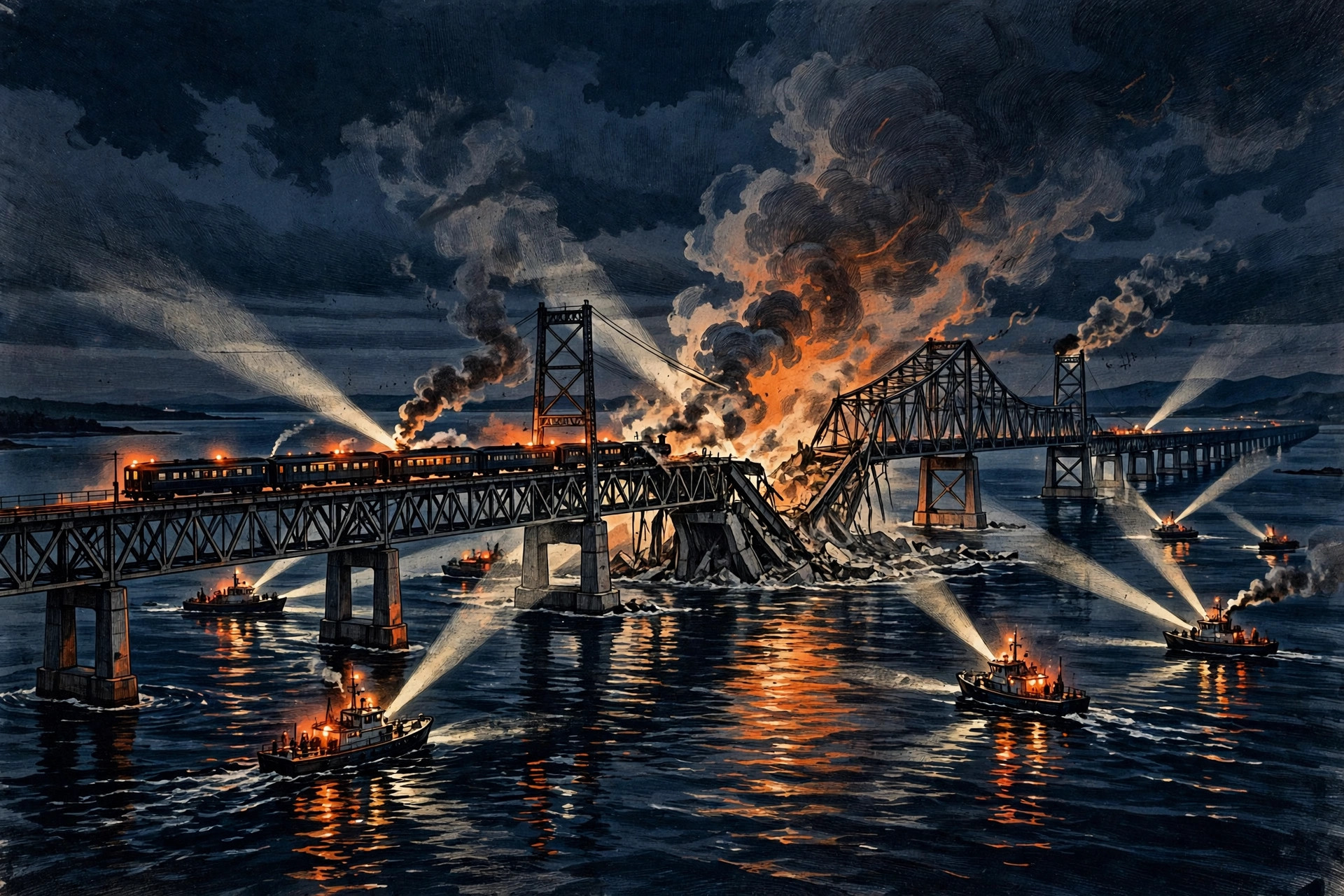
KYIV — A third Ukrainian aerial attack in four days on the Kerch Bridge linking Russia to Russian-held Crimea halted rail traffic across the span on Thursday, 19 November 2026, officials said, after earlier strikes had shut down the road section of the landmark that is a symbol of Moscow’s hold on the peninsula. Train traffic stopped after the overnight strike while authorities assessed the damage, but it resumed in the afternoon, according to Russian state news agency RIA Novosti. Later reporting showed the resumption was limited, with trains running on only one of the bridge’s two tracks at reduced speed. The Moscow-appointed head of Crimea, Sergei Aksyonov, had said earlier in the day that services were expected to be restored from around 4 p.m. local time. Ukraine’s Defence Ministry said the latest attack used domestically produced Neptune missiles and damaged the train track, with hits recorded near the arch and the railway tracks. The extent of the damage was still being assessed when the trains began running again, and the full cost of three attacks in four days on a single crossing was not yet clear.
The 19-kilometre bridge is a key route for military and civilian supplies to Crimea, which Moscow seized in defiance of international law in 2014 and uses to support front-line troops in southern Ukraine. It is also, in the words of several reports, a potent symbol of Russia’s annexation — the physical link between the Russian mainland and the peninsula, opened with great ceremony and presented by Moscow as proof that Crimea was permanently Russian. That symbolism is part of why Ukraine has targeted it repeatedly, and why each strike is reported so widely. The latest attack was the third in a sustained operation that, according to Ukrainian President Volodymyr Zelenskyy, unfolded over seven stages across several weeks, culminating in the collapse of a large section of the road deck and an arch earlier in the week. The rail strike on 19 November showed that the campaign was not over, and that the bridge’s railway — believed to be stronger than the road section, because it must bear the weight of cargo wagons — was now the target.
How the Kerch Bridge rail strike unfolded overnight
The strike came overnight on 18–19 November, when explosions were heard over the Kerch Strait and in the city of Kerch itself. Ukraine’s Defence Ministry said its forces had struck the railway section of the bridge with Neptune coastal missile systems, and that hits had been recorded near the arch and the railway tracks. “The extent of the damage is being clarified, but train traffic has currently been halted,” the ministry said in a statement. Russia’s Transport Ministry announced in the morning that train services on the railway section had been temporarily suspended as a result of an overnight drone attack, and specialists were sent to assess the damage. Aksyonov, the Moscow-appointed head of Crimea, confirmed the suspension and said traffic was expected to resume from around 4 p.m. local time, or 1300 GMT, on Thursday.
By the afternoon, RIA Novosti reported that train traffic had resumed. That quick resumption does not necessarily mean the damage was slight. The rail section is built to carry heavy freight, and a single point of impact — as satellite imagery and monitoring channels suggested in this case — can halt traffic while engineers check the track, the arch and the supporting structure, even if the bridge is not destroyed. Ukrainian monitoring channels published satellite images after the strike, and analysts said the images showed damage to the road deck and to the rail section, though the full extent could not be independently verified from the images alone. The Kyiv Independent, which said it could not independently verify the extent of the damage, reported that the attacks on the bridge involved more than 16 strikes using multiple weapon systems, according to Ukrainian defence company Fire Point. What is clear is that the railway was the target on 19 November, that traffic stopped, and that it started again within hours — a pattern that has repeated across the week, as each strike has been followed by a Russian effort to restore movement as quickly as possible.
Three strikes in four days: 16, 17 and 19 November
The 19 November strike was the third attack on the bridge in four days, and it followed two earlier strikes that had already done serious damage. On 16 November, drones hit the crossing, and satellite images taken that day showed two areas of impact. On the night of 16–17 November, the operation reached its most destructive stage so far: a large section of the road deck and an arch collapsed, according to Zelenskyy, in what he described as the culmination of weeks of preparatory strikes over seven stages. Ukrainian forces used a mix of weapons in that operation, including Palianytsia drones, Neptune missiles, Ruta and FP-1 drones and a Flamingo missile, according to Zelenskyy and Ukrainian officials. The road section was shut, and the rail section was also hit, though rail traffic had resumed by the next day.
The sequence matters, because it shows a deliberate campaign rather than a series of isolated attacks. The first strike tested the defences and caused limited damage. The second, on the night of 16–17 November, was the main blow, collapsing the road deck and the arch and closing the road. The third, on 19 November, returned to the railway, which had kept running after the second strike, and halted it. Ukraine’s Defence Ministry described the latest attack as a response to Russian strikes on Ukraine, and said the bridge was the main land route through which the Russian army supplies its occupation forces in southern Ukraine with fuel, ammunition and military equipment. “Now Russia will need to reroute fuel and ammunition supplies over land, where ‘our drones are waiting for the cargo,’” the ministry said. Russian occupation authorities, meanwhile, announced ferry services between the ports of Krym and Kavkaz across the Kerch Strait, with the first trips expected on 20 November and offered free to passengers — a sign that Moscow was preparing for a period in which the bridge could not be relied on for normal crossings.
Why the 19-kilometre bridge matters so much
The Kerch Bridge, also known as the Crimean Bridge, is 19 kilometres long, making it the longest bridge in Europe. It connects Russia’s Krasnodar Krai, on the Taman Peninsula, with Crimea across the Kerch Strait, and it carries both a four-lane road and a double-track railway. It was built after Russia’s illegal occupation of Crimea in 2014 and opened to road traffic in 2018 and rail traffic in 2019, at a cost of billions of dollars. For Moscow, it was a flagship project: a concrete demonstration that Crimea was integrated into Russia, and a practical link for moving people, goods, fuel and military supplies to the peninsula without relying on ferries or on a land corridor through territory that Ukraine still contests.
For Ukraine, that practical role is precisely the problem. Crimea is used by Russia to support front-line troops in southern Ukraine, and the bridge is the most direct route for fuel, ammunition and military equipment to reach those forces. Cutting it, or even disrupting it repeatedly, forces Russia to reroute supplies over land, through territory where Ukrainian drones operate, or by sea, where ferries are slower and more vulnerable. That is why Kyiv has targeted the bridge since the full-scale invasion began, and why the strikes of November 2026 are the latest in a long series. The bridge has been attacked before, in 2022 and 2023, and each time Russia has repaired it and restored traffic. The question after the latest strikes is not whether Russia will repair it — Putin has already vowed to rebuild the road side — but how long repairs will take and whether Ukraine can strike it again before they are complete. For Moscow, the bridge is proof of permanence; for Kyiv, it is proof that nothing Russia built in Crimea is safe.
Putin vows retaliation and says the road side is seriously damaged
Russian President Vladimir Putin vowed retaliation for the strikes, speaking to reporters in Shenzhen, China, where he was attending the APEC summit. “We will respond to these attacks, and I want everyone to be clear about that,” Putin said. He insisted the bridge is a civilian asset, adding that he had ordered the bridge closed to the transport of military hardware or ammunition. He also said the road side of the bridge had been “seriously damaged” but vowed to rebuild it. The claim that the bridge is a civilian asset is disputed by Ukraine, which says the bridge is a military supply route and a legitimate target. The order to close it to military transport, if it is carried out, would itself be an admission that the bridge’s military role is central to the dispute — and it would raise the question of how Russia would supply its forces in Crimea without it.
Putin also used the Shenzhen appearance to close the door on a partial ceasefire. He said he had discussed with Russia’s Security Council the possibility of halting strikes on energy infrastructure and on shipping in the Black Sea, but that after the bridge strikes there would be no negotiations on such a truce. “I believe our retaliatory actions will be far more painful than what the Kyiv regime did to the bridge,” he said. He also said the railway section had already been restored, a claim Ukrainian reports and satellite imagery contradicted, showing track damage and an interrupted rail service.
Putin’s response was part of a wider pattern in which the bridge strikes have become a political as well as a military issue in Moscow. The bridge was a personal project for Putin, who drove a truck across it at its opening, and attacks on it are presented in Russian state media as attacks on Russia itself. The vow of retaliation was therefore expected, but its form was not specified, and it was not clear on 19 November what retaliation would involve, or when it would come. What was clear was that the strikes had embarrassed the Kremlin at a moment when Putin was abroad, presenting himself as a peacemaker on the world stage, and that they had demonstrated that Ukraine retained the ability to strike deep into territory Russia controls. That demonstration, as much as the physical damage, was the point of the operation, according to Ukrainian officials and analysts: to show that Kyiv still holds cards in the war, and to undermine Russia’s argument that its victory is inevitable.
Russia reports 53 drones intercepted and civilian deaths in Saratov and Bryansk
Russia’s Defence Ministry said on Thursday, 19 November, that its air defences had intercepted 53 Ukrainian drones over 10 Russian regions during the night. The figure, which could not be independently verified, was part of a wider account of overnight fighting in which both sides reported large-scale drone and missile attacks. The ministry’s statement did not say how many drones had got through, or where, and it did not address the bridge strike directly, beyond the Transport Ministry’s announcement that rail traffic had been suspended after an overnight drone attack. The gap between the claim of 53 interceptions and a successful strike on the bridge illustrates a familiar feature of this war: both sides claim success in air defence, and both suffer damage from the attacks that get through.
The drone figure also underlines the scale of the overnight exchange. Fifty-three drones over 10 regions is a large attack, even by the standards of a war in which nightly drone raids have become routine. It suggests that the bridge strike was not an isolated operation, but part of a broader Ukrainian effort to hit targets across Russia on the same night. The Russian authorities reported civilian casualties from the Ukrainian attacks, and those reports — attributed to named regional governors — are set out below. They should be read alongside the Ukrainian reports of Russian attacks on Ukraine, which are set out after them, because the two sets of figures come from opposing sides in an active war, and neither can be independently verified in full on the day they are reported.
Ukrainian attacks on Russia killed four civilians, according to Russian officials, whose figures are reported here as their claims, not as independently verified facts. A Ukrainian attack on Russia’s Saratov region killed three people and wounded two others, local Governor Roman Busargin said. A drone killed a woman travelling by bicycle with her 8-year-old grandson in the Bryansk region, Governor Egor Kovalchuk said. The reports did not say, in the accounts available on 19 November, whether the boy was also killed or wounded, and that detail should not be assumed. The two incidents, in regions far from the front line, illustrate how the war has spread beyond the battlefield: drones that can reach the Kerch Bridge can also reach cities and villages across western and southern Russia, and civilian areas are at risk from both the drones themselves and from falling debris when air defences intercept them.
The Russian figures should be treated with the same caution as any casualty claim by a party to the conflict. Governors in Russia are often the only source for such figures, because independent journalists have limited access to the affected areas; the same is true, in reverse, for Ukrainian reports of Russian attacks. What can be said with confidence is that civilians are being killed on both sides. For Moscow, the Saratov and Bryansk reports were a counterpoint to the bridge strike: evidence, in the Kremlin’s telling, that Ukraine was attacking civilians as well as infrastructure. Kyiv says its strikes are aimed at military targets and infrastructure supporting the Russian war effort, and that it does not deliberately target civilians — a claim that, like Moscow’s, cannot be independently verified in each case.
Ukraine says Russia fired 98 drones and missiles
Ukrainian authorities said that Russia launched anti-ship missiles and 98 drones at Ukraine overnight, with hits recorded at 18 locations. Explosions and sirens rang out across Kyiv during the day, and the Dutch and Austrian embassies sustained minor damage, officials said. Two people, including a 44-year-old woman, were killed and at least 23 people, including a 12-year-old boy, were reported wounded as Russian strikes caused damage in 12 regions, according to Ukrainian officials. The figures are attributed to Ukrainian authorities, and, like the Russian figures above, they have not been independently verified in full. They are, however, consistent with the pattern of Russian attacks in recent weeks, which have placed a particular emphasis on knocking out power and other infrastructure ahead of winter, and on wearing down Ukraine’s resistance through sustained bombardment.
The Russian campaign against Ukrainian infrastructure is now a central feature of the war. Moscow has resorted to strategic bombing to wear down Ukraine’s resistance, placing special emphasis on knocking out power ahead of winter, while Kyiv’s long-range drones and missiles have struck deep inside Russia, often targeting oil refineries. The exchange on 18–19 November fits that pattern — except for the bridge. A strike on a power station can be repaired, but a strike that collapses a bridge deck and halts rail traffic on the main link to Crimea is harder to hide and harder to repair quickly. That is why the bridge strikes have attracted so much attention: for Ukraine, the bridge is a target whose damage is visible, whose repair is slow, and whose disruption directly affects Russia’s ability to supply its forces in the south.
Five days on: one rail track, no road, and fuel queues in Crimea
By Friday, 20 November, the picture was clearer — and bleaker for Moscow than the first reports of a resumed rail service had suggested. Deputy Prime Minister Marat Khusnullin, the Russian official overseeing the repairs, said there was still no timeline for restoring the bridge, that both the arch and the main girder had been damaged, and that only some elements might reopen in one to two months. Rail service had resumed, but on one track and at slow speed, and the road section remained closed. Russia’s government announced up to 20 billion rubles from its reserve fund for the R-280 highway and a bypass around Mariupol through occupied southern Ukraine, money for the overland route drivers are now being diverted onto. The ferries meant to replace the crossing fared no better: a storm halted them, and the launch of the free passenger boats between Krym and Kavkaz was postponed.
For people living in occupied Crimea, the disruption quickly became a daily hardship. By Monday, 23 November, only one rail track was usable, with seven pairs of suburban trains carrying about 2,000 passengers in one direction — against road traffic that had carried up to 10,000 people a day before the strikes. Residents described long queues at ATMs, multi-day power cuts, suspended passport services and restricted sales of basic groceries, according to Ukrainian public broadcaster Suspilne and the Association for the Reintegration of Crimea. Fuel ran short as well: drivers queued at filling stations and bought fuel in bulk, and the Russian-installed authorities in Sevastopol restricted sales to one full tank plus 20 litres in canisters at the peninsula’s two largest fuel chains, according to reporting by The New Voice of Ukraine.
Military analysts warned the squeeze would deepen. The Institute for the Study of War assessed on 22 November that the strikes would likely hamper Russian logistics and transport links to occupied Crimea, citing Ukrainian Navy spokesman Dmytro Pletenchuk, who said Russia had nothing that could replace the bridge as a transport link and warned that Russian forces in Crimea could run short of fuel, drones and military aviation supplies within weeks as existing stocks were used up. Independent analysts cited by the Kyiv Post estimated that restoring the custom arch and road span would take at least a year, and more likely two, under favourable conditions — and longer if Ukraine kept striking repair work, which Kyiv has shown every sign of doing.
What happens next for the bridge and the fighting
As of Monday, 23 November, the immediate situation was clear, but the longer-term picture was not. Rail traffic was running again, but only on one track and at reduced speed, while the road section remained closed after the collapse of the deck and the arch on 17 November, and the full extent of the damage to the rail section was still being assessed. Ferry services between Krym and Kavkaz, due to begin on 20 November, were disrupted by storms, and ferries cannot replace a bridge for freight in any case — they are slower and more vulnerable to attack. Russia will need to repair the road deck and the arch, and to check and repair the rail track, before the bridge can return to normal use. How long that will take is not yet known — the deputy prime minister overseeing the work has given no timeline beyond one to two months for some elements — and it will depend on the extent of the damage, the availability of materials and engineers, and whether Ukraine strikes the bridge again while repairs are under way.
The wider fighting is likely to continue on the same pattern: Russian attacks on Ukrainian cities and infrastructure, Ukrainian attacks on Russian targets including energy infrastructure and the bridge, and a grinding front-line war in which Russia’s larger army hopes to exhaust Ukraine, while Kyiv’s defences hold it back with drones that choke off troop advances. The bridge strikes do not change that pattern, but they show Ukraine can still hit a target of great symbolic and practical importance, three times in four days, and that Russia cannot fully protect it. Whether the strikes lastingly disrupt Russian supplies to Crimea, or Russia repairs the bridge and restores traffic, will be known in the days ahead, in satellite images and train timetables. For now, the bridge stands damaged, the trains are running again, the road is closed, and the war goes on.
Sources
USN reviewed reporting from multiple outlets for this story. Read more from The Straits Times, The New Voice of Ukraine and Kyiv Independent.