

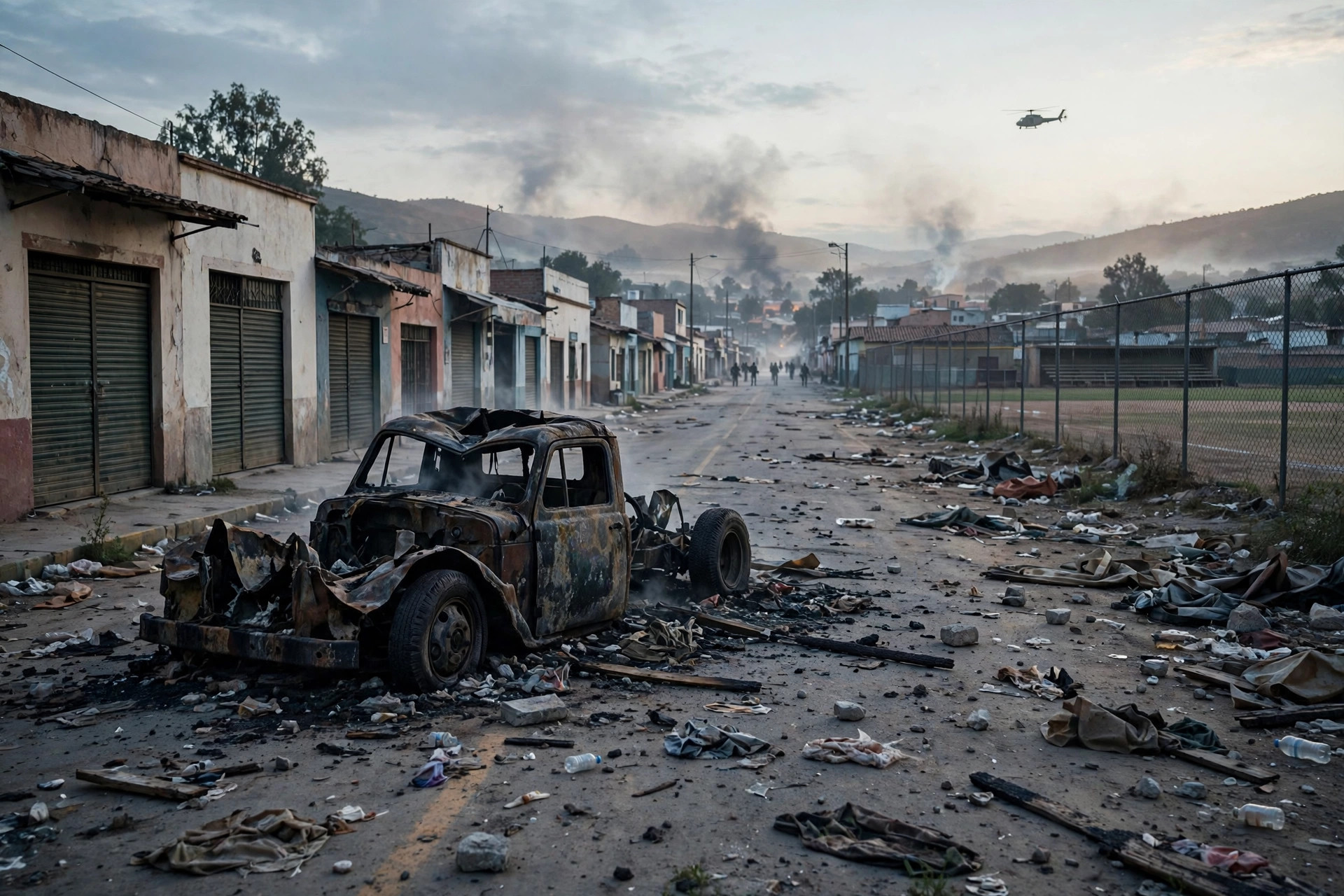
GUASAVE, Mexico — Mexican special forces captured Fausto Isidro Meza Flores, known as “El Chapo Isidro” and one of the FBI’s 10 most-wanted fugitives, in an overnight raid in the north-western state of Sinaloa that left 20 people dead and a city terrorised. Meza Flores, 44, was arrested on Friday night, 20 November 2026, after security forces faced fierce resistance from suspected cartel gunmen in the town of Guasave, and was flown to Mexico City on Saturday, 21 November, to appear before prosecutors. Mexican officials said on Monday, 23 November, that 16 suspected cartel gunmen and four Mexican soldiers were killed in the operation, revising an earlier toll of 11 dead. The raid triggered hours of gunfire, roadblocks and burning vehicles across the city. The capture, carried out with intelligence support from the United States, was celebrated in both capitals as a major blow against organised crime — and immediately raised fears of more violence in a region already torn by a power struggle between rival cartel factions.
The operation began at around 7 p.m. on Friday, when elite units of the Mexican Army and the National Guard moved on a building in Guasave where Meza Flores was believed to be hiding. According to Mexican authorities, the forces used “stealth and surprise”, establishing a security perimeter around the building before moving in. They came under attack with guns and explosives from suspected cartel operatives, and troops then entered the home and detained him. What followed was hours of fighting across the city of about 290,000 people. Military helicopters and drones flew overhead, and helicopters opened fire on locations across Guasave. A professional baseball game was suspended as spectators fled gunfire inside the stadium. Videos circulating on social media showed screaming civilians running for cover, burning cars and businesses, and helicopters firing from above. “The fighting was happening all over Guasave,” said Alma Camacho, a Guasave resident and local journalist. “It spread throughout the city.”
Because of the violence, the Mexican army and National Guard special forces were unable to extract Meza Flores from Guasave until around 4 a.m. on Saturday, a federal official told reporters on condition of anonymity because he was not authorised to discuss the operation. The official described an intense response by members of the criminal group, who maintained at least 10 roadblocks with burning vehicles on the city’s streets. Video shared by Mexico’s Defence Ministry showed Meza Flores and two others being marched by heavily armed soldiers onto a military aircraft. Eight people were detained in total, according to authorities, including Meza Flores, his alleged deputy, identified as German N and known as “Serafín”, and an alleged financial operator, identified as Jose N. The three senior members were handed over to prosecutors. Troops recovered a .50-calibre rifle, a grenade launcher, grenades, other firearms, drugs and cash, the Defence Ministry said. No civilian casualties were reported, according to the ministry — a claim that could not be independently verified in the immediate aftermath, when residents were still sheltering indoors and firefighters had yet to reach many of the burning sites.
A night of terror in Guasave after the El Chapo Isidro raid
For the people of Guasave, the operation was not a distant military manoeuvre but a night spent sheltering from gunfire. Paola Sanchez, a Guasave resident and firefighter, said thousands of people were terrorised late on Friday as they took shelter from intense gunfire in grocery stores and other locations. “Last night, many businesses were burned … along with cars and trucks,” she told The Associated Press. She said the city’s firefighters had to take shelter at their station and wait until Saturday morning for orders from their superiors to dispatch the first crews to check whether any businesses or vehicles were still burning. Burned-out trucks continued to line the freeway leading into the town on Saturday, blocking roadways, and residents described several convenience stores of the Oxxo chain as completely burned down. “The aftermath of last night’s war still lingers. Burned cars in the streets, several Oxxo stores completely burned down,” Camacho said. She said Guasave residents remained “very afraid” because security forces were absent from the streets.
An uneasy calm seemed to settle over the city on Saturday, but the fear did not lift. Mexican Security Secretary Omar García Harfuch wrote on social media on Saturday morning that armed forces would remain deployed in Sinaloa state to protect civilians, and he lamented the deaths of the four soldiers killed in the operation. The Defence Ministry said the four soldiers were from the army’s regular infantry and were en route to provide security reinforcements in Guasave when they were killed. Such shows of force by cartels are common following the capture or killing of leaders, and the pattern in Guasave — roadblocks, arson and attacks on businesses — followed a familiar script. What was different was the scale: a full night of fighting in a city of nearly 300,000 people, with helicopters firing over residential streets and a baseball stadium emptied by gunfire. Another unverified video that circulated overnight appeared to show Meza Flores in detention, asking his associates to stand down and warning that “children, women, innocent people” could be put at risk. That footage has not been authenticated, and its contents should be treated with caution.
Who is Fausto Isidro Meza Flores, the FBI most-wanted fugitive?
Meza Flores rose through the ranks of the Beltrán Leyva cartel before breaking away to lead his own organisation, known as the Meza-Flores Transnational Criminal Organization, also referred to as Los Mazatlecos. He is accused by US and Mexican authorities of leading a drug-trafficking organisation affiliated with the Beltrán Leyva cartel, and his group was allied with Los Mayos, one of the rival factions within the Sinaloa Cartel. The United States designated the Sinaloa Cartel as a foreign terrorist organisation last year. The US State Department had offered a reward of up to US$5 million for information leading to his arrest, and he was placed on the FBI’s list of 10 most-wanted fugitives. He is wanted by US authorities for allegedly possessing, distributing and smuggling large shipments of heroin, methamphetamine, cocaine, fentanyl and marijuana into the United States, and for illegally carrying firearms. He faces criminal charges in both the United States and Mexico.
The nickname “El Chapo Isidro” invites comparison with Joaquín “El Chapo” Guzmán, the former Sinaloa Cartel leader who was extradited to the United States in 2017 and is serving a life sentence. The two men are not the same, and the nickname reflects Meza Flores’s standing in the criminal underworld of Sinaloa rather than any formal succession. His organisation operated in the same terrain — the coastal and mountain corridors of Sinaloa through which drugs move north towards the United States — and his capture removes one of the most prominent figures in that landscape. His detention also comes amid a series of high-profile cases involving Sinaloa Cartel figures. In July 2026, Ismael “El Mayo” Zambada, a longtime cartel leader and former associate of Guzmán, was sentenced to life imprisonment in New York. Earlier in 2026, Jalisco New Generation Cartel leader Nemesio Oseguera Cervantes, known as “El Mencho”, was killed by the military in February. Each of those cases was presented by the authorities as a decisive blow; each was followed by warnings that the violence would continue.
US intelligence support and the Trump pressure on Mexico
The Mexican government said in a report early on Saturday that intelligence from the Trump administration helped authorities capture Meza Flores, but provided few details about how authorities in Mexico and the United States coordinated the operation. The Mexican military said the operation followed coordination with US intelligence agencies as part of bilateral cooperation. The US Department of Justice welcomed the arrest on Saturday, saying the operation had been supported by a combined interagency effort, including the Homeland Security Task Force. US Attorney General Todd Blanche described the arrest as the result of bilateral cooperation and offered condolences to the families of the four Mexican soldiers killed. The US Drug Enforcement Administration also commended Mexican authorities, calling the arrest a significant victory against one of Mexico’s most violent criminal networks. “Results like these don’t happen overnight. They are built on sustained cooperation and trust. This is what partners can accomplish together,” US Ambassador Ronald Johnson said in a social media post. “We will continue the hunt.”
The capture comes amid intense pressure from US President Donald Trump on Mexican President Claudia Sheinbaum to intensify action against drug cartels. Trump has repeatedly said the cartels are running Mexico, telling reporters at the White House on Friday: “We’re working with her on the cartels because the cartels are running Mexico.” Sheinbaum met Trump on the sidelines of a summit in Asia earlier in the week, and the US president said on Friday that the two leaders had discussed trade and security, including cooperation against drug cartels. Sheinbaum has pursued a more aggressive crackdown on criminal groups than her predecessors, and homicides in Mexico have declined significantly during her two years in office, according to reporting on the operation. Her government has targeted a number of cartel kingpins, and Meza Flores’s detention marks another high-profile capture in that campaign. García Harfuch called the detention “an important step in pacifying Sinaloa”.
The cooperation, however, is not without tension. Earlier in 2026, Sheinbaum faced political pressure after reports emerged that US intelligence personnel had been operating in Mexico without her government’s approval, following a road accident that killed two people reportedly working for the CIA. The Mexican government has been careful to present the Guasave operation as a Mexican-led action supported by US intelligence, rather than a US operation on Mexican soil. That distinction matters politically in Mexico, where sovereignty over security operations is a sensitive subject, and it explains why the official accounts of the raid emphasised Mexican forces, Mexican command and Mexican casualties, with the US role described in general terms. The precise nature of the intelligence shared, and the extent of any US involvement on the ground, has not been disclosed by either government.
Mexico Will Try Him at Home Despite a US Extradition Request
The legal future of Meza Flores became clearer — and more contentious — on Monday, 23 November. Security Minister Omar García Harfuch said Washington had requested his extradition, and the United States Justice Department said he faced six charges in the US, including running a continuing criminal enterprise, narcoterrorism, money laundering conspiracy and weapons offences, under a second superseding indictment returned by a federal grand jury in Washington, D.C., on 25 September 2026. But Attorney General Ernestina Godoy, asked whether he would be sent to the United States, answered: “We are going to put him on trial in this country.” Mexican prosecutors said on Monday that he faced charges at home on weapons offences and possession of methamphetamine with intent to sell, and formally charged him and two other alleged cartel members on those counts.
Monday also brought new detail about how the raid was carried out. Mexican security officials said a United States surveillance drone flew over Mexican territory to help track Meza Flores before his capture, and Defence Secretary General Ricardo Trevilla said the operation followed three months of “very important intelligence sharing” with US authorities to pinpoint his location in Guasave. President Claudia Sheinbaum stressed that US forces were not allowed to operate on the ground in Mexico and that the cooperation was limited to intelligence — a distinction her government has been careful to maintain, given the sensitivity of foreign security operations on Mexican soil. The drone disclosure, and Mexico’s decision to try Meza Flores at home rather than hand him over, could become a flashpoint in a bilateral relationship already strained by Washington’s pressure on Mexico over the cartels.
The kingpin strategy: a victory, or a trigger for more violence?
As the US and Mexican governments celebrated the capture on Saturday, experts warned that removing a cartel leader often sets off another wave of violence in a region already caught up in a power struggle between warring cartel factions. Meza Flores was a key ally of Los Mayos, a faction of the Sinaloa Cartel, which is fighting another faction for control of the northern Mexican state. His capture removes a senior figure from one side of that fight, but it does not remove the networks, the money or the guns that sustain it. Mexican security analyst David Saucedo said the capture marked another case of the governments of Mexico and the US increasingly falling back on a longstanding security strategy that critics warn could fuel more violence in the long run.
The so-called kingpin strategy relies on zeroing in on capos like Meza Flores as a way to combat cartels. But experts say it often triggers violent power disputes among groups, like the one already under way in Sinaloa. “What is evident is this is a product of pressure from the United States,” Saucedo said. “What they do is capture high-profile kingpins — the leaders — but they don’t dismantle the entire organization. They arrested the No. 1 and No. 2, but the entire network of hit men, street-level drug dealers, businesses and political and police connections remains intact.” That assessment is borne out by the history of the strategy in Mexico: the capture or killing of a leader is frequently followed by a violent contest for succession, with rival factions and lieutenants fighting for territory, routes and revenue. The night of arson and roadblocks in Guasave was, in that sense, both the immediate cost of the operation and a preview of what may follow.
There is also the question of what happens to Meza Flores himself. He was handed over to prosecutors in Mexico City, and he faces charges in both countries. Whether he will be extradited to the United States, as Guzmán was, or tried first in Mexico, has not been announced. Extradition has become the standard path for senior cartel figures wanted in the US, and the US charges against him — large-scale trafficking of cocaine, methamphetamine, heroin, marijuana and fentanyl — would form the basis of any such request. For now, the Mexican authorities have said only that he is in custody and that the investigation continues. The eight people detained in the operation, including his deputy and financial operator, are also in the hands of prosecutors, and the seizure of weapons, drugs and cash may provide investigators with material for further cases.
What the Sinaloa capture means for the cartel war
The capture of Meza Flores is, on its own terms, a significant law-enforcement success. He was one of the FBI’s most-wanted fugitives, with a US$5 million reward on his head, and his organisation is accused of moving large quantities of drugs into the United States, including fentanyl, the synthetic opioid at the centre of the overdose crisis. Removing him disrupts a trafficking network, deprives Los Mayos of a senior ally, and demonstrates that Mexican forces, with US intelligence support, can find and arrest a fugitive who had evaded capture for years. For Sheinbaum, it is evidence that her more aggressive approach is producing results. For the Trump administration, it is evidence that pressure on Mexico works. Both governments have reason to present it as a turning point.
Yet the history of the cartel war counsels caution about that framing. The Sinaloa Cartel has survived the capture of its most famous leaders before — Guzmán was captured twice and extradited, and the organisation continued — and the current factional war in the state predates Meza Flores’s arrest and will continue without him. The violence in Guasave on Friday night, in which four soldiers died and a city was terrorised, is a reminder that each high-profile capture carries a human cost, paid first by the soldiers sent to carry it out and by the civilians caught in the crossfire. The Mexican government has kept forces deployed in Sinaloa to protect civilians, but residents said on Saturday that they remained very afraid, and that security forces were absent from the streets even as burned-out trucks blocked the roads. The test of the operation will not be the photographs of a captured fugitive being marched onto a military aircraft, but whether Guasave and the wider state become safer in the weeks that follow — or whether, as analysts warned, the removal of one capo simply opens the next round of the fight for Sinaloa.
Extradition next? What happens to Meza Flores now
Meza Flores is now in the hands of prosecutors in Mexico City, and the question of what happens to him next has become a diplomatic one. He faces criminal charges in both the United States and Mexico. The US charges — six counts including running a continuing criminal enterprise, narcoterrorism, money laundering conspiracy and weapons offences — form the basis of the extradition request Washington has already made. But Attorney General Ernestina Godoy has said Mexico will try him at home, and Mexican prosecutors have formally charged him with weapons offences and possession of methamphetamine with intent to sell. Extradition has become the standard path for senior cartel figures wanted in the United States: Joaquín “El Chapo” Guzmán was extradited in 2017 and is serving a life sentence, and Ismael “El Mayo” Zambada was sentenced to life imprisonment in New York in July 2026. Whether Meza Flores will eventually follow the same path, or remain in Mexico for trial first, has not been settled.
The eight people detained in the operation, including his alleged deputy German N, known as “Serafín”, and the alleged financial operator Jose N, are also in the hands of prosecutors. The weapons, drugs and cash seized in Guasave — including a .50-calibre rifle, a grenade launcher and grenades — may provide investigators with material for further cases against the organisation’s finances and supply lines. For the US authorities, the priority will be the trafficking network itself: the routes, the money and the associates who moved drugs north. For the Mexican authorities, the priority will be the violence in Sinaloa and the organisation’s grip on Guasave. Both sets of cases will take months to build, and the first public indication of the legal path ahead is likely to come from the Mexican prosecutors now holding him, or from a formal US extradition request if one follows.
Sinaloa’s faction war: the fight behind the raid
The raid in Guasave did not happen in a vacuum. Sinaloa has been torn for years by a power struggle between rival factions of the Sinaloa Cartel, and Meza Flores was a key ally of Los Mayos, one of those factions. The fighting between the factions has turned parts of the state into a battleground, with roadblocks, arson and gun battles becoming a recurring feature of life in cities like Guasave and the state capital, Culiacán. The capture of a senior figure on one side of that fight can shift the balance, but it can also intensify it, as rivals and lieutenants move to claim territory, trafficking routes and revenue left behind.
President Claudia Sheinbaum has made the crackdown on organised crime a central part of her government, pursuing cartel leaders more aggressively than her predecessors, and homicides in Mexico have declined significantly during her two years in office, according to reporting on the operation. Her government has targeted a series of kingpins: Jalisco New Generation Cartel leader Nemesio Oseguera Cervantes, known as “El Mencho”, was killed by the military in February 2026, and the capture of Meza Flores is the latest in that sequence. Each success, however, has been followed by the same warning from analysts — that removing a leader does not dismantle the organisation beneath him. The network of gunmen, street-level dealers, businesses and political and police connections that Saucedo described remains in place in Sinaloa, and the violence that followed the Guasave raid suggests it is still capable of mounting a coordinated response within hours. Whether the capture marks a genuine step towards pacifying Sinaloa, as García Harfuch claimed, or simply the latest round in a war that outlasts every capo, will become clear in the weeks ahead, in the streets of Guasave rather than in the statements of either government.
Sources
USN reviewed reporting from multiple outlets for this story. Read more from Reuters, The Straits Times and Arab News.