

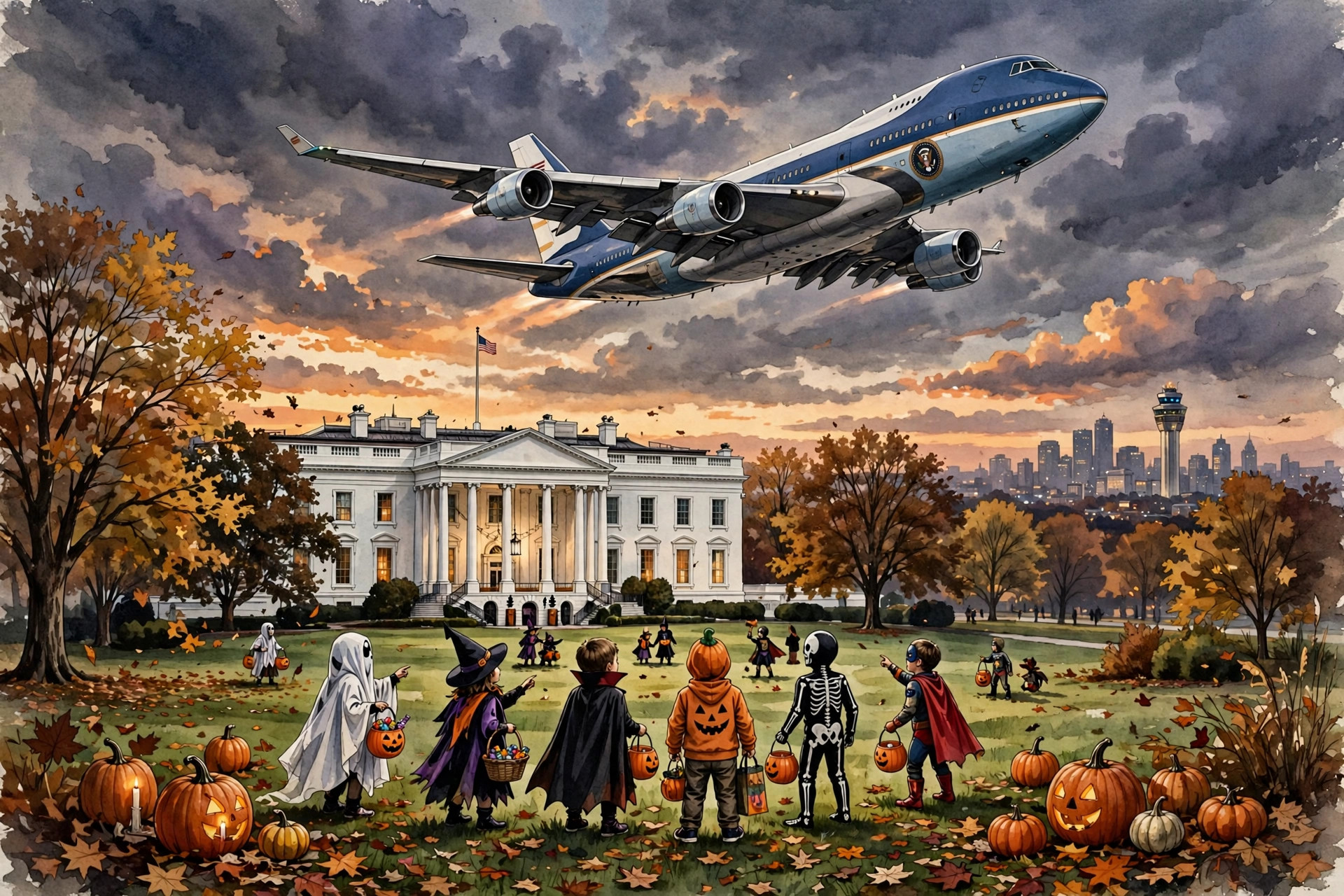
WASHINGTON — A presidential aircraft — designated Air Force One only when the president is aboard, and on this evening the president was on the ground, waving from outside — made two low passes over the White House on the evening of 29 October 2026, during a children’s Halloween party on the South Lawn, in a surprise flyover that delighted the costumed children gathered below and, within hours, drew sharp criticism from local officials and travellers. President Donald Trump waved from outside as the aircraft passed overhead, and the White House later posted video of the moment, describing it as an epic flyover for the trick-or-treaters. At almost the same time, however, the Federal Aviation Administration imposed a temporary ground stop at Ronald Reagan Washington National Airport, and flights in and out of one of the country’s busiest airports were delayed into the evening.
The contrast between those two experiences — celebration on the lawn and disruption in the air — is at the heart of the dispute that followed. Supporters of the flyover described it as a memorable, patriotic moment for children at a long-standing White House tradition. Critics, including members of the DC Council, said residents, workers and travellers were given far too little warning, and that a festive gesture should not have come at the cost of grounded flights and startled neighbourhoods. What is not in dispute is the basic sequence reported by multiple outlets: a Halloween event was under way, an aircraft associated with the president flew low over the White House twice, and airport operations nearby were interrupted. How much notice was given, and whether that notice was adequate, is where accounts and judgments diverge, and that question is now the focus of public debate.
A Halloween Party Interrupted — In a Good Way, For Those On the Lawn
The event itself was the White House Halloween celebration, hosted by First Lady Melania Trump, at which children in costume collected treats on the grounds. According to reporting on the evening, the celebration included touches from across the administration: the Treasury Department offered colouring books promoting Trump Accounts, the savings accounts for children championed by the president, and the Agriculture Department provided pumpkins. It was, by design, a family occasion, with children, parents and costumed characters moving between stations on the lawn.
Into that setting came the flyover. The aircraft made two low passes over the White House, close enough and loud enough to be unmistakable to everyone below. The president waved from outside as it passed, and the White House video of the moment framed the flyover as a highlight of the evening for the trick-or-treaters. For the children present, the effect appears to have been exactly as intended: a spectacular, unexpected arrival in the sky above a party already built around spectacle and surprise. There is no suggestion in reporting so far that anyone on the grounds was harmed or that the event itself was disrupted in any way. The celebration continued, and the video shared by the White House presented the flyover as a deliberate gift to the young guests.
That framing matters, because it explains why the White House and its supporters saw nothing to apologise for. From their perspective, a presidential flyover at a children’s party is a moment of national pageantry, the kind of memory that children carry for years. It also fits a broader pattern in which presidential appearances are staged for maximum visual impact, with the aircraft itself serving as a symbol of the office. Critics do not dispute that the children enjoyed it. Their argument is different: that enjoyment on the lawn does not answer the question of what happened beyond the fence, in neighbourhoods and at an airport that had little or no time to prepare.
Fifteen Minutes’ Notice, According to the DC Council
The sharpest criticism came over notice. The DC Council said that downtown Washington, the Pentagon and National Airport received only 15 minutes’ notice of the flyover, a claim reported by Reuters and other outlets. If that account is accurate, it means that residents in some of the most densely populated and security-sensitive parts of the capital, along with the staff running a major airport, learned of a low-flying presidential aircraft only a quarter of an hour before it arrived overhead.
Fifteen minutes is, by any ordinary measure, a very short window. It is not enough time for an airport to re-sequence departures and arrivals in an orderly way, for local police to field and answer public enquiries, or for residents to distinguish a planned flyover from an unexpected security event. In a city where low-flying aircraft can understandably cause alarm, and where the airspace around the White House and the Pentagon is among the most restricted in the country, short notice carries a particular weight. People who hear a large aircraft at low altitude without warning may reasonably wonder whether something is wrong, and emergency services may receive calls that could have been avoided with earlier information.
It is important to be precise about what the DC Council’s statement establishes and what it does not. It establishes that elected local officials say notice was 15 minutes, and that they regard that as inadequate. It does not, on its own, establish the full chain of communication inside the federal government, or whether other agencies received earlier information that did not reach the council or the public in time. The White House and the Federal Aviation Administration have not, in the reporting reviewed for this story, been shown to have disputed the 15-minute figure in detail, but readers should treat the precise internal timeline as a matter that further official statements could clarify. What is clear is that the council’s complaint has become the central political fact of the episode, quoted in coverage and repeated by critics who say the flyover was poorly coordinated with the city that hosts it.
The Ground Stop at Reagan National Airport
The most concrete consequence beyond the White House grounds was at Reagan National Airport, where the Federal Aviation Administration imposed a temporary ground stop. A ground stop is an air-traffic management measure under which departures to or from an affected airport are held on the ground, usually to manage congestion, weather, security or airspace restrictions. In this case, the ground stop was linked to the flyover and to the temporary airspace arrangements around it, and it rippled through the evening’s flight schedule.
According to FlightAware data cited by Reuters, 26 percent of departures and 17 percent of arrivals at Reagan National were delayed, with 202 flights delayed in total. Those figures describe delays recorded in connection with the episode, and they should be read with care: a percentage of departures delayed on a busy evening can reflect a combination of the ground stop itself and the knock-on effects as aircraft and crews fall out of sequence. A single delayed departure can delay the next flight that aircraft was due to operate, and a ground stop, even a temporary one, can therefore produce delays that last well beyond the period in which aircraft are actually held. That is why a short interruption in the air can produce a long tail of disruption on the ground, with passengers missing connections, crews timing out, and evening arrivals bunching together once operations resume.
For travellers, the experience was the opposite of the lawn party. Passengers waiting at gates or on aircraft would have had little idea, at first, why their flights were not moving, and the Halloween timing may have added to the frustration, with families travelling for the holiday weekend and others trying to get home for the evening. The airport itself did not create the flyover, and air-traffic controllers implement ground stops as safety and flow measures, not as commentary on the event that prompted them. But from the passenger’s point of view, the distinction hardly matters: a flight delayed is a flight delayed, whatever its cause, and the question many will ask is whether earlier notice could have allowed airlines and the airport to plan around the interruption rather than absorbing it at short notice.
How Low, and How Coordinated?
Two further reported details help readers judge the scale of the event. First, the aircraft’s altitude was reported by the Washington Post, via People magazine, at between 400 and 1,000 feet during the passes. That is low by the standards of ordinary commercial flight over a city, though low passes are precisely what a flyover is designed to be: high enough to be safe, low enough to be seen and heard clearly from the ground. The range reflects the fact that an aircraft in a flyover manoeuvre does not hold a single altitude throughout, and different observers and tracking sources may record different points in the pass. Second, the Federal Aviation Administration confirmed to People that the flyover was coordinated with the agency. That confirmation is significant, because it rules out the most alarming interpretation — that an aircraft appeared over the White House without the knowledge of air-traffic authorities. Coordination, however, is not the same as public notice. An operation can be fully coordinated between federal agencies and still be a surprise to residents, local officials and travellers if the information does not travel beyond those agencies in good time.
That distinction is likely to shape any official review. Federal aviation and security agencies routinely coordinate presidential movements, and they do so under procedures designed to protect both safety and security. The White House airspace is restricted, presidential aircraft movements involve the Secret Service, the military and the Federal Aviation Administration, and not every detail of a presidential movement can or should be broadcast in advance. At the same time, a flyover that is intended as a public celebration, rather than a discreet movement, sits in a different category from a routine transit. When the purpose is for people on the ground to look up and enjoy the sight, the case for giving the surrounding city enough warning to enjoy it without alarm, and for the airport to plan around it, is stronger. Whether the balance struck on 29 October was the right one is a judgment call, and it is one on which the White House, the Federal Aviation Administration, the DC Council and the travelling public may reasonably disagree.
A Tradition Dating Back to 1958
The Halloween event at the White House is itself a long-standing tradition, dating back to 1958, and that history forms part of the backdrop to the flyover. For decades, presidents and first ladies have welcomed children to the White House at Halloween, turning the grounds into a place of costumes, treats and photo opportunities. The tradition has survived changes of party and president precisely because it is understood as non-partisan family pageantry: a moment when the White House belongs, briefly, to children.
Supporters of the 2026 flyover can fairly argue that it belongs in that spirit, adding a spectacular element to an occasion already designed to delight. Critics can equally argue that tradition does not by itself justify every addition to the event, and that a low flyover over a densely populated capital is different in kind from handing out sweets on the lawn. Both points can be true at once: the event is traditional, and the flyover was novel. The question is not whether Halloween at the White House should happen, but whether this particular addition, at this altitude, with this amount of notice, was proportionate to its purpose.
Presidential Flyovers in Context
Presidential flyovers are not new in American public life. Aircraft associated with the presidency have appeared at sporting events, commemorations and celebrations, and such appearances are generally planned as moments of national symbolism. What varies is the context: a flyover at a stadium, announced in advance and expected by a crowd gathered for that purpose, is a different proposition from a flyover over a working city centre and a busy airport, where most people below are not an audience but residents, workers and travellers going about their evening.
That difference does not make the White House flyover improper on its own, but it does explain why notice matters more in this setting. At a stadium, the crowd is there to watch the sky. In downtown Washington, the audience is the whole city, including people who may be driving, working, caring for children or waiting for flights. A flyover that surprises a stadium crowd delights it. A flyover that surprises a city can alarm parts of it, even if others enjoy it, and can disrupt systems — like airport operations — that depend on predictable airspace.
It is also worth noting what has not been alleged. There is no reporting reviewed for this story suggesting that the flyover breached safety rules, endangered the aircraft or people on the ground, or was conducted without Federal Aviation Administration coordination. The criticism, as reported, is about notice and disruption, not about the basic safety of the flight. That distinction should be kept in view, because it separates a debate about judgment and coordination from a claim of recklessness, and only the former is supported by the reporting so far. If further official statements or data change that picture, they should be reported on their merits, but readers should not assume a safety failure from a delay figure alone.
What Happens Next
The immediate aftermath is likely to be measured in statements rather than in formal action, unless an agency or the DC Council pursues the matter further. Local officials may press the White House and the Federal Aviation Administration for a fuller account of the notice timeline, and for assurances about how similar events will be communicated in future. The Federal Aviation Administration may review its own coordination and notification procedures, particularly where a celebratory flyover intersects with operations at Reagan National, an airport whose proximity to the capital makes it unusually sensitive to airspace changes. Airlines and passenger groups, for their part, may ask whether ground stops linked to ceremonial flights can be anticipated earlier, so that schedules can be adjusted before passengers reach the gate.
None of those steps should be described as already decided. At the time of reporting, the established facts are the flyover itself, the White House’s celebratory framing, the DC Council’s 15-minute notice claim, the temporary ground stop, and the FlightAware delay figures cited by Reuters. Everything beyond that — whether procedures will change, whether an apology or explanation will follow, and whether future flyovers will be announced differently — remains open. That openness is itself part of the story: a single evening’s celebration has raised a practical question about how the presidency shares the sky with the city that surrounds it, and that question will only be answered by what officials say and do next.
For the children on the lawn, the memory will likely be of an aircraft roaring overhead on Halloween night, waved at by the president, at a party designed to be unforgettable. For travellers delayed at Reagan National, and for residents given 15 minutes’ warning, the memory may be rather different. Both memories are real, and both belong in any fair account of what happened on 29 October 2026. The challenge for those responsible for future events is to find a way to preserve the first without imposing the second — to give a city enough notice to look up in delight, rather than in alarm, and to give an airport enough time to keep its flights moving while the celebration passes overhead.
Sources
USN reviewed reporting from multiple outlets for this story. Read more from Reuters, People and USA Today.