

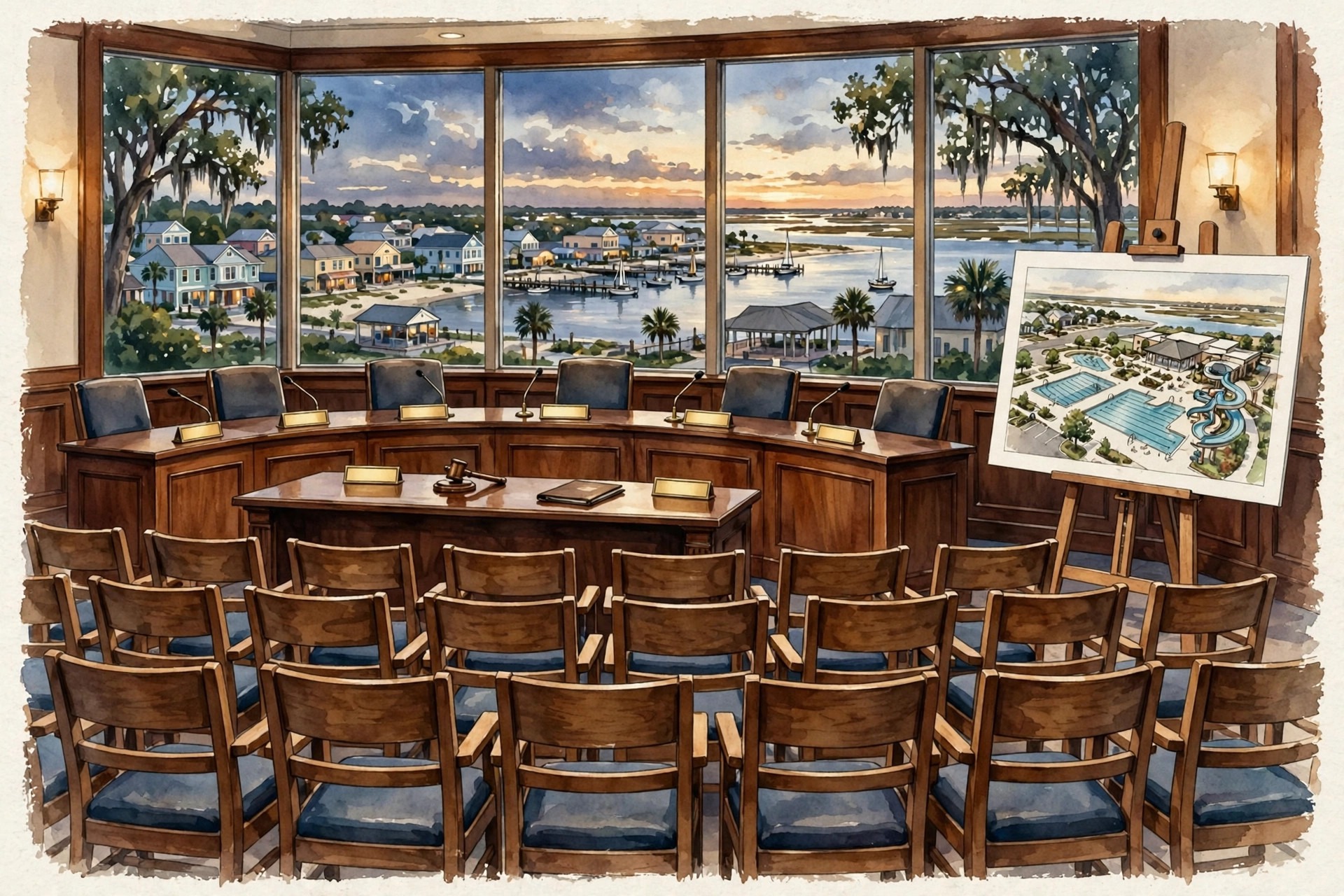
On Tuesday, November 3, 2026, at 5 p.m., the Orange Beach City Council will meet in the Council Chambers at City Hall, 4099 Orange Beach Boulevard, to vote on six resolutions that touch very different parts of city life: a swimming pool expansion, disaster planning, a holiday trail, tax audits, traffic signals and sea turtle care. None of the six items is scheduled as a public hearing, and residents who want to speak may do so during the public comment period at the end of the meeting. The council already discussed all six items at its October 20 evening work session, formally the Committee of the Whole, so Tuesday’s meeting is the decision point rather than the first airing of the proposals.
That distinction is the most important thing for readers to understand about this story. Everything described here is a proposal to be voted on, not a done deal. A council can approve a resolution, amend it, defer it for more information, or vote it down. A headline that says the city “will spend” a sum of money before the vote has taken place would mislead readers, because the money is not committed until the council acts. This article therefore describes each item as it stands on the agenda, explains what approval would mean, and explains what would still remain undecided even after a yes vote.
Taken together, the six items also give a useful snapshot of how a small coastal city governs itself. Orange Beach is a beach town on the Alabama Gulf Coast, exposed to hurricanes and flooding, dependent on tourism and seasonal visitors, and responsible for facilities that residents use all year round. A single council agenda can therefore move, in one evening, from a multi-million-dollar pool project to a free holiday event, from a countywide disaster plan to the medical equipment used to treat injured sea turtles. The sums and the subjects vary widely. The process is the same: a resolution, a vote, and a public record.
Orange Beach City Council November 3: what is on the agenda
The headline item, in money terms, is the Aquatics Center expansion. The council will vote on up to $274000 for Lose Design to oversee construction of the first phase of the expansion. The firm would visit the site during construction, review the builder’s payment requests and help manage changes during construction. That role is sometimes called construction administration, and it is distinct from designing the building. Design work has already been authorised in earlier votes. Tuesday’s vote would pay for the architect’s work while a contractor builds phase one.
A cost estimate in the council packet puts construction of phase one itself at $7,240,375. That figure, prepared July 3 by Axias for Lose Design, is an estimate for building phase one, not the $274000 oversight sum. Confusing the two figures would badly understate the project. The $274,000 is the cost of professional oversight during construction. The $7.24 million is the estimated cost of the construction itself. Neither figure is a final contract price for building the pool, and the packet does not name a funding source for the construction, according to the agenda reporting.
The other five items are smaller in money terms but not in consequence. The council will vote on adopting the 2026 Baldwin County hazard mitigation plan, which keeps the city eligible for federal disaster-mitigation grants. It will vote on an agreement for the free Merry Memories Tinsel Trail at Waterfront Park in December. It will vote on a three-year contract to audit businesses subject to city taxes. It will vote on soil testing for three new traffic signal poles at Canal Road and Wharf Parkway East. And it will vote on $54612.39 in medical equipment for the city’s sea turtle facility. Each of those items is explained in detail below, because each one affects a different group of residents.
Aquatics Center expansion phase one: what $274000 would oversee
The Orange Beach Aquatics Center, at 4853 Wilson Boulevard, opened in 2002 with a heated outdoor pool, a diving well and a wading pool. It is a long-established public facility, not a new idea, and the expansion is a renovation and enlargement of something residents already use. In April 2025 the council hired Lose Design to plan a renovation and expansion. In February 2026 it approved up to $781,700 for Lose of Tennessee to design the expansion. Tuesday’s proposed $274000 task order would fall under the city’s existing design contract with Lose of Tennessee, PLLC, and would cover construction administration for phase one.
Phase one, as described in the packet estimate, includes a second, larger leisure pool, a new pump house with meeting rooms and new pool decks. A leisure pool is different from a competition pool. It is designed for lessons, classes, open swimming and family use, with features that make it accessible and flexible, rather than for timed racing lanes alone. A new pump house matters because it houses the filtration and circulation equipment that keeps a public pool safe and clean; meeting rooms matter because they let the facility host classes, community groups and swim-team activities alongside swimming itself. Pool decks matter because they are where swimmers, lifeguards, parents and people with limited mobility all move around the water, and a deck that is too small or poorly drained becomes a safety and accessibility problem.
The estimate assumes construction starts in April 2027. That date is an assumption in the estimate, not a promise that building will begin on that day, and it is worth noting what the estimate does not include: design fees, furniture and equipment, audio-visual systems, and any hazardous-material removal in the renovation. A reader who takes $7,240,375 as the total cost of a finished, furnished, equipped pool would therefore be undercounting. The council packet describes a construction estimate for phase one, and the full cost of opening a finished facility will include items outside that estimate.
Why pay an architect to oversee construction at all, when a contractor is already being paid to build? In public construction, the architect’s construction-phase role is a check on quality and on payment. Site visits let the architect confirm that work matches the drawings. Reviewing payment requests lets the architect confirm that the contractor is billing only for work actually completed. Managing changes lets the city handle the inevitable surprises of a renovation, such as a condition found behind a wall that was not visible in the design, through a formal process rather than an informal agreement on site. For a public body spending public money, that independent check is part of how it protects residents from paying for work that was not done, or for changes that were not properly priced.
The broader expansion, as shown in the city’s May 6, 2026 town hall presentation, is larger than phase one alone. Tuesday’s vote, however, covers construction oversight for phase one only. Residents who follow the project should therefore keep two questions separate: whether phase one proceeds, and what happens to later phases. Approving oversight for phase one does not automatically approve a later phase, and it does not settle the funding question for construction itself, which the packet leaves unnamed.
Why the Baldwin County hazard mitigation plan matters for FEMA grants
The second major item is easy to overlook because it costs the city nothing to adopt, but it may be the most consequential vote of the evening for Orange Beach’s long-term finances. The council will vote on adopting the 2026 Baldwin County Multi-Jurisdictional Hazard Mitigation Plan, a 654-page countywide plan for reducing damage from hurricanes, flooding and other disasters. The plan was written by a planning committee representing the county and its cities and towns, and the Federal Emergency Management Agency has marked it “Approval Pending Adoption”. Each participating government must now adopt it for the plan to take full effect for that government.
Adoption costs the city nothing, according to an October 15 memo from Coastal Resources Assistant Director Nicole Woerner, who served as vice chair of the county planning committee. That memo also explains the two practical benefits. First, adoption keeps Orange Beach eligible for FEMA mitigation grants. The city is already using one of those grant programmes for its First Responder Safe Room, and without an adopted plan it could lose eligibility for future mitigation funding. Second, adoption supports the city’s standing in FEMA’s Community Rating System, which lowers flood insurance premiums for property owners. In a coastal city where flood insurance is a real household cost, a rating that lowers premiums is a direct benefit to residents, not an abstract planning credit.
To understand why a plan is a condition of grants, it helps to understand what FEMA mitigation grants are for. Disaster assistance after a hurricane pays for recovery. Mitigation grants pay, before the next disaster, for work that reduces future damage: elevating a road, strengthening a building, improving drainage, or building a safe room. FEMA requires a local government to have an adopted, up-to-date hazard mitigation plan before it can receive that kind of funding, because the agency wants the money to follow a studied assessment of local risk rather than a wish list drawn up after a storm. The requirement is set out in federal regulation, and the county plan states that adoption is required to maintain eligibility for FEMA Hazard Mitigation Assistance funding, consistent with that regulation.
The county plan’s own assessment of Orange Beach is stark. Its planning committee rated flooding and hurricanes as high-impact hazards for the city, and the only two hazards expected to reach a significant share of the city. That assessment will surprise no one who lives on the Gulf Coast, but its formal place in a 654-page adopted plan matters: it gives the city a documented basis for seeking mitigation money for flood and hurricane projects, and it gives FEMA a documented basis for approving them. A city that cannot point to an adopted plan describing its flood risk is in a weaker position when it applies for money to reduce that risk.
It is also worth noting that Orange Beach is not adopting this plan alone. The plan is multi-jurisdictional, covering Baldwin County and its participating cities and towns, including Gulf Shores, Foley, Daphne, Fairhope and others. Each government adopts the same countywide plan for its own jurisdiction. That shared approach reflects a practical truth about hurricanes and flooding: water does not respect a city boundary, and a drainage or elevation project in one town can affect flooding in the next. A countywide plan lets neighbouring governments coordinate, even though each council votes separately.
Tinsel Trail, tax audits, traffic signals and sea turtle care
The remaining four items show the range of ordinary council business. The Tinsel Trail item would authorise an agreement for the Garner C. Tampary Memorial Foundation, a nonprofit that promotes seatbelt safety, to hold its fourth Merry Memories Tinsel Trail. Live trees would line the lawn and gazebo at Orange Beach Waterfront Park and part of the Coastal Arts Center lawn, facing Canal Road. The trail would be free and open to the public from December 5 to 25. The agreement includes no city payment: the city would provide the space, electricity and barricades, and the foundation would organise the trail. For residents, the practical point is that a free holiday attraction at a public park depends on a council vote authorising the use of that park, even when no city money changes hands.
The business-tax audit item would authorise a three-year contract to audit businesses subject to city taxes. Cities that rely on business taxes, lodging taxes and similar revenues need a way to check that the taxes owed are the taxes paid. An audit contract does not mean the city suspects a particular business of wrongdoing. It means the city is buying professional capacity to review returns across many businesses over three years, which is work its own staff may not have the time or specialist expertise to do at scale. The revenue effect, if audits find underpayments, goes to the city budget that funds roads, parks, public safety and facilities such as the Aquatics Center itself.
The soil-testing item would authorise soil tests for three new traffic signal poles at Canal Road and Wharf Parkway East. Soil testing, or geotechnical exploration, sounds technical because it is: a traffic signal pole is a tall structure carrying heavy equipment over a road, and it needs a foundation suited to the ground beneath it. Testing the soil before installing poles avoids a foundation failure later, and it lets engineers design the pole foundations correctly the first time. Canal Road is a major route through Orange Beach, and Wharf Parkway East serves a busy commercial and entertainment area, so a signal project there affects many drivers, including visitors unfamiliar with the road.
The sea turtle item would authorise $54612.39 in medical equipment for the city’s sea turtle facility. Sea turtles that wash ashore injured, sick or cold-stunned need veterinary assessment and treatment before they can be released, and that treatment requires specialist equipment. The precise figure, down to the cents, suggests a quoted equipment list rather than a round-number estimate, and the council vote would authorise that purchase. For a Gulf Coast city, sea turtle care is both a wildlife responsibility and a public-facing conservation activity: injured turtles are a visible reminder of the marine environment on which the city’s tourism and fishing depend.
How to follow the vote and what happens next
Residents who want to follow Tuesday’s meeting can attend in person at City Hall, 4099 Orange Beach Boulevard, for the 5 p.m. start. Because none of the six resolutions is scheduled as a public hearing, there will not be a formal hearing procedure for each item, but residents may speak during the public comment period at the end of the meeting. That is the point in the meeting at which a resident who has a concern about any item, or about the meeting as a whole, can put it on the public record.
After the vote, the next steps differ by item. If the Aquatics Center oversight resolution passes, Lose Design will be authorised to perform construction administration for phase one when construction proceeds, but the city will still need a construction contract and a funding source for the $7.24 million build estimate. If the hazard mitigation plan resolution passes, Orange Beach will have adopted the countywide plan and preserved its FEMA mitigation-grant eligibility and its Community Rating System standing. If the Tinsel Trail agreement passes, the foundation can proceed with the December 5 to 25 trail at Waterfront Park. If the audit contract passes, the three-year audit programme can begin. If the soil-testing and sea turtle items pass, those smaller purchases and studies can proceed.
If any item fails or is deferred, that is also a decision with consequences. A deferred Aquatics Center item would delay oversight arrangements and could affect the assumed April 2027 construction timetable. A deferred hazard plan adoption would leave the city’s grant eligibility in an uncertain position until the council acts, because FEMA’s “Approval Pending Adoption” status requires the adoption step. A deferred Tinsel Trail agreement, close to December, would put pressure on the foundation’s timetable for a free public event. None of those outcomes can be predicted from the agenda alone, which is why the meeting itself, rather than the agenda preview, is the news.
Readers should also be careful about a common misunderstanding in local government reporting: a work-session discussion is not a vote. The council discussed all six items at its October 20 work session, but discussion does not commit the city. Tuesday’s regular meeting is where the formal votes take place, and the minutes of that meeting, not the work-session discussion, will be the official record of what was decided. Anyone who wants to know the outcome should check the meeting minutes or the city’s own record after Tuesday, rather than relying on a preview article, including this one, as proof of a result.
Orange Beach’s November 3 agenda is, in the end, a reminder that local government is where abstract policies become concrete. A hazard mitigation plan becomes flood insurance premiums and grant eligibility. An architect’s oversight contract becomes the quality of a pool that children will swim in for decades. A free trail agreement becomes a December evening at Waterfront Park. A tax audit contract becomes the revenue that pays for services. Soil tests become signal poles that stand safely over a busy road. Medical equipment becomes a chance for an injured sea turtle to return to the Gulf. None of those outcomes is decided until the council votes at 5 p.m. on Tuesday, and that vote is the reason the meeting is worth watching.
Sources
USN reviewed reporting from multiple outlets for this story. Read more from Baldwin Citizen (https://www.baldwincitizen.com/orange-beach/article/2026-11-03-orange-beach-orange-beach-council-to-consider-hazard-mitigation), OBA Website (https://www.obawebsite.com/orange-beach-council-prepares-for-major-grant-vote-and-infrastructure-decisions) and Baldwin County (https://baldwincountyal.gov/docs/default-source/ema/2026-final-baldwin-county-multi-jurisdictional-hazard-mitigation-plan.pdf?sfvrsn=86004349_1).
[…] What happens next will be measured in construction milestones, funding announcements and family transitions, in that order. The Philadelphia Authority for Industrial Development must now run the procurement processes for the four renovation projects, turning the board’s authorisation into contracts, designs and building sites. The district must pursue the state and philanthropic funding that would close the gap between the $3 billion ambition and the money currently available. And, most importantly for the families directly affected, the district must show that receiving schools such as Bache-Martin, Catharine, Patterson and F.S. Edmonds are ready — in seats, in staffing and in welcome — before the seventeen closing schools shut their doors after the 2026-27 school year. Related USN coverage: Foley Alabama city council e-bike rules and flood ordinance. Related USN coverage: Orange Beach council November 3 vote on aquatics centre oversight. […]