

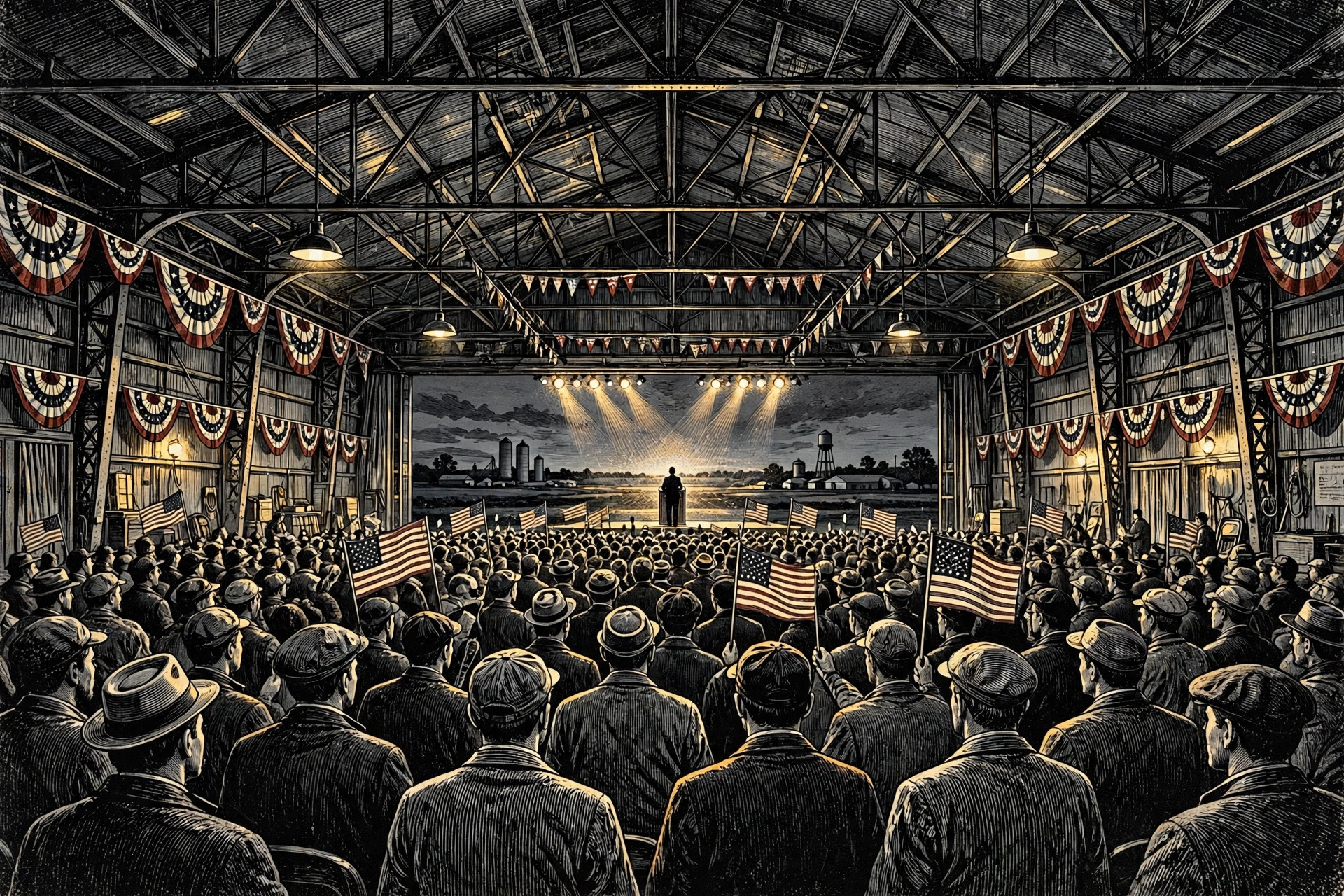
President Donald Trump closed his travelling midterm campaign on Sunday, November 1, with back-to-back rallies in Dubuque, Iowa, and Salina, Kansas, telling supporters that the United States could shut Iran down whenever it chose, that American intelligence out-spies China and Russia, and that fuel prices would fall sharply once the war with Iran ends. The two stops, held two days before Election Day on Tuesday, November 3, were the final in-person rallies of a campaign in which Trump said he had now held 30 rallies, and they set the tone for his last full day of campaigning before voters decide control of the House and Senate.
The Salina event was, in Trump’s own words at the rally, the last stop. “This is actually, this is our last stop. We close it down tonight,” he told the Kansas crowd, according to agency reporting of the speech. He said he had come to Kansas because he did not want to take a chance on the re-election of Republican Senator Roger Marshall, who faces Democrat Adam Hamilton. In Iowa earlier in the day, he campaigned for Republican Representative Ashley Hinson, who is running for the Senate seat being vacated by retiring Senator Joni Ernst against Democrat Josh Turek. Both states are Republican-leaning states that Trump won comfortably in 2024, and both now have competitive Senate races that have drawn heavy late attention.
The rallies had a tangled recent history. The in-person events in Iowa and Kansas were cancelled on Thursday, October 29, in favour of a run of telephone rallies, then restored less than a day later after pushback from Republicans in both states. USN previously reported the November 1 rallies as scheduled events: Trump Iowa Kansas rallies November 1: Dubuque and Salina on final Sunday before Election Day (https://usnbreaking.com/trump-iowa-kansas-rallies-november-1-dubuque-and-salina-on-final-sunday-before-election-day/). Sunday’s speeches are therefore best read as the delivery of that restored schedule, not as a new itinerary, and the remarks themselves, rather than the scheduling, are what is new.
What Trump said at the final midterm rallies in Iowa and Kansas
In Dubuque, at the Five Flags Event Center, Trump spoke for just over two hours, according to agency reporting. The longest and most striking passages concerned Iran. Trump said the United States had overwhelmed Tehran, that Iran had been left without military capacity or anyone to negotiate with, and that the war, which began in February 2026, was being finished by the United States. “We didn’t start it. We’re finishing it. We’re beating the crap out of them,” he said. “They have no radar. They have no anti-aircraft weaponry. They have no leaders,” he added, before acknowledging that the loss of leaders had gone far enough that there was, in his words, nobody left to talk to.
In Salina, at Salina Regional Airport’s Hangar 509, he returned to the same theme in blunter terms. “We can we can close them down any time we want. We’re trying to be nice,” he said. “But I think it’s going to be very close. We’re just going to close them down. That’s going to be the end of it.” He contrasted his approach with the 2015 nuclear agreement negotiated under former President Barack Obama, calling that deal a path to a nuclear weapon and saying his administration had done the opposite. “I stopped Iran from having a nuclear weapon,” he said, and added that Iran “never will have a nuclear weapon.”
Those remarks matter for what happens after the election as well as for the campaign itself. USN has previously reported that the White House has weighed further strikes on Iran while officials have said no decision has yet been taken: White House weighs new Iran strikes: Trump says one or two targets remain as Rubio says no decision yet (https://usnbreaking.com/white-house-weighs-new-iran-strikes-trump-says-one-or-two-targets-remain-as-rubio-says-no-decision-yet/). Sunday’s language does not itself announce a new strike or a new decision, and it should not be read as one. It is campaign rhetoric about an existing war, delivered at a moment when reporting has said allies have been told to prepare for possible new strikes after the midterms. At the same time, a fact-check published on November 2 found no evidence for a separate online claim that Trump had announced a settlement with Iran: no such announcement, statement or social media post from the president or the White House was found, and video circulating with the claim dated from June. Readers should therefore treat Sunday’s “close them down” line as a threat and a boast, not as a policy announcement.
Trump also used the Salina rally to explain why he was holding back, in his telling, from finishing Iran off. He said the only reason he did not want to do so was that he wanted to show goodwill and save lives, but added that at some point the United States would deliver what he called a powerful blow. That framing, restraint as a choice rather than a constraint, ran through both speeches: American power presented as overwhelming, and its non-use presented as generosity.
Trump final midterm rallies turn to spying, Alaska gas and the cost of living
The second headline passage from Dubuque concerned espionage. Brushing aside concerns about Chinese and Russian spying on the United States, Trump told supporters that America spies on them too, and does it better. “Somebody said, China’s spying on us, sir. I said, yeah, and we’re spying on them, too. Don’t worry about it,” he said. “China, Russia, they’re spying on us, sir. I said, that’s true. And we’re doing it to them also. But we do it even better. So don’t worry about it,” he added.
The remark landed only weeks after a report about a suspected Chinese spy said to be close to Nvidia chief executive Jensen Huang, a story that had already raised questions about espionage and technology. Trump did not, in the reported remarks, address that report directly, and his Dubuque line offered no evidence, detail or policy proposal about intelligence operations. It was a reassurance, delivered as a boast, and it is best understood that way: a claim about relative capability, not a disclosure. Intelligence agencies do not publicly confirm the details of such operations, and neither supporters nor critics can verify a claim of this kind from a rally stage.
Trump also promoted the Alaska liquefied natural gas project at the rallies, saying the project had been dead until he intervened and that there was now a pipeline for gas carriers headed to Japan, South Korea and China. He presented the project as an achievement of his administration and as evidence of American energy strength. The details of export volumes, timelines and buyers for the Alaska project were not set out in the reported rally remarks, and the claim should be read as a campaign summary of a long-running energy project rather than as a new export announcement. Energy projects of this scale typically take years from approval to first cargo, and a rally line about carriers is not a substitute for a contract or a shipping schedule.
On the economy, the Salina speech returned to the themes that have dominated the closing days of the campaign: inflation, oil and blame for high prices. “Your inflation for the last three months is 1.7 per cent way down. I inherited high prices from sleepy Joe Biden. I didn’t cause it,” Trump said. He added that oil prices were much lower than they had been under former President Joe Biden or former President Barack Obama, and that when the war with Iran ends, prices will plunge. “When that war is over, it’s going to come plunging,” he said, describing higher fuel prices in the meantime as a very small price to pay for the security of the country and the world.
That prices claim sits uneasily against the official figures cited in the same agency reporting. United States Energy Information Administration figures put the national average price of regular gasoline at about $4.27 a gallon on October 26, about $1.23 higher than a year earlier, while West Texas Intermediate crude averaged about $107 a barrel in the week ended October 23, compared with about $73 to $79 a barrel in January 2025, when Biden left office. In other words, pump prices and crude prices were higher, not lower, than a year earlier at the time of the rally. Trump did not cite a figure or a source for his claim in the reported remarks, and the gap between the claim and the official series is one voters can check for themselves. It does not prove what prices will do after the war ends, which is a forecast, but it does show that the present-tense claim about lower prices does not match the published data.
On immigration, Trump repeated a claim that the southern border had been sealed. “And now we’ve gone 17 months, think of it, with zero people coming into our country illegally,” he said in Salina. That is a sweeping claim about unlawful entries over a long period, and the reported remarks offered no data to support a figure of zero. Border agencies publish encounter and apprehension data monthly, and a claim of literally no unlawful entries for 17 months would be extraordinary on its face. It is reported here as the president’s claim, not as an established fact, and readers should weigh it accordingly.
Attacks, hecklers and the closing ask: vote in person on Tuesday
Both speeches also featured sharp attacks on Democrats, whom Trump called a totally corrupt party, and on individual Democratic politicians. Reporting of the rallies noted attacks on Michigan Democratic Senate candidate Abdul El-Sayed and on Representative Ilhan Omar of Minnesota, alongside conspiracy claims about the Democratic Party. Critics, in coverage of the rallies, characterised some of that rhetoric as Islamophobic and conspiratorial, while supporters would characterise it as hard campaigning against political opponents. USN reports both characterisations without adopting either as its own finding: the speeches were campaign speeches, the targets were named political figures, and the judgement about the language belongs to voters and to the candidates’ own responses, not to a news summary.
Both speeches were interrupted multiple times by hecklers, according to reporting of the events. Heckling at closing rallies is not unusual, and the interruptions did not stop either speech: Dubuque ran for more than two hours, and Salina closed the travelling campaign. The interruptions are worth noting because they cut against any impression of an entirely uncontested final weekend. Even in states Trump won comfortably in 2024, dissent was audible in the room.
Trump’s closing ask was practical, and it was repeated in Salina: vote in person on Tuesday rather than by mail. “I really want you to pretend I’m on the ballot,” he told supporters, urging them to turn out as if his own name were at stake. That line captures the central paradox of this midterm for Republicans. Trump is not on the ballot, but the campaign has been built around him, his record and his agenda, and the final rallies asked voters to treat a congressional election as a referendum on his presidency. Democrats have made the same referendum argument from the opposite direction, urging voters to check presidential power by changing control of Congress.
The stakes, on paper, are narrow majorities. Republicans hold the House by 218 seats to 214 and the Senate by 53 to 47. Democrats need a net gain of four seats in each chamber to overturn those majorities, although in the Senate a 50-50 tie would still leave Republicans in control because Vice President JD Vance can break tied votes, so Democrats in practice need 51 seats for outright control. Forecasts have favoured Democrats to win the House, with the Senate closer, but forecasts are probabilities, not results, and the final weekend’s rallies were aimed at the voters who could still change them.
What happens next: the November 2 Reflecting Pool speech and Election Day
Sunday’s rallies were the last travelling stops, but they were not Trump’s last scheduled appearance before the vote. On Monday, November 2, Trump is scheduled to speak at the Lincoln Memorial Reflecting Pool in Washington, D.C., in closing remarks that USN has previously previewed. That speech, unlike the Iowa and Kansas rallies, will be delivered from the capital on the eve of the election itself, and its contents cannot be reported before it happens. Readers should therefore treat any summary of the Reflecting Pool speech that appears before Monday afternoon in Washington with caution, and look for the actual remarks rather than a preview dressed up as a report.
After that, the campaign ends and the counting begins. On Tuesday, November 3, voters who have not already cast a ballot will vote in person, joining the more than 53 million Americans who had already voted early before Election Day, a record for a midterm. Polls close in stages from 6 p.m. Eastern Time, with the final closures in Alaska’s Aleutian Islands at 1 a.m. Eastern on November 4. Some races will be called on election night; others, particularly where mail ballots can arrive after Election Day if postmarked by then, will take days.
Sunday’s rallies will be judged, in the end, by whether they moved anyone who had not already decided. The speeches offered no new policy, no new announcement and no new endorsement beyond the candidates already backed in Iowa and Kansas. What they offered was a closing frame: a war presented as nearly won, an economy presented as about to improve, opponents presented as corrupt, and a turnout plea presented as personal. That is a familiar closing frame for a president whose party is defending narrow majorities. Whether it was enough will be known only when the votes, early and on the day, are counted.
Sources
USN reviewed reporting from multiple outlets for this story. Read more from Telangana Today (https://telanganatoday.com/trump-says-us-spies-on-china-russia-even-better-as-he-closes-midterm-push-on-iran-oil-prices), BizzBuzz (https://www.bizzbuzz.news/international/trump-ends-midterm-campaign-in-kansas-says-us-can-close-down-iran-any-time-1413467) and Al Jazeera (https://www.aljazeera.com/amp/news/2026/11/2/trump-leans-into-islamophobia-and-conspiracy-in-last-ditch-campaign-rallies).