

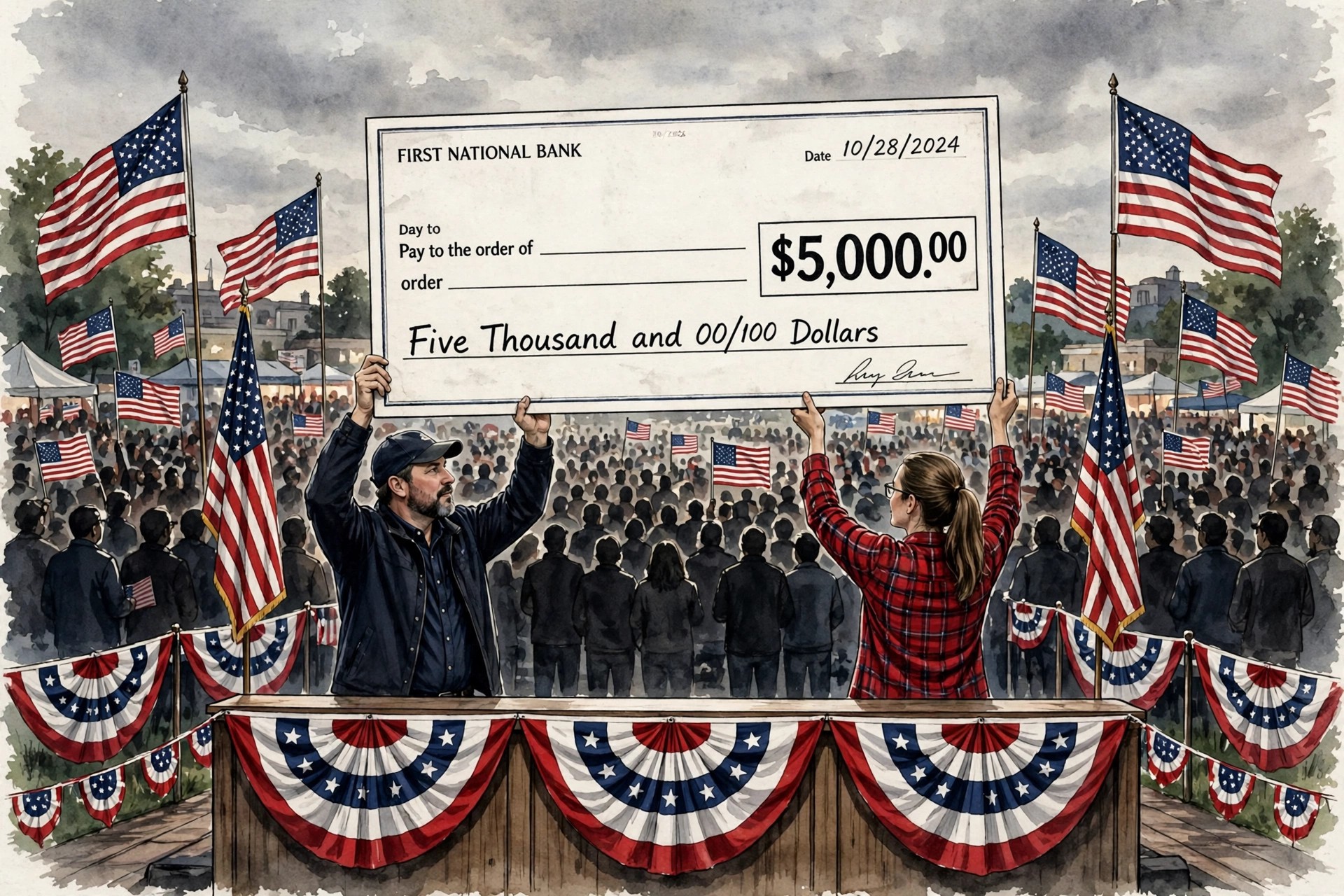
The offer could hardly be simpler, and President Donald Trump repeats it at nearly every campaign stop: if Republicans keep control of the House and the Senate in the November 3 midterm elections, his administration will send a check for $5,000 to every adult in the United States. If Democrats win, he tells the crowds, the money disappears. “If we lose, you get nothing,” he said while discussing the proposed dividend checks before a rally crowd in North Carolina. It is the centerpiece of a closing campaign strategy built on promised payouts, project announcements and financial rewards — many of them conditional, most of them requiring action by a Congress that has so far shown little appetite for them, and all of them arriving in the final days of an election dominated by voters’ anxiety about the cost of living.
The $5,000 promise
Trump first floated the idea in September and put it in writing on October 3, posting that if Republicans won the House and Senate, “I’m going to give all adult citizens in the United States of America, $5,000,” and adding that he looked forward to signing the checks. The proposal — which he frames as a dividend from what he describes as the tremendous strength and success of the American economy — would cost an estimated $1.3 trillion, according to USA Today, and would require congressional approval. Reuters reported this week that the idea has gained little traction among lawmakers, including within the president’s own party, and Trump has not explained how it would be paid for.
The president himself has begun joking about the limits of his own offer. At a rally in Corpus Christi, Texas, on October 27, he urged Americans to spend the money at home rather than overseas, then riffed on the prices at his own Florida resort. “You could even come to Mar-a-Lago. I said it the other night. You’ll be my guest at Mar-a-Lago. The problem is that for $5,000, the most you’ll be able to buy is a hamburger and maybe a small dessert. I’m not even sure you could buy that. No, don’t go there. It’s not a good place if you’re price conscious,” Trump said, drawing laughter from the crowd. The joke landed oddly against the backdrop of the election’s central issue: a Pew Research Center poll this month found that 60 percent of Americans say they do not have enough income to lead the life they want, and 70 percent say they have cut back on extra spending such as eating out.
Checks already in the mail
The dividend pledge is the largest item in a rolling series of payments and promises. In recent weeks the administration has distributed $500 rebate checks to about one million Americans whom Trump said were overcharged for health insurance bought through the Affordable Care Act’s federal exchange, and has sent $90 to some 21 million seniors by diverting money from a Medicare improvement fund that Congress created in 2008 to improve Medicare services. The president has announced financial rewards for tipsters who uncover fraud in government programs — whistleblowers, he said, will receive a 1 percent commission on money recovered, with no limit on how much an individual can collect. And on October 26, he announced a $1 million reward for anyone who reports voter fraud in United States elections in a way that results in an arrest or conviction; he did not specify where the funding for the rewards would come from.
The pattern extends to bricks and mortar. At a rally in Highland Heights, Kentucky, on October 17, Trump promised that if Republicans win, the Department of War will invest $100 million in the pharmaceutical company Antheia to revitalize a large drug manufacturing facility in Winchester, Kentucky — and suggested Democrats “wouldn’t be able to do it.” He has also promised to allow year-round sales of the corn-derived fuel blend E15 if voters re-elect Senator Roger Marshall of Kansas, a Republican facing an unexpectedly close race against Democrat Adam Hamilton in a state that has not sent a Democrat to the Senate in nearly a century. Reuters, reviewing the trail of announcements, noted that beyond the investment pledges, Trump has made a series of election-year promises of payments and policy changes, some of them explicitly tied to Republican victories.
‘Bribery’ or ‘record of delivery’? The two arguments
Democrats have been blunt in response: they describe the dividend pledge as an attempt to buy votes, and note that even some of the president’s MAGA allies have criticized it on those terms. Senator Mark Warner of Virginia told USA Today that he believes Trump feels unconstrained heading into the election. “I think he feels he is unconstrained,” Warner said. “I think he can and would try anything.” Democrats have also pointed to the administration’s use of government resources — including publicly funded advertising promoting the president’s agenda — as blurring the line between governing and campaigning.
The White House rejects that characterization. Defending the announcements, an administration official told Reuters: “The president has a proven record of securing historic investment, creating high-paying jobs, and bringing manufacturing back to the United States.” White House spokesman Davis Ingle, responding to questions about the president’s midterm efforts, described Trump as “the unequivocal leader, best messenger, and unmatched motivator for the Republican Party,” and said he “is committed to maintaining Republican majorities in Congress.” The administration argues that its election-security measures, including the fraud-reward program, are designed to protect the integrity of the vote, and describes its promotional advertising as public service announcements rather than political ads.
Some of the announcements carry a local specificity that reveals the strategy. In Kentucky, the promised $100 million for Antheia’s Winchester facility was delivered at a rally alongside Representative Andy Barr, the Republican nominee for the Senate, and Ed Gallrein, the party’s nominee in the state’s 4th Congressional District, both of whom joined Trump on stage. The president paired it with a reference to a $1 billion investment by GE Appliances and the IUE-CWA union that will make Louisville’s Appliance Park the largest home appliance manufacturing site in the country. Reuters, reviewing the full trail of pledges, cautioned that many of the touted projects carry uncertain futures — and that Trump is hardly the first president to announce major economic projects in an election year whose completion depends on events, and appropriations, beyond his control.
An old playbook, a new scale
Trump is not the first president to reach for voters’ wallets in an election year. Former President Joe Biden announced billions of dollars in student loan relief ahead of the 2024 election, and congressional Democrats backed expanded health-insurance subsidies and other benefits aimed at easing household costs. What distinguishes the current effort, analysts note, is the explicit conditionality: the checks, the factory investment and even the fuel policy are all framed not as proposals to be weighed on their merits, but as rewards that flow only from one electoral outcome. Throughout the campaign, Trump has touted the strength of the economy while mocking “affordability” as a term manufactured by Democrats — even as polling shows prices remain the electorate’s dominant concern.
Whether the strategy works will be known on November 3, when all 435 House seats and 35 Senate seats are decided. If Republicans hold both chambers, the president will face immediate pressure to convert his promises into legislation — legislation that, on the evidence of the past two months, Congress has not yet agreed to write. If they lose, by the president’s own formulation, the offer expires with the returns.
Sources
USN reviewed reporting from multiple outlets for this story. Read more from Reuters and USA Today.
[…] weighing those promises should distinguish between enacted law and campaign proposals. Reporting on household payments promised in the campaign has stressed that some high-profile payment proposals are conditional on election outcomes and […]