

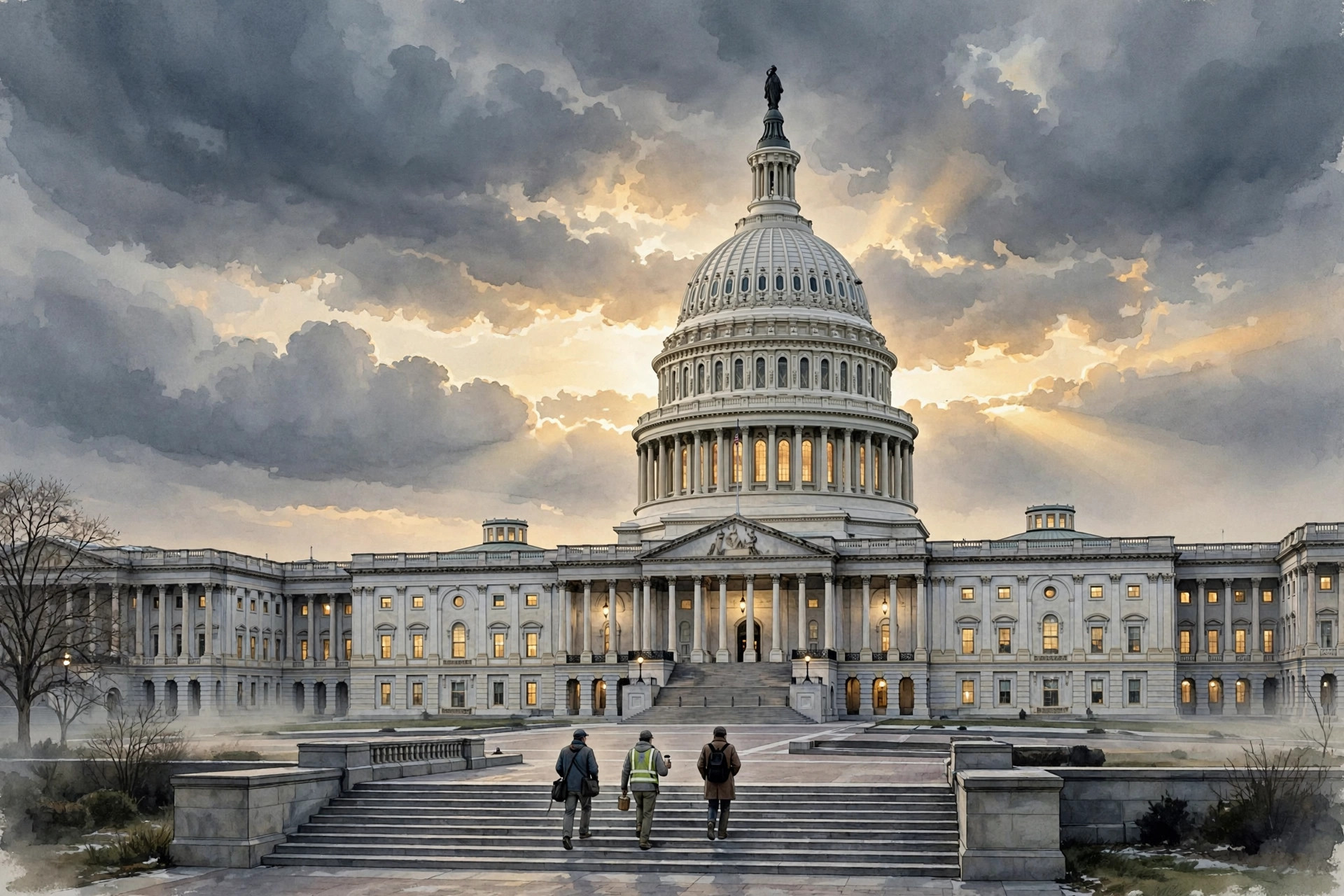
The longest government shutdown in American history is over. The House of Representatives passed the funding bill by 222 votes to 209 on Wednesday evening, November 11, 2026, and President Donald Trump signed it into law in the Oval Office less than two hours later, at about 9.45 p.m. Eastern Time, ending a 43-day funding lapse that left hundreds of thousands of federal workers unpaid, threw food assistance for millions of families into doubt and cancelled thousands of flights. The shutdown, which began on October 1 when Congress failed to pass funding for the new fiscal year, passed the previous record of 35 days set during the funding lapse of December 2018 to January 2019, in Trump’s first term.
The end came fast once it finally came. The Senate had passed the package on Monday night by 60 votes to 40, after a group of Senate Democrats broke with their party’s leadership to end the stalemate on the shutdown’s 41st day. The House, which had not taken a chamber-wide vote since mid-September, approved the same measure on Wednesday evening, and the president signed it the same night. Federal agencies were expected to begin reopening within hours, with furloughed workers returning to their jobs on Thursday, November 12, and back pay to follow. But the deal that ended the shutdown did not settle the argument that caused it, and the same fight will return in eleven weeks, when the stopgap funding runs out on January 30, 2027.
The legislation, the Continuing Appropriations, Agriculture, Legislative Branch, Military Construction and Veterans Affairs, and Extensions Act of 2026, known as H.R. 5371, is a 394-page package that funds most federal agencies at existing levels through January 30, 2027, and wraps three full-year spending bills inside it. It fully funds the Supplemental Nutrition Assistance Program, which serves about 42 million lower-income Americans, through the end of the fiscal year, along with 8.2 billion dollars for WIC, the nutrition programme for women, infants and children. What it does not contain is the extension of the enhanced Affordable Care Act tax credits that Democrats made the condition of their support for six weeks, and those credits still expire at the end of December.
The Votes That Ended the Shutdown
The breakthrough came on Sunday night, November 8, when the Senate voted 60 to 40 on a procedural motion to advance the deal, the first crack in a standoff that had lasted five weeks. The vote only succeeded because eight members of the Democratic caucus broke with their party leadership. Seven Senate Democrats, Dick Durbin of Illinois, John Fetterman of Pennsylvania, Maggie Hassan and Jeanne Shaheen of New Hampshire, Tim Kaine of Virginia, and Catherine Cortez Masto and Jacky Rosen of Nevada, joined the Republicans, along with independent Senator Angus King of Maine. Senate Democratic leader Chuck Schumer voted against the deal, along with most of his caucus, because it failed to resolve the health care question at the heart of the shutdown. Senator Rand Paul of Kentucky was the only Republican to vote against it.
On Monday night, the Senate then passed the bill itself by the same 60 to 40 margin, sending it to the House. The deal had been brokered over the weekend by Senate Majority Leader John Thune, Hassan, Shaheen and King, together with Senate Appropriations Chair Susan Collins and White House negotiators. The eight Democrats who broke ranks argued that the damage of keeping the government closed, unpaid workers, grounded flights, families without food aid, had become too great to continue, even without a health care deal.
The House vote on Wednesday evening was mostly along party lines, but six Democrats voted with Republicans to reopen the government: Henry Cuellar of Texas, Don Davis of North Carolina, Jared Golden of Maine, Adam Gray of California, Marie Gluesenkamp Perez of Washington and Tom Suozzi of New York. The 222 to 209 margin was narrow, and it reflected a House that had been out of session since September 19, when Republican leaders sent members home after passing a stopgap they knew the Senate would not take up. The vote was the chamber’s first in nearly two months, and it ended the longest shutdown the country has ever seen.
The Longest Government Shutdown in American History Ends
Counted as the wires count it, the shutdown lasted 43 days, passing the previous record of 35 days by eight days. One report notes a discrepancy in the count: by the calendar, the funding lapse ran from October 1 to November 11, which is 42 days, and the 43-day figure reflects the count used by several news wires. Either way, it was the longest government-wide shutdown in American history, longer than the 35-day lapse of 2018 to 2019 and longer than any of the shorter funding gaps that came before it.
The damage took 43 days to pile up, and it will not all unwind overnight. Hundreds of thousands of federal workers went without pay for more than a month, food banks across the country reported long lines as families waited for assistance, and air travel was disrupted as controllers and security staff worked without pay. The government also stopped publishing key economic data: the October jobs report and the consumer price index are unlikely to be released, according to the White House press secretary, because the agencies that collect the data were closed during the lapse. The Congressional Budget Office estimated that a six-week shutdown would lower real GDP growth in the current quarter by about 1.5 percentage points, with a permanent loss of about 11 billion dollars in economic activity.
Public opinion on who was to blame was closely divided. A Reuters/Ipsos poll released on November 12 found that 50 percent of Americans blamed Republicans for the record-long shutdown, while 47 percent blamed Democrats. That near-even split helps explain why the standoff lasted so long: neither side felt the political pressure to give way, and both believed the other would blink first. In the end, it was the Democrats who blinked, or at least eight of them, and the price of their decision is now being debated inside a party that is about to take control of Congress.
What the Funding Bill Contains
The package is really two bills stitched together. Its core is a continuing resolution that funds most federal agencies at existing levels through January 30, 2027, buying Congress about eleven weeks to finish the full-year spending bills for the fiscal year that began on October 1. Wrapped inside it are three full-year appropriations bills, funded through September 30, 2027: the Agriculture Department, including the Food and Drug Administration; the Department of Veterans Affairs and military construction; and the legislative branch.
The food assistance provisions were among the most important parts of the deal. The Supplemental Nutrition Assistance Program, used by about 42 million lower-income Americans, is fully funded through the end of the fiscal year under the Agriculture bill, along with 8.2 billion dollars for WIC. That funding removes the uncertainty that hung over food aid during the shutdown, when the programme’s future was thrown into doubt and families were left wondering whether their benefits would arrive. USN has covered the fight over food aid during the shutdown, when the SNAP benefits dispute reached federal court.
The bill also reverses the administration’s firing of furloughed federal workers and temporarily blocks the administration from carrying out mass firings of federal workers until January 30. During the shutdown, Trump took unusual steps, including cancelling projects and attempting to fire federal workers, to pressure Democrats into accepting his policy demands. The funding bill puts a stop to those firings, at least until the stopgap expires, and guarantees back pay for the workers who went unpaid.
What the Deal Left Out: The Health Care Fight
The one major issue the deal does not resolve is health care. It does not extend the enhanced Affordable Care Act tax credits that lower the cost of health insurance bought through the marketplaces, the demand Democrats made the condition of their support for six weeks. Those credits expire on December 31, and the promise Democrats extracted in return is a Senate vote on extending them, no later than the second week of December, rather than the extension itself.
Senate Majority Leader John Thune committed to holding that vote, and the question now is whether it can reach the 60 votes needed to pass. The House passed a three-year extension in January 2026 by 230 votes to 196, but the Senate has not passed it, and House Speaker Mike Johnson has made no commitment to holding a similar vote in his chamber. The extension would still need 60 votes in the Senate and a path through the House, and the arithmetic is not obviously there.
The health care gap is the reason many Democrats opposed the deal, and the reason the party’s leadership is now under pressure from its own members. Schumer voted against the package, and the eight Democrats who broke ranks have been criticised by colleagues who argue that the party gave up its leverage for nothing. The counter-argument, made by the defectors themselves, is that the damage of the shutdown had become too great, and that a vote on the credits in December is worth more than a shutdown that was hurting the very people the credits are meant to help. That argument will be tested in the second week of December, when Thune’s promised vote takes place.
The Eight Democrats Who Broke Ranks
The story of the shutdown’s end is, in large part, the story of the eight members of the Democratic caucus who broke with their leadership. Seven Senate Democrats and one independent, Angus King of Maine, provided the votes that took the package past the 60-vote threshold needed to overcome a filibuster. Without them, the Senate would have remained deadlocked, and the shutdown would have continued into its seventh week.
The defectors were not a random group. They included Dick Durbin, the number two Democrat in the Senate, and John Fetterman, who has voted with Republicans on the war powers resolutions as well. They included Maggie Hassan and Jeanne Shaheen of New Hampshire, who helped broker the deal with Thune and Collins, and Tim Kaine of Virginia, Catherine Cortez Masto and Jacky Rosen of Nevada. Their argument was practical: the shutdown was doing more harm than the health care fight was worth, and the time had come to reopen the government and fight the credits battle on its own terms.
Their decision has already reshaped the politics of the Democratic Party. Schumer, who voted against the deal, is now facing a leadership challenge from Chris Van Hollen of Maryland, and the party’s progressive wing has accused the defectors of surrender. The eight have defended themselves by pointing to the workers who went unpaid, the families who waited for food aid and the flights that were cancelled, and by arguing that a shutdown is a blunt instrument that hurts the people it is meant to protect. USN has covered the long stalemate that preceded the breakthrough, when the Senate held firm through 13 failed votes.
The Cost of 43 Days
The cost of the shutdown is measured in more than the Congressional Budget Office’s 11 billion dollars of permanent economic loss. It is measured in the missed paychecks of hundreds of thousands of federal workers, in the food bank lines that stretched around city blocks, and in the thousands of flights that were cancelled as the aviation system strained under the weight of unpaid controllers and security staff. It is measured in the data that was never collected, the reports that were never published, and the decisions that businesses and families could not make because the government was not there to provide the information they needed.
The shutdown also deepened the partisan divide in Washington. Trump took unusual steps during the lapse, cancelling projects and attempting to fire federal workers, to pressure Democrats into accepting his demands. The Democrats, for their part, held firm for six weeks on the demand that the administration refused to meet. The result was a standoff in which both sides believed they were right, and in which the public, split almost evenly on blame, gave neither side a clear signal to back down.
The reopening will take time. Federal workers were expected back on the job starting Thursday, November 12, but the White House and congressional leaders acknowledged that it could take days, or even weeks, for the federal bureaucracy to fully restart and dig out of the backlog after being closed since October 1. The damage to the economy, to the data and to public trust in the government’s ability to function will take longer still to repair.
January 30: The Next Deadline
The stopgap runs out on January 30, 2027, which means the same fight returns in eleven weeks, with a new Congress, under Democratic control, taking over in January. The new Congress will be sworn in on January 3, and the Democrats who won both chambers in the midterm elections will hold the gavels when the funding deadline arrives. The shutdown that ended on November 11 was fought by a Republican Congress; the next one will be fought by a Democratic one, and the dynamics will be different.
The immediate question is the health care vote promised for the second week of December. If Thune holds the vote and it passes, the credits could be extended before they expire on December 31, and the January 30 deadline becomes a more conventional funding fight. If the vote fails, or if Thune does not hold it, the credits expire, premiums rise, and the January fight becomes a fight about health care all over again, with the Democrats now in control of the committees and the calendar.
Either way, the 43-day shutdown will stand as a warning. It was the longest in American history, it cost 11 billion dollars in permanent economic activity, and it ended not with a resolution of the issue that caused it, but with a promise to vote on that issue later. The government is open again, the workers are back, and the food aid is funded. But the argument that closed the government is still open, and it will be back on January 30.
Sources
USN reviewed reporting from multiple outlets for this story. Read more from NewsOne USA, Manila Metro and Geostrategic Review.