

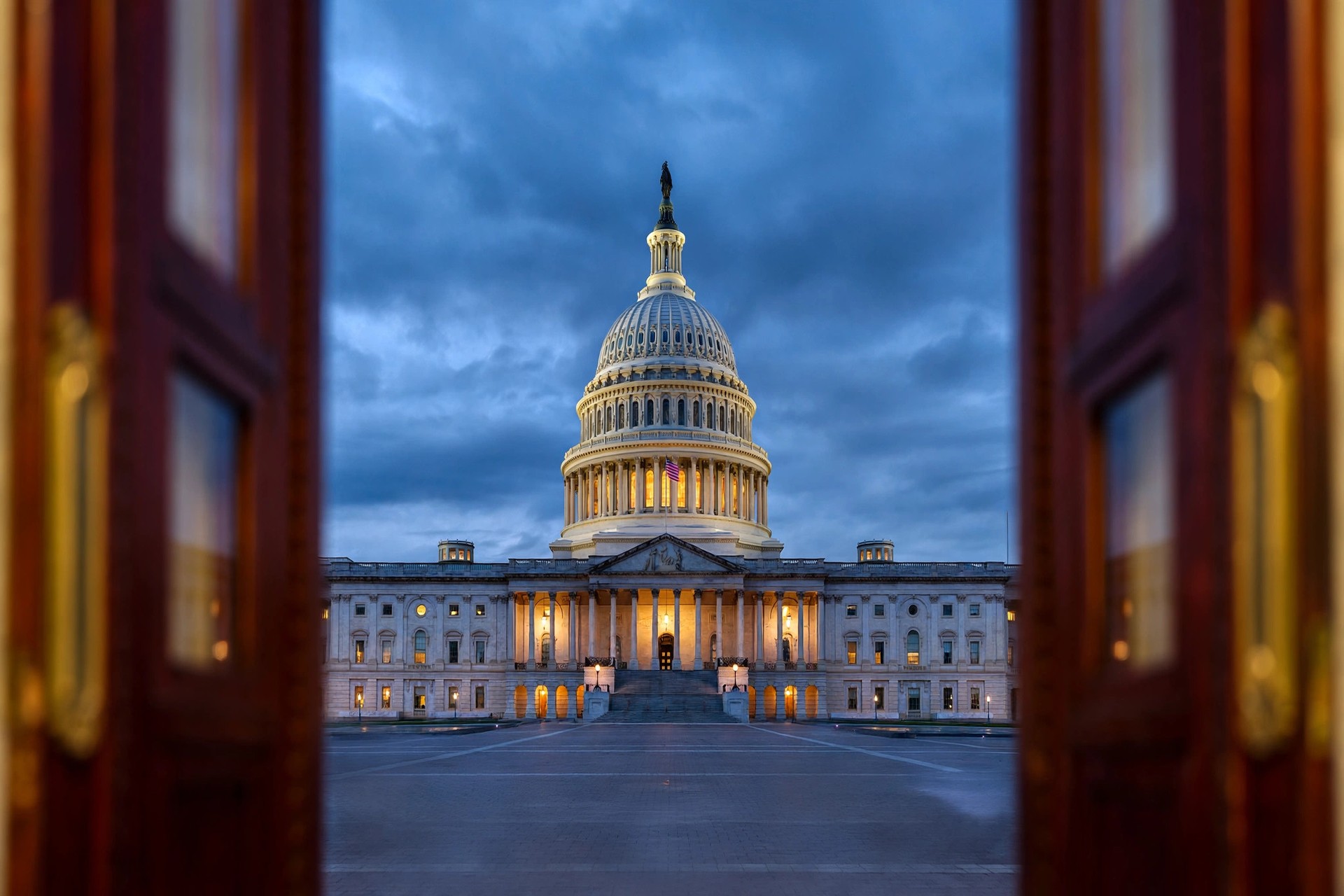
Chuck Schumer led Senate Democrats through midterm elections that delivered the party a decisive 56-seat majority in the 100-seat chamber, a result that would ordinarily settle any question about who should lead the caucus. Instead, the scale of the victory has opened the most serious internal fight over the Senate Democratic leadership in more than three decades. Within days of the results, progressives who had worked to elect the new majority began arguing that Schumer should step aside at the height of his success, and a challenger stepped forward to make that argument inside the caucus itself.
The contest now heading toward a secret ballot on December 1 is the first contested Senate Democratic leadership race since 1994. It pits Schumer, the New York senator who has led Senate Democrats for the past decade, against Senator Chris Van Hollen of Maryland, a 67-year-old progressive who says the election results were a demand for a break with business as usual. Schumer, who turned 76 on Monday, November 23, has projected total confidence, telling reporters last week, in plain terms, that he will be elected majority leader. Van Hollen, who has acknowledged he is the underdog, has answered that the race is far from settled and that senators should not rush into what he calls a coronation.
What makes the fight unusual is not only that it is happening at all, but when it is happening. Democrats seized majorities in both the Senate and the House of Representatives from President Donald Trump’s Republicans, and they will formally take control of Congress in January. The leadership vote therefore decides who will run the Senate majority through the final two years of Trump’s presidency, a period both sides expect to be defined by fierce fights over government funding, health care subsidies, and the direction of the Democratic Party heading into the 2028 presidential election.
A Victory That Opened a Fight Over the Future
Schumer’s allies argue that the midterm results are, on their own, the strongest possible case for keeping him in place. Democrats flipped nine Senate seats in November, including in several states that Trump won by double digits in 2024, and the party’s allied super PAC was the largest Democratic spender of the cycle. Schumer helped recruit candidates such as Sherrod Brown of Ohio, Mary Peltola, and Roy Cooper of North Carolina, and he oversees the Senate Democrats’ campaign spending group, which funnelled millions of dollars into many of the races. For his supporters, the message of the midterms is that the leadership that engineered the majority should be trusted to run it.
The challenger’s camp reads the same results in the opposite way. Van Hollen has said the 2026 election results show voters demanding that the party break with the status quo and adopt a bolder approach, one that gives new voices, including incoming progressive lawmakers, more influence inside the caucus. In his telling, the victories belong to the candidates and the activists who knocked on doors, not to the leadership in Washington, and rewarding the people who did that work means changing who sits at the head of the table. That argument has found a receptive audience among grassroots activists, some of whom have flooded Senate offices with calls urging senators to reject Schumer.
The scale of the incoming class sharpens the argument on both sides. Thirteen new Democrats are set to join the Senate, part of the largest incoming class in decades, and several of them won in Republican strongholds by promising to shake up Washington and act as independent voices. Many of those incoming freshmen said during their campaigns that they would oppose Schumer for Democratic leader. Senator-elect Troy Jackson of Maine put the sentiment bluntly when asked about Schumer, saying the New York senator had been great but that it was time for new ideas. The leadership vote is therefore the first test of whether the change those newcomers promised on the campaign trail will extend to the way the Senate Democratic caucus governs itself.
Inside the Senate Democratic Leadership Race
The mechanics of the contest are simple, and they are part of what makes the outcome hard to predict. The vote will be held behind closed doors on December 1, by secret ballot, and the winner will need a simple majority of the caucus. Because the ballot is secret, senators can say whatever they like in public while voting differently in private, and both camps have spent the past two weeks trying to read a room that will not show its hand until the votes are counted. Schumer has said repeatedly that he has the votes. Van Hollen has said the race is very much in flux.
Van Hollen launched his challenge after days of public speculation, announcing his bid in an interview on MS NOW and framing it as a choice about the party’s direction rather than a personal dispute. He has argued that the caucus needs to change its culture, giving new members a seat at the table and a real say in decisions, and he has promised a more confrontational approach toward the Trump administration, a more ambitious economic agenda, and changes to the way the party handles primary contests. His campaign has been deliberately public, in contrast to the traditionally private character of Senate leadership elections, and he has spent the past week calling colleagues one by one to argue that the leadership post should not simply be handed to Schumer by default.
Schumer’s response has been to welcome the discussion while insisting the result is not in doubt. In a statement after Van Hollen’s announcement, he said he welcomed any discussion about the future of the caucus and the important work ahead, pointed to the 55 seats and counting that Democrats had won, and declared that he has the votes to continue serving as Democratic leader. His allies in the caucus have echoed that confidence, while also making clear that they find the fight itself frustrating, because it puts the focus on Democratic divisions at a moment when they believe the party should be concentrating on its agenda and on taking aim at President Trump.
The Case for Change: Van Hollen’s Challenge
Van Hollen’s pitch rests on three connected claims: that the party’s base wants a sharper break with the past, that the caucus itself needs new leadership to deliver an ambitious agenda, and that he is the person to provide it. He has pointed to his record as a past chair of both the House and Senate Democrats’ campaign arms, arguing that he understands how Washington and the Senate work, and he has pointed to his willingness to take political risks as evidence that he would lead differently. Senator-elect Abdul El-Sayed of Michigan, one of his earliest backers, has made the same point, saying Van Hollen understands the institution and is willing to take risks, and citing his trips to advocate for a wrongly deported migrant and to draw attention to the war in Gaza as examples.
The generational argument is the most visible part of the challenge, even though the age gap between the two men is modest. Van Hollen is 67, Schumer 75, and both have spent most of their careers in Congress. But the challenger’s supporters have cast the nine-year difference as symbolic of a wider divide between an establishment shaped by decades in Washington and a caucus increasingly shaped by younger, anti-establishment lawmakers. Critics of Schumer say his long tenure, his age, and his close ties to the party establishment make him ill-suited to lead that changed caucus, and they argue that stepping aside now, at the height of a victory he helped secure, would itself be a demonstration that the party had heard the voters’ call for change.
That call was put in writing on November 13, when leaders of the populist Working Families Party, which backs like-minded Democratic candidates in elections, sent Schumer a letter urging a generational leadership change. The letter opened by thanking him, then argued that stepping aside would show voters the party had heeded their demand for change and would let the new majority begin its work united and focused on fighting for the people who elected them. Large progressive organisations, including MoveOn and Indivisible, have since endorsed Van Hollen, and rallies outside his Senate offices have drawn activists who say their door-knocking helped deliver the midterm wins and who want a leader who understands that demand for change.
The Case for Continuity: Schumer’s Record and His Math
Schumer’s case is built on tenure, institutional knowledge, and the numbers he says he already has. He has been the top Democrat in the Senate since 2017, serving as majority leader from 2021 until 2025, and his supporters argue that his long-standing relationships and his knowledge of Senate machinery are decisive advantages at a moment when the party is about to take control of the chamber and face a hostile White House. They also argue that the midterm campaign itself is proof of his effectiveness: he recruited the candidates, raised and directed the money, and delivered a majority that few forecasters expected to be as large as it turned out to be.
The senator himself has shown little public doubt. He has told reporters he is confident he will be elected majority leader, and he has described the caucus as united behind a programme of bringing down costs, ending corruption, ending chaos, and ending the war. When asked about his future beyond the leadership election, he has swatted the questions aside, saying he is focused on 2027 and on delivering for the American people. That message is aimed as much at the undecided senators as at the public: a leader who looks inevitable is easier to support than one who looks embattled, and Schumer’s camp has worked to make the outcome look settled even while Van Hollen’s camp insists it is not.
There is also a longer history behind the current tension. The rift between Schumer and the party’s left opened in the spring of 2025, when Schumer was put on the defensive after siding with Republicans on a spending vote, and the frustration from that episode has never fully faded among progressives. Van Hollen’s challenge gives that frustration a formal outlet for the first time in decades, and even senators who support Schumer acknowledge that the contest reflects a genuine debate inside the caucus about its future direction. Senator Tim Kaine of Virginia has described the fight as a healthy discussion, saying there is nothing wrong with it, a framing that both sides have been happy to adopt for different reasons.
The Public Count: 16 for Schumer, Six for Van Hollen
On the public scoreboard, Schumer holds a clear lead. At least 16 of the 56 members of the Senate Democratic caucus have publicly committed to backing him, while six have said they will vote for Van Hollen. The Schumer camp includes Senators Tammy Baldwin of Wisconsin, Brian Schatz of Hawaii, who is expected to rise to the number two position in Democratic leadership, and Sherrod Brown of Ohio, the returning senator-elect, along with Angus King of Maine, the independent who caucuses with Democrats. The Van Hollen camp includes Senators Bernie Sanders of Vermont, the independent who votes with Democrats, Elissa Slotkin of Michigan, and Jeff Merkley of Oregon, along with senators-elect Abdul El-Sayed of Michigan and Peggy Flanagan of Minnesota.
But the public count is a poor guide to the private result, and both campaigns know it. Most senators and senators-elect have declined to say publicly how they will vote, and the secret ballot means that even the declared supporters cannot be taken entirely at face value. Sanders and Slotkin, an unlikely pairing of a progressive icon and a moderate pragmatist, held a joint news conference to announce that they would not support Schumer, with Sanders saying he liked Schumer and that nobody worked harder, but that the time had come for change. Their joint appearance was designed to show that the demand for new leadership crosses the party’s ideological lines, and it put pressure on other senators who had privately expressed doubts about Schumer to say so openly.
Van Hollen has spent the days since then pressing his case in public. Appearing on NBC’s Meet the Press on Sunday, he said his support stood at “north of 15” senators, that momentum was moving in his direction and that he expected to win, while acknowledging that he still needs 28 votes to prevail in the secret ballot. An Economist/YouGov poll conducted November 20 to 23 found 28 percent of respondents preferred Van Hollen as leader, against 14 percent for Schumer, with 59 percent undecided; among voters who backed Kamala Harris in 2024, the split was 48 percent for Van Hollen and 18 percent for Schumer.
The contest has also drawn in voices from outside the Senate. On Tuesday, about three dozen celebrities and Democratic donors, including Jane Fonda, Robert De Niro, Chelsea Handler and Marisa Tomei, signed a letter urging Senate Democrats to pass over Schumer and elect Van Hollen, first reported by The New York Times. The signatories, who said they had given or helped raise more than 23 million dollars for Democratic candidates in the 2026 cycle, argued that elevating Schumer would run counter to the demand for change voters delivered in the midterms. The letter also objected to the secrecy of the vote, noting that the leader “will be chosen behind closed doors, by secret ballot” and that no senator will ever have to tell voters how they voted.
The pressure has cut both ways. Senators who have publicly backed Schumer have faced protests from activists, including a gathering of about 50 people outside an office of Senator King in Augusta, Maine, pressing him to reconsider, and one Senate office reported receiving more than 280 calls from people urging Schumer’s removal after Van Hollen’s announcement. Van Hollen’s supporters say that energy shows the base is with them. Schumer’s supporters say it risks turning off the undecided senators whose votes will decide the race, and they argue that a leadership fight waged through the Capitol switchboard and social media is a poor way to choose the person who will have to hold a diverse 56-member caucus together.
The Issues Dividing the Caucus
Policy divides run through the contest, and the most prominent is the party’s approach to Israel. Schumer has long been one of the Israeli government’s most outspoken supporters in the Democratic Party, though he has also been a vocal critic of Prime Minister Benjamin Netanyahu. Van Hollen is an outspoken critic of Israel’s conduct in Gaza and has opposed offensive weapons transfers to the country. The difference has become a proxy for a wider argument about the party’s direction, and it has drawn in outside voices, including actor Mark Ruffalo, who endorsed Van Hollen and criticised Schumer’s positions on Israel.
Van Hollen has also criticised Schumer’s role in recent primary contests, arguing that the leader aligned with powerful pro-Israel and cryptocurrency interests in races where two incoming senators won despite Schumer’s efforts to back their opponents. In an interview on CNN’s State of the Union, he cited what he called a hunger for change among Senate Democrats and pointed to those primary results as evidence that the party’s voters had already moved past the old leadership. Schumer backed other candidates in all three of those primaries, though he supported the winners once they were nominated, and his allies say the primary disputes are a distraction from the work of governing a new majority.
Beyond Israel and primaries, the two men differ on tactics. Van Hollen has promised a more aggressive legislative approach and a more confrontational posture toward the Trump administration, and he has pledged to oppose any bill that would keep the government funded past December 11 if it includes money for the war with Iran. He and a dozen other senators have also called for stripping a provision from the defence bill that would mandate weapons co-production between the American and Israeli militaries. Schumer’s camp argues that confrontation without a workable plan risks shutdowns and defeats that a new majority cannot afford, and that the leader’s job is to deliver results rather than to stage fights the party cannot win.
Trump Weighs In From the Sidelines
President Trump has added his own voice to the contest, and his intervention has complicated the calculations for both sides. On Sunday, Trump wrote on his Truth Social platform that it would be difficult for him to work with Schumer, saying the senator had failed badly as leader once before, calling him one of the worst in history, and adding that he had little doubt Schumer would fail again. The post was a reminder that whoever leads the Senate Democratic majority will have to deal with a president who has made no secret of his contempt for Schumer, and it raised an awkward question for the caucus: whether Trump’s open hostility makes Schumer a liability or whether it makes rallying behind him a matter of party pride.
For Schumer’s supporters, the Trump attack is useful, because it allows them to frame the leadership vote as a choice between standing with their leader against a hostile president or giving Trump what he wants. For Van Hollen’s supporters, it is beside the point, because their argument is not about who Trump dislikes but about who can best lead the caucus through two years of confrontation with him. Neither side has welcomed the intervention in public, and both have tried to keep the focus on the caucus’s own future rather than on the president’s preferences. But in a race where a handful of undecided votes could decide the outcome, the signal from the White House is one more factor senators will weigh before they cast a secret ballot.
What the December 1 Vote Will Decide
The December 1 vote will settle only one question, but its consequences will reach well beyond it. If Schumer wins, he will lead the new Senate majority into January with his authority intact but with a visible record of dissent inside his own caucus, and he will have to govern a group that includes a large bloc of newcomers who campaigned on change. If Van Hollen wins, it would be a genuine upset, and it would signal a sharp turn in the party’s direction, with a new leader promising a more confrontational approach and a different relationship with the progressive base. Either way, the result will shape the Democratic Party’s identity heading into the 2028 presidential election.
The stakes for Schumer personally are also high. He is up for re-election in 2028, and losing the leadership race could make him a more vulnerable target, with ambitious Democrats such as Representative Alexandria Ocasio-Cortez considering a run for his seat. A memo from Ocasio-Cortez’s campaign has acknowledged that she could run for president, for the Senate, or for re-election to the House in 2028, and a leadership defeat would invite exactly the kind of primary challenge Schumer has spent his career avoiding. Winning the leadership vote would not end that speculation, but it would make it considerably harder for a challenger to argue that Schumer’s time has passed.
Van Hollen’s own future is tied to the outcome as well. He set aside talk of a 2028 White House run to concentrate on the leadership bid, telling colleagues that the Senate fight was where his energies belonged, and he has staked his standing in the caucus on the argument that the party needs new leadership. A strong showing, even in defeat, would establish him as a leading voice for the party’s progressive wing and for the incoming class that backed him. A poor showing would leave him as the man who challenged a leader who had just delivered a 56-seat majority and lost. That is the gamble both men have accepted, and it is why the secret ballot on December 1, a vote that will be cast behind closed doors and counted in private, has become one of the most closely watched moments in the Democratic Party’s post-midterm reckoning.
Sources
USN reviewed reporting from multiple outlets for this story. Read more from CNN, The Baltimore Banner and Al Jazeera.