

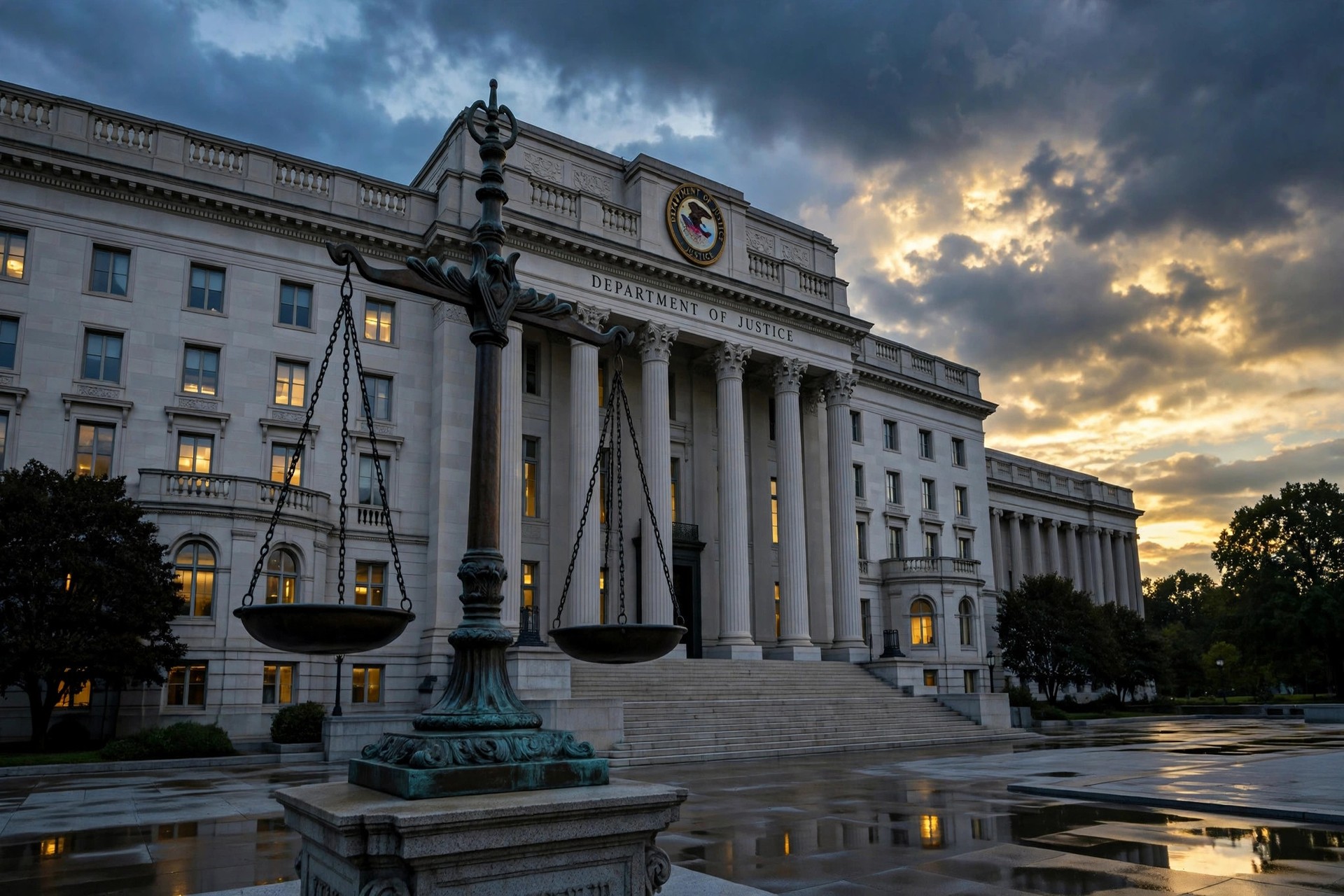
WASHINGTON — President Donald Trump used a rare appearance at the Department of Justice on Monday, November 23, 2026, to order a sharp acceleration of federal executions and to attack California Governor Gavin Newsom over his decision to commute every death sentence in California. Speaking in the department’s Great Hall, flanked by the families of murder victims, Trump signed a presidential directive instructing the Justice Department to seek the death penalty for people who murder children, and for rapists and human traffickers who kill their victims, and to move faster on executions already ordered by federal courts.
The event was billed by the White House as an address on protecting American families, but much of it was devoted to Newsom, a Democrat widely seen as a possible candidate for the 2028 presidential election. Trump described the governor’s commutation of 548 death sentences as one of the most shocking acts of injustice the country has ever seen, and he called the prisoners whose sentences were changed some of the most evil people on the face of the Earth. Newsom announced on November 5 that he intended to commute all 548 sentences to life in prison without the possibility of parole, arguing that capital punishment is unjust, error-prone and incompatible with the values of his state.
Trump was joined on stage by Attorney General Todd Blanche and FBI Director Kash Patel, and by relatives of murder victims, several of whom spoke about their loved ones and condemned the commutations. The president said the ultimate crimes deserve the ultimate punishment, and he presented the death penalty as a cornerstone of virtually every successful society throughout history. He also announced 150 million dollars in Justice Department grants to help local police departments hire more than 1,000 additional officers and speed up responses to domestic violence and sexual assault reports, and he directed the Department of Housing and Urban Development to strengthen tenant screening in public housing.
What Trump Announced at the Justice Department
The centrepiece of the visit was the presidential directive Trump signed at the end of his remarks. According to the White House and reporting of the event, the directive orders the attorney general to seek the death penalty, when appropriate and consistent with the law, in cases involving the first-degree murder of a minor, and in murders committed during specified sexual offences, kidnapping or human trafficking. It also directs the Justice Department to prioritise litigation over federal death sentences, to seek expedited consideration from the courts, and to eliminate unnecessary administrative delays that have kept condemned prisoners on federal death row for years.
A White House fact sheet described the signed document as a memorandum. It directs the attorney general to seek the death penalty for first-degree murder of a minor, for murder committed in the course of rape, sexual abuse, sexual exploitation of a child or sex trafficking, and for murder committed in the course of kidnapping or human trafficking, and to ensure federal death sentences are carried out as quickly as possible, including by prioritising the prompt resolution of appeals and habeas petitions and opposing delay tactics in litigation.
Trump told the audience that the directive would strengthen the death penalty in America, and he urged Congress to pass legislation that would put the same approach into statute. The bill he named was the Just Punishment for Murder Act, sponsored by Republican Representative Brandon Gill of Texas. Trump said the legislation would codify his directives and broaden capital punishment to cover the killers of law enforcement officers and people in the country illegally who commit murder. The bill has not been passed, and its prospects in Congress were not clear on Monday.
Presidential appearances at the Justice Department are relatively unusual, because the department has long sought to present itself as independent of the White House, whatever party holds the presidency. Monday was only the second time Trump has spoken at the department since the start of his second term; his previous address there was in March 2025, when he used a speech focused on crime and immigration to air grievances about his own criminal prosecutions and to promise to expose what he called misconduct by the officials who had investigated him. Monday’s event drew similar attention, with critics arguing that a president should not use the department as a stage for attacking a political rival, while supporters said the setting was appropriate for an announcement about federal law enforcement.
How the Trump Federal Executions Directive Would Work
The directive builds on steps Trump took on the first day of his second term, when he signed an executive order ending a moratorium on the federal death penalty imposed under former President Joe Biden and instructing the Justice Department to seek death sentences in federal cases and to help states obtain lethal injection drugs for their own executions. Attorney General Todd Blanche, introducing Trump on Monday, said the department has sought the death penalty 49 times since Trump returned to office, compared with once under the previous administration. Those figures, as reported by the department, concern prosecutors seeking capital punishment in new cases, not the number of death sentences imposed by courts or executions carried out.
Trump carried out 13 federal executions between July 2020 and January 2021, in the final months of his first term, according to the Death Penalty Information Center, before the Biden administration halted federal executions. No federal executions have taken place since then, and the number of prisoners on federal death row is small compared with the state systems. The practical effect of Monday’s directive will therefore depend less on the number of people already sentenced to death by federal courts than on how aggressively prosecutors pursue capital charges in future cases, and on how quickly the courts move through the appeals that follow a death sentence.
The Justice Department has also proposed changes that would make it easier for states to win fast-track federal review of death penalty cases, according to reporting of the proposal. The change would allow states that demonstrate a robust post-conviction review process for prisoners who cannot afford lawyers to move more quickly to execute convicted criminals under a provision of the Antiterrorism and Effective Death Penalty Act of 1996. Under the current process, prisoners have one year after their state-court appeals are finalised to challenge a death sentence in federal court; in states allowed to opt into the fast-track system, that deadline would be cut to 180 days. The proposal was put forward by the department under the previous attorney general, Pam Bondi, who argued that regulations imposed during the Obama and Biden administrations had prevented states from using the 1996 law as Congress intended.
Trump has also called for expanding the death penalty well beyond the categories named in Monday’s directive, including to anyone convicted of murder in Washington, DC, anyone who kills a law enforcement officer or a firefighter, and anyone who leaks government secrets. None of those proposals has become law, and any attempt to apply the death penalty to new categories of crime would face legal challenges, because the Supreme Court has placed limits on which offences can carry a death sentence. The directive signed on Monday stays within the categories the administration believes the law already allows, but it signals that the president intends to test the boundaries of capital punishment wherever he believes he can.
The Newsom Death Row Commutation at the Centre of the Speech
Newsom’s decision, announced in an open letter to Californians on November 5, two days after the midterm elections, was the largest single commutation in American history. California holds the largest death row in the country, and the 548 people whose sentences Newsom moved to commute account for close to 30 percent of everyone on death row in the United States. None of them would go free: every sentence would become life in prison without the possibility of parole, meaning the prisoners would die behind bars. Newsom has said he alone bears responsibility for the decision and for its impact on victims’ families.
Trump framed the mass commutation as an act of mercy for people he said did not deserve it. He told the audience that Newsom had granted clemency to 548 of the most evil monsters on the face of the Earth, and he brought relatives of victims onto the stage to describe the crimes that had put the prisoners on death row. Among the cases highlighted by the White House were those of notorious child killers, and Trump said the families had been brutally betrayed by bad government. Newsom’s office, responding before Trump spoke, issued a statement highlighting what it alleged was Trump’s own use of presidential clemency to benefit wealthy political allies and people convicted of fraud, an argument his supporters have made throughout the dispute.
Newsom, whose second term as governor ends in January because of term limits, has said he will decide early next year whether to run for president. He has told media outlets that the decision will come in January, and Trump treated Monday’s speech in part as a preview of a possible 2028 contest, calling Newsom a terrible governor and presenting the commutation as evidence that Democrats are weak on crime. The governor is a longtime opponent of capital punishment, and he placed a moratorium on executions in California months after taking office in 2019. The state has not carried out an execution since 2006, and Newsom has argued that the system is broken beyond repair.
Why California Has Not Executed Anyone Since 2006
California’s death penalty has been in practice suspended for two decades, even though voters have twice rejected efforts to abolish it, in 2012 and again in 2016, and in 2016 they approved Proposition 66, a measure intended to speed up executions. The last execution in the state took place in 2006, when Clarence Ray Allen was put to death. Since then, legal challenges over the state’s lethal injection procedures, combined with the difficulty of obtaining execution drugs and the moratorium imposed by Newsom in 2019, have meant that no one on California’s death row has been executed, even as the number of condemned prisoners grew to 548.
Supporters of the death penalty in California argue that the voters have spoken clearly and that the governor is overriding their will, as well as the wishes of victims’ families who have waited decades for the sentences imposed by juries to be carried out. Critics of capital punishment argue that the system is costly, unevenly applied, and carries an unacceptable risk of executing innocent people, and they point to the long delays as evidence that the punishment cannot be administered fairly. Newsom’s commutation does not repeal the death penalty in California, which only voters can do, and it applies only to the sentences of people currently on death row. Future juries could still impose death sentences, although no executions could take place while the moratorium remains in force.
The scale of the commutation is what makes it different from the clemency decisions governors usually make, which tend to involve individual prisoners reviewed one at a time. Newsom’s order covers every person on the state’s death row at once, and it was announced in a single letter rather than through the usual process of individual applications, referrals to the Board of Parole Hearings, and recommendations from prosecutors and trial courts. That breadth is at the heart of both the political argument Trump made on Monday and the legal challenge now before the California Supreme Court.
The Families Who Shared the Stage
Several relatives of murder victims spoke during Monday’s event, and their accounts were the emotional core of the programme. Trump invited them to describe their loved ones and to condemn the commutations, and he praised them for their courage in speaking publicly about crimes that had devastated their families. The White House had highlighted a number of the cases in advance, including murders of children, and the families said the commutations had reopened wounds that had never healed. For the relatives who support the death penalty, the prospect of execution is not only a punishment for the killer but a recognition by the state that the crime was among the worst a person can commit.
Trump also singled out a 17-year-old relative of one victim and said he would give the teenager 5,000 dollars, a personal gesture that drew attention during the event. The president has frequently used meetings with victims’ families to underline his law-and-order message, and Monday’s event followed that pattern, with the families presented as the people most directly affected by a decision made by a governor they had never met. Newsom has acknowledged that some victims’ families strongly oppose his decision, while his office has pointed to other survivors who support eliminating capital punishment and who have said the long wait for an execution that never comes is itself a form of cruelty.
The divide among victims’ families is one of the most difficult parts of the debate over the death penalty, and it was on display on Monday. There is no single view among the relatives of murder victims: some believe only a death sentence can deliver justice, while others believe a sentence of life without parole is enough, and that the years of appeals that follow a death sentence prolong their suffering. Both sides were represented in the arguments made around Monday’s event, but only one side shared the stage with the president.
The Just Punishment for Murder Act and the Call to Congress
Trump used the event to press Congress to pass the Just Punishment for Murder Act, the bill introduced by Representative Brandon Gill at the president’s request. According to the White House account of the bill, it would strengthen the federal death penalty by putting the president’s directives into law, including the instruction to seek capital punishment for child murderers, for the killers of law enforcement officers, and for people in the country illegally who commit murder, while also speeding up federal executions. Trump said the legislation would give prosecutors a clearer mandate and make it harder for a future administration to reverse the policy with a stroke of a pen.
Whether the bill can pass is far from certain. Congress is in the final weeks of a session in which the parties are already looking ahead to a change of control in January, when Democrats are due to take over, and a bill expanding the death penalty would face determined opposition from Democrats and from some Republicans who have concerns about the federal government’s use of capital punishment. Trump presented the bill as a test of whether lawmakers are serious about protecting families, and he warned that opponents would have to explain their position to voters. The bill’s supporters argue that a clear statute would settle the legal arguments that have surrounded the administration’s directives; its critics argue that it would expand a punishment the federal government has used unevenly and at great cost.
The Legal Fight Over Newsom’s Commutations
The commutations have not yet taken effect for most of the prisoners involved. Under the California Constitution, the governor must obtain a recommendation from at least four of the seven justices of the California Supreme Court before commuting the sentence of a prisoner with more than one felony conviction, and Newsom’s office has said that rule covers 382 of the 548 prisoners. The governor formally asked the court for that recommendation on the same day he announced the commutations, and he has asked the justices to act before his term ends in January. The state attorney general, Rob Bonta, has told the court that Newsom will not formally commute any of the death sentences, including those of prisoners with only one felony conviction, until the justices act.
The legal battle intensified last week when a coalition of California prosecutors and victims’ advocates asked the state Supreme Court to halt the plan. The Criminal Justice Legal Foundation filed a petition on November 16 on behalf of 28 district attorneys and 31 victims’ families, arguing that the governor was attempting a blanket commutation that skipped the notice rules, victims’ rights protections and constitutional check required for hundreds of multi-felony inmates. A second lawsuit was filed on November 19 by the Orange County district attorney, Todd Spitzer, covering 18 prisoners whose commutations would not need court approval. The governor’s preliminary opposition in that case is due on November 30. On Tuesday, November 24, the court filed amicus briefs from the district attorneys of ten counties — Merced, Monterey, San Joaquin, Los Angeles, San Luis Obispo, San Diego, Modoc, Riverside, Tulare and Sonoma — as well as briefs supporting the commutations from the American Civil Liberties Union and other lawyers, and briefs from the Manhattan Institute and a group of California constitutional scholars. A day later, the United States Secret Service Association filed a statement urging the court to protect the sentence in the case of Special Agent Julie Y. Cross, murdered in the line of duty. The governor’s preliminary opposition to the first writ petition was due on November 25, with a reply due by December 4, and Newsom’s consolidated answer to the amicus briefs is due the same day. In a letter to the court on November 17, the governor said he would not issue any commutations until the writ petition and related proceedings are ruled on, as long as there are rulings by the end of the year.
The petitioners argue that Newsom decided his personal views should override the process that the law requires, including individualised review and notice to prosecutors and victims’ families, and that this alone amounts to an abuse of power. Newsom’s office has argued that the governor’s broad constitutional clemency authority allows him to begin blanket commutations without following the statutory procedures that govern individual applications, while still seeking the court’s required recommendation for the multi-felony cases. The court now has to decide whether the Constitution still requires him to follow those rules first, and its ruling is likely to come before Newsom leaves office.
Trump said on Monday that the Justice Department was working to get the commutations “overturned in some form”, but he gave no detail of the legal steps it would take or what federal authority it would rely on, and the department has announced no filing.
What Happens Next for Federal Executions
The immediate question after Monday’s event is how quickly the Justice Department will act on the directive. The department has already been seeking the death penalty far more often than its predecessor, and the directive gives prosecutors a written instruction from the president to pursue capital charges in the most serious murder cases and to press the courts for faster decisions. But a death sentence in a federal case is only the beginning of a long legal process: defendants can appeal their convictions and sentences through the federal courts, and in many cases those appeals take years, sometimes more than a decade. The directive’s instruction to eliminate unnecessary administrative delays may shorten some of that time, but it cannot remove the constitutional protections that apply to every capital case.
The second question is what the California Supreme Court will do with Newsom’s commutations. If the court approves the recommendation for the 382 multi-felony prisoners, the commutations could take effect before Newsom leaves office, permanently removing the prospect of execution for the largest death row in the country. If the court blocks the plan, the sentences would remain in place, and the next governor would inherit both the death row and the moratorium. Governor-elect Xavier Becerra has pledged to continue the moratorium once sworn in, according to reporting on the transition. Either way, the dispute is likely to continue into the 2028 presidential campaign, with Trump presenting himself as the defender of victims and of the death penalty, and Newsom, if he runs, presenting himself as the governor who ended a punishment he believes the state should no longer impose.
What is clear from Monday is that the death penalty has returned to the centre of American politics in a way it has not been for years. Trump has made it a defining issue of his second term, from the executive order on his first day in office to the directive signed in the Great Hall. Newsom has answered with the largest act of clemency in the country’s history. The two men now offer voters a stark choice, and the courts, in California and in the federal system, will decide how much of either man’s vision can actually be carried out.
Sources
USN reviewed reporting from multiple outlets for this story. Read more from Al Jazeera, USA Today and CNN.