

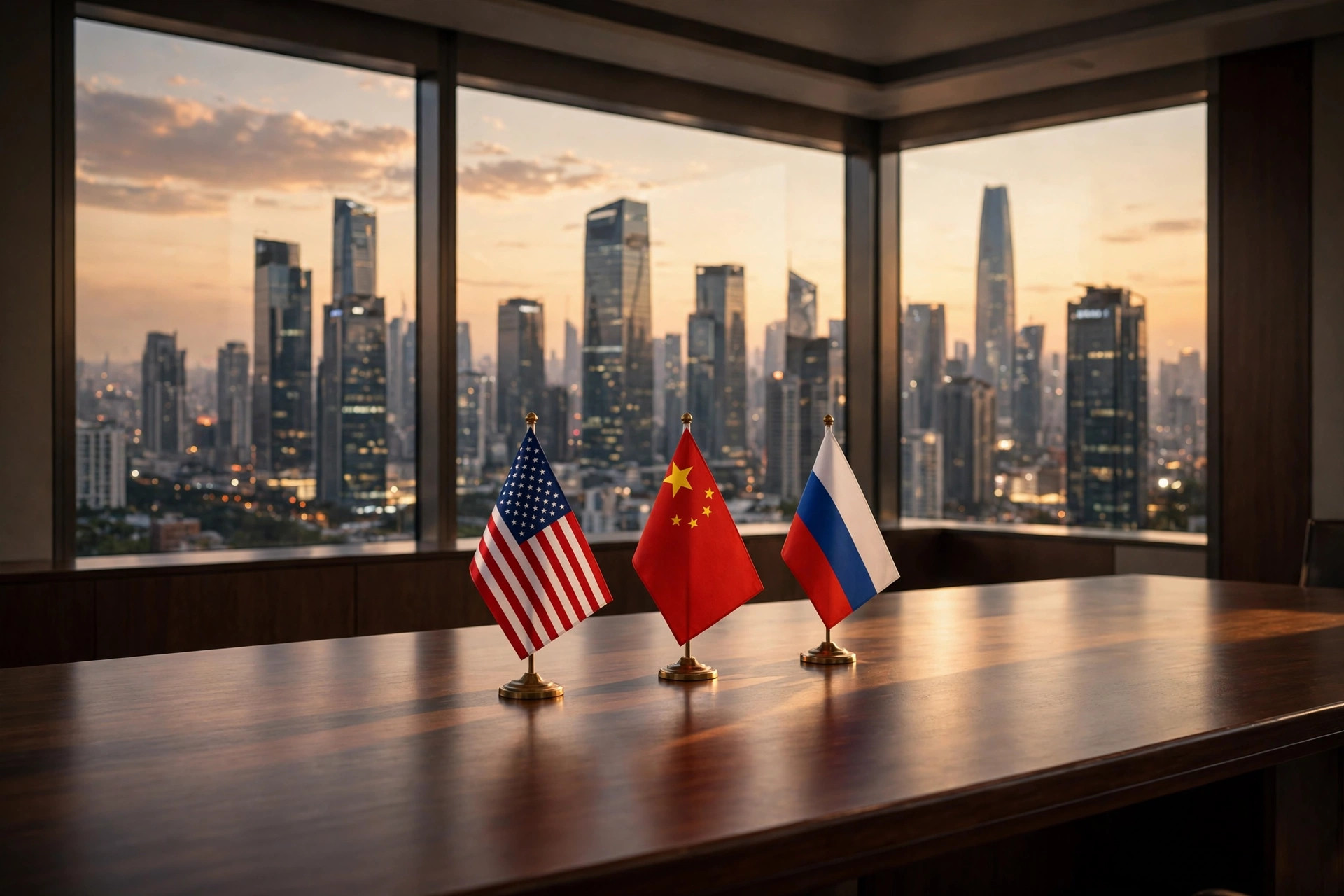
President Donald Trump will meet Russian President Vladimir Putin and Chinese President Xi Jinping in Shenzhen on Thursday, 19 November 2026, for the first trilateral summit of the three leaders, the White House confirmed on Friday, 13 November. The meeting, held on the sidelines of the Asia-Pacific Economic Cooperation summit in the southern Chinese tech hub, will bring together the leaders of the world’s three largest nuclear powers for the first time in a single room, with the reduction of nuclear weapons at the top of the agenda. It is a gathering without precedent in modern diplomacy, and one that the White House has presented as the centrepiece of Trump’s four-day trip to Asia.
The announcement caps weeks of speculation about whether such a meeting would happen. Trump first raised the idea publicly on 8 November, telling reporters that he expected one of his meetings during the Asia-Pacific Economic Cooperation summit to include both Putin and Xi. At the time, officials in all three capitals were cautious, and Beijing in particular was reported to want control over the format of any three-way session. The White House confirmation on Friday removed that doubt, although officials were quick to lower expectations about what the meeting will achieve, describing it as the start of a conversation rather than the occasion for a deal.
The summit matters for what it symbolises as much as for what it may produce. The last nuclear arms treaty between the United States and Russia expired in February 2026, leaving the world’s two largest arsenals without caps for the first time in more than half a century, while China’s arsenal has grown rapidly. Trump has argued for years that any new agreement must include all three countries, and Shenzhen will be the first test of whether that idea can move from rhetoric to negotiation.
A First in the History of Great-Power Diplomacy
No American, Russian and Chinese leader has ever sat down together in a three-way summit before. The leaders of the three countries have met in pairs many times, and all three have shared rooms at large gatherings such as the United Nations and the Group of 20, but a dedicated trilateral meeting of the three presidents is new. The White House described it as a historic gathering, and analysts agree that the image alone, of the three leaders seated together in Shenzhen, will carry weight far beyond whatever is said in the room.
The setting is significant. Shenzhen is China’s great technology city, a symbol of its rise as a manufacturing and innovation power, and Xi is hosting this year’s Asia-Pacific Economic Cooperation summit there, chairing the leaders’ meeting on 18 and 19 November under the theme of building an Asia-Pacific community to prosper together. The Chinese government had planned the summit as a showcase for trade and regional cooperation, and the arrival of Trump and Putin for a discussion of nuclear weapons gives the gathering a very different character from the one Beijing originally intended.
The meeting will take place towards the end of Trump’s visit to China, after his bilateral meeting and working lunch with Xi on Thursday afternoon. It will be his third one-on-one meeting with the Chinese leader this year, and their fourth since Trump returned to power, a sign of how central the United States-China relationship has become to Trump’s second-term diplomacy. Putin’s presence adds a further dimension: the Russian leader has not met Trump face to face in this setting before, and his attendance turns a bilateral visit into a three-way encounter with global consequences.
Why Nuclear Arms Reduction Tops the Agenda
Trump has made clear that he wants the meeting to focus on reducing the world’s nuclear arsenals. White House Assistant Press Secretary Olivia Wales told reporters that the president has made it clear that, among other topics, he will discuss the reduction of nuclear weapons in the world, adding that Trump believes the proliferation of such weapons is very dangerous. It is a theme Trump has returned to repeatedly, arguing that the three countries together hold the overwhelming share of the world’s nuclear weapons and therefore bear a shared responsibility to reduce them.
The numbers frame the challenge. The United States and Russia each hold more than 5,000 nuclear warheads, according to Pentagon estimates, while China holds more than 600, a far smaller arsenal but one that has been growing fast. That imbalance is one reason previous American and Russian arms control agreements were bilateral: Washington and Moscow had roughly equal arsenals to limit, while Beijing’s was far smaller and, in China’s view, not yet a subject for negotiation. Trump has rejected that logic, insisting that any lasting agreement must cover all three arsenals, and he has pressed the point in meetings with both Xi and Putin.
China has been sceptical. A Chinese foreign ministry spokesperson has said it is not realistic to ask China to join trilateral nuclear disarmament talks at this stage, and Beijing has been riled by Trump’s focus on nuclear weapons at a summit it wanted to devote to trade. Chinese officials argue that their arsenal is a fraction of the American and Russian stockpiles and that the two larger powers should cut first. Whether Xi is willing to discuss limits at all, even in principle, will be one of the key questions coming out of Shenzhen.
The Treaty That Expired
The urgency of the meeting is sharpened by the collapse of the old arms control architecture. New START, the last nuclear arms treaty between the United States and Russia, expired in February 2026, removing the caps on the two largest atomic arsenals for the first time in more than half a century. The treaty had limited each side to 1,550 deployed strategic warheads and provided for inspections and data exchanges that gave both countries confidence about the other’s arsenal. With its expiry, those limits and those verification measures are gone.
Trump has spoken of replacing New START with a broader agreement that includes China, but no negotiations towards such a pact have begun, and the obstacles are formidable. The three countries disagree on what should count, how verification would work, and whether tactical and strategic weapons should be treated together. Russia has its own priorities, including the war in Ukraine and its relationship with China, while China has shown little appetite for formal limits on an arsenal it is still expanding. The Shenzhen meeting, in that context, is best understood as an opening move rather than a negotiation.
The stakes of failure are real. Without a treaty, the United States and Russia are free to expand their deployed arsenals, and China faces no external constraint on its build-up. Arms control experts warn that the absence of limits, combined with the absence of the communication channels the old treaties provided, increases the risk of miscalculation in a crisis. That is the case Trump is making for a new agreement, and it is the argument he will put to Putin and Xi in person.
Low Expectations for a Deal
For all the historic framing, officials on all sides have been careful to manage expectations. A senior American official told reporters that the administration does not expect to get to any kind of agreement in Shenzhen, and other officials described the talks as an entry point to future negotiations rather than an opportunity to strike a deal. Analysts quoted in the days after the announcement agreed, saying the meeting would be heavier in symbolism than in substance, and that the most realistic outcome is an agreement to keep talking.
That caution reflects the difficulty of the subject. A trilateral arms agreement would require the three countries to agree on numbers, definitions, verification and timelines, any one of which has defeated negotiators in the past. It would also require political will in three capitals at a moment when trust between them is low, when Russia’s war in Ukraine continues, and when the United States and China are locked in a fragile trade truce. None of those conflicts will be resolved in a single afternoon in Shenzhen.
Even so, the meeting has value as a signal. The fact that the three leaders are willing to sit down together to discuss nuclear weapons, after years in which arms control was treated as a bilateral matter or ignored altogether, suggests that all three recognise the danger of an unconstrained arms race. If Shenzhen produces nothing more than a shared statement of intent to continue the discussion, that alone would mark a change from the drift of recent years, and it would give diplomats something to build on in the months that follow.
The Asia Trip: Manila First, Then Shenzhen
The trilateral summit is the climax of a four-day Asia trip that begins early on Monday morning, 16 November, when Trump leaves Washington. He will arrive in the Philippines on Tuesday for a summit of the Association of Southeast Asian Nations, where he is also scheduled to meet leaders of the Quad, the grouping of the United States, Japan, India and Australia, on Tuesday evening to discuss security, prosperity and cooperation across the Indo-Pacific, and to take part in a special United States-ASEAN summit.
Trump will then meet the Philippine president at the presidential palace to discuss commercial agreements and strategic investments intended to strengthen American interests in aviation, defence, energy and technology. From Manila he will travel to Shenzhen, where on Thursday morning he will take part in a multilateral meeting with Asia-Pacific Economic Cooperation leaders before his bilateral meeting with Xi and the trilateral session that follows.
Elon Musk, the chief executive of Tesla and SpaceX, is expected to accompany Trump during parts of the visit to China, but he will not take part in the trilateral summit or in the president’s bilateral meeting with Xi. The White House has not said what role Musk will play during the trip, and officials have also said Trump is not expected to hold a one-on-one meeting with Putin, nor to discuss Ukraine’s access to satellite communications services provided by Musk’s SpaceX, during the visit.
What Will — and Will Not — Be on the Table
Officials have been unusually specific about what the trilateral meeting will not cover. Trump does not plan to discuss Russia’s war in Ukraine with Xi and Putin in Shenzhen, according to a senior American official, despite Putin having previously pushed for the war to be raised. The decision reflects the administration’s wish to keep the meeting focused on nuclear weapons, and it means that one of the most consequential conflicts in the world will be absent from the agenda of the most consequential meeting of the week.
Officials also said that Iran would be discussed at the meeting, a subject that will be covered in detail in a separate USN article. Trump is also not expected to meet North Korean leader Kim Jong Un during the trip to Asia, despite earlier speculation that such an encounter might be arranged. The absence of both Ukraine and Kim from the agenda underlines how narrowly the White House has defined the purpose of the summit: this is a meeting about nuclear arsenals, not a general discussion of the world’s conflicts.
That narrow focus is both a strength and a risk. It gives the meeting a clear purpose and a clear measure of success, but it also means that the leaders will be discussing the world’s most dangerous weapons while setting aside the wars that make those weapons feel most dangerous. Whether that separation can hold, and whether the leaders themselves will stick to the script once they are in the room, is one of the open questions of the week.
China, Trade and a Delicate Setting
For China, the summit is a complicated honour. Xi is hosting the Asia-Pacific Economic Cooperation gathering and chairing its leaders’ meeting, and the presence of Trump and Putin gives the event a prominence no host could have hoped for. But the subject matter is not the one Beijing chose. China wanted the summit to focus on trade and regional economic cooperation, and it has been unsettled by Trump’s determination to make nuclear weapons the centre of attention.
The trade backdrop cannot be ignored. The United States and China have been operating under a fragile trade truce, and the two leaders’ bilateral meeting on Thursday afternoon is expected to cover commercial questions alongside the nuclear discussion. The trade tensions will be in the room even if they are not on the formal agenda.
When the three leaders sit down in Shenzhen on Thursday, the world will be watching for more than a photograph. It will be watching to see whether three rivals who disagree on almost everything can agree on one thing: that the arsenals they command are too large, too dangerous and too unconstrained to be left without limits. No agreement is expected, and none has been promised. But for the first time, the three leaders will have discussed the question together, face to face, and that alone is a moment that has never happened before.
Sources
USN reviewed reporting from multiple outlets for this story. Read more from The Hindu, Nikkei Asia and Arab News.